Overview
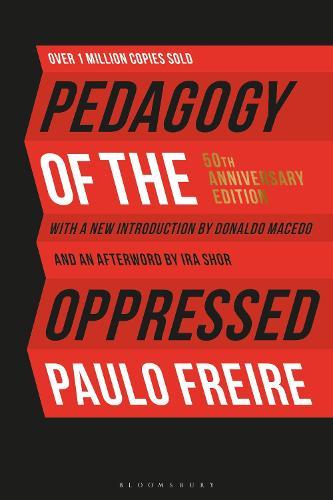
First published in Portuguese in 1968, Pedagogy of the Oppressed was translated and published in English in 1970. Paulo Freire's work has helped to empower countless people throughout the world and has taken on special urgency in the United States and Western Europe, where the creation of a permanent underclass among the underprivileged and minorities in cities and urban centers is ongoing. This 50th anniversary edition includes an updated introduction by Donaldo Macedo, a new afterword by Ira Shor and interviews with Marina Aparicio Barberán, Noam Chomsky, Ramón Flecha, Gustavo Fischman, Ronald David Glass, Valerie Kinloch, Peter Mayo, Peter McLaren and Margo Okazawa-Rey to inspire a new generation of educators, students, and general readers for years to come.
Full Product Details
Author: Paulo Freire , Professor Donaldo Macedo (University of Massachusetts Boston, USA)
Publisher: Bloomsbury Publishing Plc
Imprint: Bloomsbury Academic
Edition: 4th edition
Dimensions:
Width: 15.20cm
, Height: 1.80cm
, Length: 22.80cm
Weight: 0.362kg
ISBN: 9781501314131
ISBN 10: 1501314130
Pages: 232
Publication Date: 22 March 2018
Audience:
Professional and scholarly
,
Professional & Vocational
Format: Paperback
Publisher's Status: Active
Availability: In Print 
This item will be ordered in for you from one of our suppliers. Upon receipt, we will promptly dispatch it out to you. For in store availability, please contact us.
Table of Contents
Introduction to the 50th Anniversary Edition Donald Macedo 1. The justification for a pedagogy of the oppressed; the contradiction between the oppressors and the oppressed, and how it is overcome; oppression and the oppressors; oppression and the oppressed; liberation: not a gift, not a self-achievement, but a mutual process. 2. The banking concept of education as an instrument of oppression-its presuppositions-a critique; the problem-posing concept of education as an instrument for liberation-its presuppositions; the banking concept and the teacher-student contradiction; the problem-posting concept and the supersedence of the teacher-student contradiction; education: a mutual process, world-mediated; people as uncompleted beings, conscious of their incompletion, and their attempt to be more fully human. 3. Dialogics-the essence of education as the practice of freedom; dialogics and dialogue; dialogue and the search for program content; the human-world relationship, generative themes, and the program content of education as the practice of freedom; the investigation of generative themes and its methodology; the awakening of critical consciousness through investigation of generative themes ; the various stages of the investigation. 4. Antidialogics and dialogics as matrices of opposing theories of cultural action: the former as an instrument of oppression and the latter as an instrument of liberation; the theory of antidialogical action and its characteristics: conquest, divide and rule, manipulation, and cultural invasion; the theory of dialogical action and its characteristics: cooperation, unity, organization, and cultural synthesis. Afterword Ira Shor Interviews with Contemporary Scholars Marina Aparicio Barberan, Noam Chomsky, Ramon Flecha, Gustavo Fischman, Ronald David Glass, Valerie Kinloch, Peter Mayo, Peter McLaren and Margo Okazawa-Rey Foreword to the Original English Edition (1970), Richard Shaull Index
Reviews
Author Information
Paulo Freire is the author of the bestselling Pedagogy of the Oppressed as well as Education for Critical Consciousness, Pedagogy in Process (The Letters to Guinea-Bissau), Learning to Question (with Antonio Faundez), and Pedagogy of the City.
Tab Content 6
Author Website:
Countries Available
All regions
|