Overview
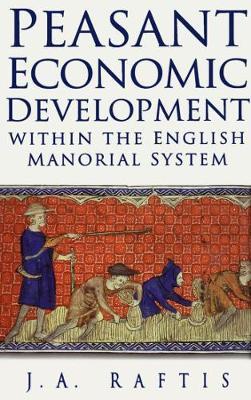
"Challenging a 100-year tradition that English peasants were serfs at the disposal of their lord, it is argued in this text that tenants were in considerable control of the manorial regime and were able to take advantage of what most scholars have considered to be exploitive and negative aspects of the medieval agricultural economy. Offering a revisionist theory that shifts the focus from labour services required by the lord to capital required by the customary tenant, the author reveals that ""peasant economic development"" and ""manorial economy"" are not mutually exclusive terms. Using account rolls, charters, court rolls, and lay subsidy rolls he demonstrates that lords subordinated their power to tax and to extract labour services to a policy of capital maintenance. This allows him to develop a more rational explanation for the growth of markets and wealth in a countryside not exclusively dependent on the economy of lords."
Full Product Details
Author: Raftis
Publisher: McGill-Queen's University Press
Imprint: McGill-Queen's University Press
Dimensions:
Width: 15.60cm
, Height: 2.40cm
, Length: 23.40cm
Weight: 0.517kg
ISBN: 9780773514034
ISBN 10: 0773514031
Pages: 256
Publication Date: 18 November 1996
Audience:
College/higher education
,
Professional and scholarly
,
Undergraduate
,
Postgraduate, Research & Scholarly
Format: Hardback
Publisher's Status: Active
Availability: Out of stock

The supplier is temporarily out of stock of this item. It will be ordered for you on backorder and shipped when it becomes available.
Reviews
Raftis brings us much closer to the medieval peasant by giving evidence of his/her standing and economic decision making. He makes a major contribution to our understanding of the emergence of the farmer or yeoman. His perspective is quite unique and very important and will inspire further studies on this group. David Gary Shaw, Department of History, Wesleyan University. Peasant Economic Development within the English Manorial System represents a major advance in thinking on the rural medieval world. [translation] Denise Angers, Departement d'histoire, Universite de Montreal.
"""Raftis brings us much closer to the medieval peasant by giving evidence of his/her standing and economic decision making. He makes a major contribution to our understanding of the emergence of the farmer or yeoman. His perspective is quite unique and very important and will inspire further studies on this group."" David Gary Shaw, Department of History, Wesleyan University. ""Peasant Economic Development within the English Manorial System represents a major advance in thinking on the rural medieval world."" [translation] Denise Angers, Département d'histoire, Université de Montréal."
Raftis brings us much closer to the medieval peasant by giving evidence of his/her standing and economic decision making. He makes a major contribution to our understanding of the emergence of the farmer or yeoman. His perspective is quite unique and very important and will inspire further studies on this group. David Gary Shaw, Department of History, Wesleyan University. Peasant Economic Development within the English Manorial System represents a major advance in thinking on the rural medieval world. [translation] Denise Angers, D partement d'histoire, Universit de Montr al.