Overview
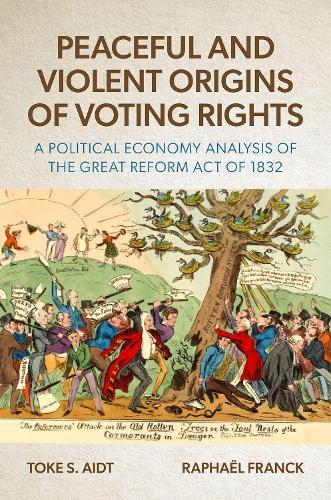
The Great Reform Act of 1832 was a pivotal moment in British political development that opened the door of democratic reform, entailing a slow and gradual journey to universal suffrage, secret ballot, and competitive elections. But it could have failed.In Peaceful and Violent Origins of Voting Rights, Toke S. Aidt and Raphaël Franck articulate a new process-based perspective on the study of democratization through a detailed analysis of the Great Reform Act of 1832. Instead of using the historical narrative to provide evidence of a particular theory, the authors use microdata generated by the reform to test competing theories. Aidt and Franck apply their approach to the Reform Bill through econometric analyses that draw on rich micro-political data to show why the reform succeeded despite significant opposition at three different stages: in both the House of Commons and the House of Lords, as well as winning popular support in a general election. While fears of revolution were critical in generating popular support for the Reform Bill in the 1831 General Election, they argue that it was mainly extra-parliamentary agitation from reform societies that helped the bill obtain its one-vote majority in the House of Commons. By viewing democratic reform as a process rather than as a single event, the authors provide more nuanced answers to what caused the West to extend the franchise. Further, the book presents new insights into the underlying forces of democratisation processes.
Full Product Details
Author: Toke S. Aidt (Reader in Economics, Faculty of Economics and Jesus College, Reader in Economics, Faculty of Economics and Jesus College, University of Cambridge) ,
Raphaël Franck (Senior Lecturer, Department of Economics, Senior Lecturer, Department of Economics, Hebrew University of Jerusalem)
Publisher: Oxford University Press Inc
Imprint: Oxford University Press Inc
Dimensions:
Width: 15.20cm
, Height: 2.30cm
, Length: 22.60cm
Weight: 0.499kg
ISBN: 9780197679715
ISBN 10: 0197679714
Pages: 248
Publication Date: 26 June 2025
Audience:
Professional and scholarly
,
Professional & Vocational
Format: Hardback
Publisher's Status: Active
Availability: To order

Stock availability from the supplier is unknown. We will order it for you and ship this item to you once it is received by us.
Reviews
At a time when democratic institutions are in danger all around the world, it is more essential to understand how these institutions emerged and evolved. This excellent book provides an invaluable perspective on this question by presenting a comprehensive study of the process of democratization around the Great Reform Act of 1832 in Britain. It convincingly shows how the threat of revolution and social unrest were the key driving forces but also that at critical points the process needed help from elites that were willing to accommodate demands and seek compromise. This is a must-read for all interested in the origins of democracy and those concerned about the state of politics today. * Daron Acemoglu, Nobel Laureate in Economics , MIT, and coauthor of Why Nations Fail and The Narrow Corridor * This is an excellent book, well written and researched, it will be the 'go to' book on the election reforms of 1832 for the next several decades. The book combines several previously published papers into a single volume. However, unlike many other efforts to do so, the result reads like a proper book, rather than a collection of papers. The authors do an excellent job of avoiding the tighter analytical writing style of most journal articles in economics by emphasizing the historical context that led to the electoral reforms of 1832. The authors depart from the usual histories of this period leading up to the reform, both by in their very detailed historical accounts of voting methods and rights both inside and outside Parliament, and by their use of statistical techniques to demonstrate that their conclusions are more than historical intuitions. * Roger Congleton, West Virginia University, and author of Perfecting Parliament * A profound captivating exploration of the forces that shaped and fortified democratic institutions. * Oded Galor, Brown University, and author of The Journey of Humanity * The watershed event of the Great Reform Act of 1832 has been touted as the canonical case of both bottom-up as well as top-down democratization by eminent scholars in the field. Starting from this seemingly paradoxical situation, the authors embark on a captivating intellectual journey to determine the accurate perspective. Their holistic approach and deep understanding of the period allow them to move beyond false binaries painting a compelling narrative. Hats off to the authors for pulling this off. * Stelios Michalopoulos, Brown University * This is interdisciplinary research at its very best: economics, political science and history analyzed by cliometric methods, and carefully explained. Thus, it should be of great interest to many. It deals with the complex political events in connection with the start of democratization in England almost 200 years ago and shows how economic and political factors interacted. Each step in the process is demonstrated by carefully collected data analyzed by solid econometric methods, by two researchers who are also strong theorists. Thus, it is making storytelling solid! * Martin Paldam, Aarhus University, Denmark, and author of The Grand Pattern of Development and the Transition of Institutions * Democracy is being challenged all over the world. But where did modern democracy come from and why was it created historically when it was? This fundamental book provides the answers and the tools to help us put our current crisis into perspective. * James Robinson, Nobel Laureate in Economics and the University of Chicago, Harris School of Public Policy * Why did pre-modern elites across Europe share their power? This hallmark study focuses on a canonical case * the UK's 1832 Great Reform Act. Aidt and Franck highlight the role of revolutionary unrest. The book stands out for its brilliant synthesis of historical analysis and rigorous, quantitative insight into the multi-causal nature of democratisation.Hans-Joachim Voth, University of Zurich * This is interdisciplinary research at its very best: economics, political science, and history analyzed by cliometric methods, and carefully explained. It deals with the complex political events in connection with the start of democratization in England almost 200 years ago and shows how economic and political factors interacted. Each step in the process is demonstrated by carefully collected data analyzed by solid econometric methods, by two researchers who are also strong theorists. It should be of great interest to many. * Martin Paldam, Aarhus University, Denmark, and author of The Grand Pattern of Development and the Transition of Institutions *
At a time when democratic institutions are in danger all around the world, it is more essential to understand how these institutions emerged and evolved. This excellent book provides an invaluable perspective on this question by presenting a comprehensive study of the process of democratization around the Great Reform Act of 1832 in Britain. It convincingly shows how the threat of revolution and social unrest were the key driving forces but also that at critical points the process needed help from elites that were willing to accommodate demands and seek compromise. This is a must-read for all interested in the origins of democracy and those concerned about the state of politics today. * Daron Acemoglu, MIT, and coauthor of Why Nations Fail and The Narrow Corridor * This is an excellent book, well written and researched, it will be the 'go to' book on the election reforms of 1832 for the next several decades. The book combines several previously published papers into a single volume. However, unlike many other efforts to do so, the result reads like a proper book, rather than a collection of papers. The authors do an excellent job of avoiding the tighter analytical writing style of most journal articles in economics by emphasizing the historical context that led to the electoral reforms of 1832. The authors depart from the usual histories of this period leading up to the reform, both by in their very detailed historical accounts of voting methods and rights both inside and outside Parliament, and by their use of statistical techniques to demonstrate that their conclusions are more than historical intuitions. * Roger Congleton, West Virginia University, and author of Perfecting Parliament * A profound captivating exploration of the forces that shaped and fortified democratic institutions. * Oded Galor, Brown University, and author of The Journey of Humanity * The watershed event of the Great Reform Act of 1832 has been touted as the canonical case of both bottom-up as well as top-down democratization by eminent scholars in the field. Starting from this seemingly paradoxical situation, the authors embark on a captivating intellectual journey to determine the accurate perspective. Their holistic approach and deep understanding of the period allow them to move beyond false binaries painting a compelling narrative. Hats off to the authors for pulling this off. * Stelios Michalopoulos, Brown University * This is interdisciplinary research at its very best: economics, political science and history analyzed by cliometric methods, and carefully explained. Thus, it should be of great interest to many. It deals with the complex political events in connection with the start of democratization in England almost 200 years ago and shows how economic and political factors interacted. Each step in the process is demonstrated by carefully collected data analyzed by solid econometric methods, by two researchers who are also strong theorists. Thus, it is making storytelling solid! * Martin Paldam, Aarhus University, Denmark, and author of The Grand Pattern of Development and the Transition of Institutions * Democracy is being challenged all over the world. But where did modern democracy come from and why was it created historically when it was? This fundamental book provides the answers and the tools to help us put our current crisis into perspective. * James Robinson, The University of Chicago, Harris School of Public Policy * Why did pre-modern elites across Europe share their power? This hallmark study focuses on a canonical case * the UK's 1832 Great Reform Act. Aidt and Franck highlight the role of revolutionary unrest. The book stands out for its brilliant synthesis of historical analysis and rigorous, quantitative insight into the multi-causal nature of democratisation.Hans-Joachim Voth, University of Zurich *
Author Information
Toke S. Aidt is Reader in Economics at the University of Cambridge, a Fellow of Jesus College Cambridge, and a CESIfo Research Associate. He is the former president of the European Public Choice Society and editor of European Journal of Political Economy (2014-23). His primary research interests lie in the area of political economics and public choice with a particular focus on democratisation, public finance, and corruption in a historical perspective. His has published 56 peered-reviewed articles in journals, such as Econometrica, The Economic Journal, Journal of Politics, Journal of Economic History, and American Economic Journal: Economic Policy. He has also edited several research monographs. His research has been supported by the grants from the Economic and Social Research Council and the British Academy. Raphaël Franck is Senior Lecturer in the Department of Economics at the Hebrew University of Jerusalem (Israel), as well as a CEPR Research Fellow, a CESIfo Research Associate, and a GLO Fellow. He previously held visiting positions at George Mason University (USA) and at Brown University (USA), where he was a Marie Curie EU Fellow. His primary research interests lie in the areas of political economy and economic growth with regional foci on Western Europe and sub-Saharan Africa from 1800 to the present. His research has appeared in peer-reviewed journals, such as the American Political Science Review, Econometrica, The Economic Journal, The Journal of Monetary Economics, and The Review of Economics and Statistics.