Overview
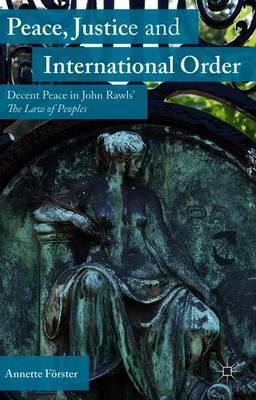
How can fair cooperation and a stable peace be reached in the international realm? Peace, Justice and International Order discusses this question in the light of John Rawls' The Law of Peoples, offers a new approach to Rawls' international theory and contributes to the discourse on international peace and justice.
Full Product Details
Author: A. Förster
Publisher: Palgrave Macmillan
Imprint: Palgrave Macmillan
Dimensions:
Width: 14.00cm
, Height: 1.70cm
, Length: 21.60cm
Weight: 0.385kg
ISBN: 9781137452658
ISBN 10: 113745265
Pages: 185
Publication Date: 28 October 2014
Audience:
College/higher education
,
Professional and scholarly
,
Postgraduate, Research & Scholarly
,
Professional & Vocational
Format: Hardback
Publisher's Status: Active
Availability: In Print

This item will be ordered in for you from one of our suppliers. Upon receipt, we will promptly dispatch it out to you. For in store availability, please contact us.
Reviews
"""The question this book engages with is crucial to understanding the relevance of Rawls's liberalism to contemporary international affairs. Exploring the question of whether there are (or could be) decent non-liberal societies is essential to establishing the boundaries of toleration in international affairs. These are the boundaries of just war, of humanitarian aid and intervention, of stability and justice. They tell us whether a liberal conception of global justice is capable of being the object of an overlapping consensus between morally and culturally distinct societies. Annette Forster has accepted this challenge and produced a fascinating study of 'the decent peace thesis' that will give students and scholars in the field much to think about."" - Peter Sutch, University of Cardiff, UK"
The question this book engages with is crucial to understanding the relevance of Rawls's liberalism to contemporary international affairs. Exploring the question of whether there are (or could be) decent non-liberal societies is essential to establishing the boundaries of toleration in international affairs. These are the boundaries of just war, of humanitarian aid and intervention, of stability and justice. They tell us whether a liberal conception of global justice is capable of being the object of an overlapping consensus between morally and culturally distinct societies. Annette Forster has accepted this challenge and produced a fascinating study of 'the decent peace thesis' that will give students and scholars in the field much to think about. - Peter Sutch, University of Cardiff, UK
Author Information
Annette Förster is Lecturer and Research Associate at RWTH Aachen University, Germany where she teaches and researches in the field of international justice and the theory of the state. She received her PhD from the London School of Economics and Political Science, UK.