Awards
- Winner of Jean Blondel PhD Prize 2004
Overview
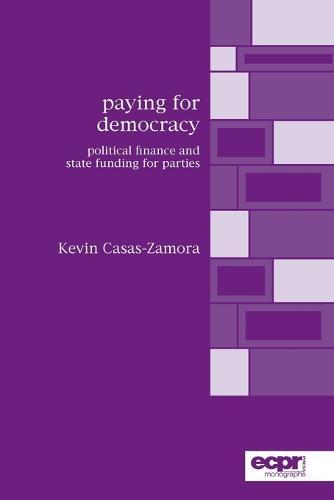
If the funding of parties and campaigns is a crucial issue for democratic theory and practice, then the spread of State subsidies for parties is, arguably, the most important trend in contemporary political finance. Using a large data set on political financing in more than 40 democracies, the book offers an unprecedented comparative study of the features of party subsidies and their effects on campaign finance practices, party systems and party organisations. The book also provides a detailed empirical account of campaign finance in two of Latin America's most consolidated democracies. Drawing upon extensive archival work and interviews, this work sheds light on largely hidden aspects of politics in the developing world and questions widespread beliefs about political finance, such as the rapid increase of campaign costs and the crucial role of television in this trend.
Full Product Details
Author: Kevin Casas-Zamora
Publisher: ECPR Press
Imprint: ECPR Press
Dimensions:
Width: 15.60cm
, Height: 1.90cm
, Length: 22.70cm
Weight: 0.494kg
ISBN: 9780954796631
ISBN 10: 0954796632
Pages: 306
Publication Date: 01 April 2005
Audience:
Professional and scholarly
,
Professional & Vocational
Format: Paperback
Publisher's Status: Active
Availability: In Print

This item will be ordered in for you from one of our suppliers. Upon receipt, we will promptly dispatch it out to you. For in store availability, please contact us.
Reviews
If there is an area in contemporary politics where black and white analysis is ineffective it is political finance, since transparency rules are weak and reliable information scarce. At least that is the message you get after reading Kevin Casas-Zamora’s book. In a thoroughly researched text (based on a doctoral thesis which was awarded a prize by the European Consortium for Political Research in 2004), the author proves his assertion that ` there is hardly an institution of state funding that can be readily advocated or criticized in the abstract, but a myriad of schemes with vastly different levels of generosity, recipients, allocation procedures and disbursement modes’. The scope of the book is wide-ranging, since it is based on a large data set on political financing in more than forty democracies, and thoroughly analyses two specific cases: Costa Rica and Uruguay…. Casas-Zamora offers the reader an illuminating comparative study of the fundamentals of party subsidies. * Journal of Latin American Studies *
If there is an area in contemporary politics where black and white analysis is ineffective it is political finance, since transparency rules are weak and reliable information scarce. At least that is the message you get after reading Kevin Casas-Zamora's book. In a thoroughly researched text (based on a doctoral thesis which was awarded a prize by the European Consortium for Political Research in 2004), the author proves his assertion that ` there is hardly an institution of state funding that can be readily advocated or criticized in the abstract, but a myriad of schemes with vastly different levels of generosity, recipients, allocation procedures and disbursement modes'. The scope of the book is wide-ranging, since it is based on a large data set on political financing in more than forty democracies, and thoroughly analyses two specific cases: Costa Rica and Uruguay.... Casas-Zamora offers the reader an illuminating comparative study of the fundamentals of party subsidies. * Journal of Latin American Studies *
Author Information
Dr. Casas-Zamora is Associate Professor of State Theory at the University of Costa Rica and international consultant on political finance issues. He currently coordinates the United Nations Development Program's National Human Development Report for Costa Rica. He holds a law degree from the University of Costa Rica, an M.A. in Latin American Government and Politics from Essex University and a D.Phil. in Politics from St. Antony's College, Oxford University. His doctoral dissertation at Oxford won the European Consortium for Political Research PhD Thesis Prize in 2004. He has written extensively on political finance, elections, democratization and civil-military relations in Latin America