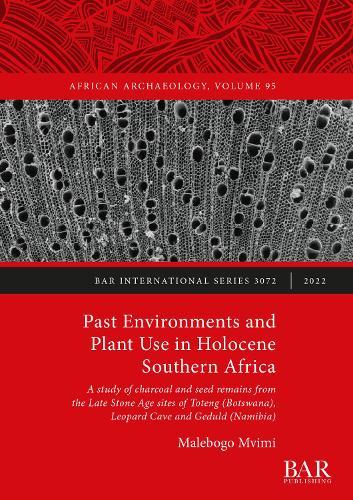
Past Environments and Plant Use in Holocene Southern Africa: A study of charcoal and seed remains from the Late Stone Age sites of Toteng (Botswana), Leopard Cave and Geduld (Namibia)

Author:   Malebogo Mvimi
Publisher:   BAR Publishing
ISBN:  

9781407357171


Pages:   214
Publication Date:   28 February 2022
Format:   Paperback
Availability:   Available To Order   Availability explained
We have confirmation that this item is in stock with the supplier. It will be ordered in for you and dispatched immediately.

Our Price $129.38 Quantity:  
Add to Cart

Share |

Past Environments and Plant Use in Holocene Southern Africa: A study of charcoal and seed remains from the Late Stone Age sites of Toteng (Botswana), Leopard Cave and Geduld (Namibia)


Overview

This book uses macrobotanical analysis (charcoal and seeds/grains) from Later Stone Age sites in Botswana and Namibia to address past climatic and environmental conditions in Southern Africa during the Holocene period, c. 2000 BP. One of its main objectives is to comprehend subsistence and overall socio-economic stratagems of human communities vis-à-vis their vegetal milieu. The majority of Southern Africa has comparatively few archaeobotanical studies, so this is the first archaeobotanical research from the site of Toteng and Botswana. Hence, this study draws equally from ethnographic inferences to understand current plant distribution and utilisation, which was achieved by using data collected among the San and Damara communities, found in the Erongo region, Namibia. Finally, a botanical reference collection was developed in order to facilitate the macrobotanical identification process, as well as to contribute to the initial reference bank that will later be developed for future research.

Full Product Details

Author:   Malebogo Mvimi
Publisher:   BAR Publishing
Imprint:   BAR Publishing
Weight:   0.853kg
ISBN:  

9781407357171


ISBN 10:   1407357174
Pages:   214
Publication Date:   28 February 2022
Audience:   Professional and scholarly ,  Professional & Vocational
Format:   Paperback
Publisher's Status:   Active
Availability:   Available To Order   Availability explained
We have confirmation that this item is in stock with the supplier. It will be ordered in for you and dispatched immediately.

Table of Contents

List of Figures List of Tables Abstract Introduction 1. Environmental Background of Southern Africa 1.1. Delimination of the study area 1.1.1. Geomorphology and soils 1.2. Past and present climatic conditions 1.3. Past and present vegetation 1.4. Fauna 2. The Late Stone Age with a Special Focus on the Studied Sites 2.1. The Late Pleistocene and the onset of the LSA in Southern Africa 2.1.1. Technical changes during the LSA 2.2. The Holocene LSA and its place among the history of the peopling of Southern Africa 2.3. Chronology and the place of herders: the advent of a Southern African 'Neolithic'? 2.3.1. Subsistence strategies 2.4. Leopard Cave (Erongo, Namibia) 2.4.1. Stratigraphy and dating 2.4.2. Lithic materials 2.4.3. Faunal remains 2.4.4. Human remains 2.4.5. Pigments and rock art 2.4.6. Present day environment 2.5. Toteng 1 (Botswana) 2.5.1. Stratigraphy and dating 2.5.2. Archaeological remains 2.5.3. Pottery 2.5.4. Lithics 2.5.5. Non lithic products 2.5.6. Faunal remains 2.5.7. Lake Ngami as an important water source 2.5.8. Present day landscape and vegetation 2.6. Geduld (Kunene, Namibia) 2.6.1. Stratigraphy and datings 2.6.2. Material cultures 2.6.3. Faunal remains 2.6.4. Botanical remains 3. Archaeobotanical Material and Methods 3.1. Description of the study material 3.2. Sampling methods 3.3. Leopard Cave 3.4. Geduld 3.5. Toteng 1 3.6. Laboratory methods and botanical identifications 3.7. Charcoal analysis 3.8. Seed analysis 3.9. Constitution of a reference collection 4. Plant Use Among Present-day Damara and San Populations in the Erongo Region, Namibia 4.1. Objectives of the ethnobotanical study 4.2. Description of the Damara village of Tubusis 4.2.1. The Damara ethnic group 4.2.2. Methodology 4.2.3. Description of plant uses for each household 4.2.4. General observations 4.3. The San Living Museum in the Omandumba farm 4.3.1. The San populations of Southern Africa 4.3.2. Plant use in the San community from Tsumkwe 5. Results 5.1. Description of identified taxa 5.2. Leopard Cave: results of the anthracological study 5.2.1. Results of the seed analysis 5.2.2. First observations on the macrobotanical record at Leopard Cave 5.3. Geduld: results of the anthracological study 5.3.1. Results of the seed analysis 5.3.2. First observations on the macrobotanical record at Geduld 5.4. Toteng: results of the anthracological study 5.5. Preliminary conclusions 6. Discussion 6.1. Leopard Cave's arboreal species from charcoal 6.2. Arboreal species from seed analysis 6.3. Geduld's arboreal species from charcoal 6.4. Arboreal species from seed analysis 6.5. Annual plants from seeds analysis 6.6. Toteng's arboreal species from charcoal 6.7. Making inferences from today's vegetation 6.8. Wild fauna to complement the environmental setting 6.9. Subsistence strategies and use of biological resources 6.10. The choice of species 6.11. Two exceptional species of Colophospermum mopane and Sclerocarya birrea 6.12. Seasonality of fruit collection and possible processing Appendix 1: Wood Anatomy for Identification Purposes Appendix 2: List of Identified Families Featuring in the Wood Atlas (According to Coates and Palgrave 2002; van Wyk and van Wyk 2007) References

Reviews

'Charcoal studies are still rare in southern Africa and this research is therefore very important for developing this field. The archaeobotanical data contributes with new knowledge about place and landscape that is not available from other methods.' Dr Anneli Ekblom, Uppsala University 'This book represents an important contribution to archaeobotanical research in South Africa, and in Africa in general. The archaeobotanical approach may be useful to deepen the history of the countries, to outline the existence of special - autochthonous - history in these regions, to discover the links between the past and current folk traditions, and to help future young researchers to work on the links between environment and culture in South Africa.' Professor Anna Maria Mercuri, Università degli Studi di Modena e Reggio Emilia    


'Charcoal studies are still rare in southern Africa and this research is therefore very important for developing this field. The archaeobotanical data contributes with new knowledge about place and landscape that is not available from other methods.' Dr Anneli Ekblom, Uppsala University 'This book represents an important contribution to archaeobotanical research in South Africa, and in Africa in general. The archaeobotanical approach may be useful to deepen the history of the countries, to outline the existence of special - autochthonous - history in these regions, to discover the links between the past and current folk traditions, and to help future young researchers to work on the links between environment and culture in South Africa.' Professor Anna Maria Mercuri, Universita degli Studi di Modena e Reggio Emilia


Author Information

Malebogo Mvimi is a lecturer in archaeology at the University of the Witwatersrand. She focuses mainly on plant use by past and present societies, ethnography, spatial analysis and environmental evolution in Southern Africa, from the Late Stone Age to more recent periods.

Tab Content 6

Author Website:  

Countries Available

All regions
Latest Reading Guide

April RG 26_2


Shopping Cart
Your cart is empty
Shopping cart
Mailing List