Overview
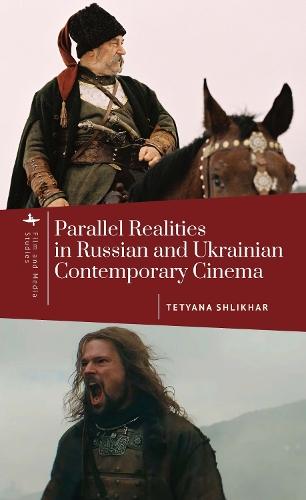
This book examines Russian and Ukrainian feature films to trace the roots and consequences of the Russian invasion of Ukraine. It argues that the cultural war stems from a colonial past, where Russia viewed Ukraine as an inferior ""little brother."" By examining cinematic representations of the countries' shared history, this book reveals how Russia has used cinema to promote a strong, unified state and patriotic narratives, while Ukrainian cinema seeks to overcome colonial trauma and build a distinct national identity. It also investigates how cultural memories of Kyivan Rus, the Cossacks, World War II, the Soviet past, and the Russian war in Ukraine are depicted differently in Russian and Ukrainian cinema.
Full Product Details
Author: Tetyana Shlikhar
Publisher: Academic Studies Press
Imprint: Academic Studies Press
ISBN: 9798897830145
Pages: 271
Publication Date: 28 August 2025
Audience:
Professional and scholarly
,
General/trade
,
Professional & Vocational
,
General
Format: Hardback
Publisher's Status: Active
Availability: Temporarily unavailable

The supplier advises that this item is temporarily unavailable. It will be ordered for you and placed on backorder. Once it does come back in stock, we will ship it out to you.
Reviews
“This is an essential companion to recent Ukrainian cinema and post-Soviet historical filmmaking more broadly. Shlikhar’s work is both urgent and enduring. Parallel Realities provides critical context for understanding our acute moment in time, while also making important contributions to the study of post-Soviet cultural memory and the role of the historical film in Russia’s imperial cinematic consciousness. To add to its many strengths, the book is written in a style that is compelling for specialists and students alike, making it an excellent choice for undergraduate courses in post-Soviet culture, cinema, and history.” — Alyssa DeBlasio, John B. Parsons Chair in the Liberal Arts & Sciences, Dickinson College “Parallel Realities in Russian and Ukrainian Cinema is an insightful, synoptic, analysis of the use of historical film since 1991 in Russia and Ukraine. Comparing competing cinematic treatments of Kyivan Rus, the Cossack heritage, World War Two, the Soviet era and depictions of Russia’s post 2014 war on Ukraine, Shlikhar shows two contrasting visions of the same historical events (or myths) and alternative visions of society. Whereas Ukrainian film concentrates on trauma and open enquiry, Russia actively promotes top-down monolithic narratives of nostalgia. This is a much-needed corrective to sometimes inadvertently russocentric surveys of post-Soviet film, and boost to Ukrainian film history.” — Jeremy Hicks, Professor of Post-Soviet Cultural History and Film, Queen Mary University of London “The long shadow of a memory war haunts Russia’s war of aggression against Ukraine. One of its most powerful cultural weapons, especially since 1991, has been film. In this insightful and urgent book, Tetiana Shlikhar explores the clashing, discordant visions of the past driving Ukrainian and Russian films after the dissolution of the Soviet Union. What emerges is a striking portrait of Russian cinema advancing the imperialist aims of the state and of Ukrainian cinema plumbing the emotional worlds of the people. A must-read for anyone striving to understand the deeper roots of the most dangerous conflict in Europe since the Second World War.” — Rory Finnin, Professor of Ukrainian Studies, University of Cambridge
“This is an essential companion to recent Ukrainian cinema and post-Soviet historical filmmaking more broadly. Shlikhar’s work is both urgent and enduring. Parallel Realities provides critical context for understanding our acute moment in time, while also making important contributions to the study of post-Soviet cultural memory and the role of the historical film in Russia’s imperial cinematic consciousness. To add to its many strengths, the book is written in a style that is compelling for specialists and students alike, making it an excellent choice for undergraduate courses in post-Soviet culture, cinema, and history.” — Alyssa DeBlasio, John B. Parsons Chair in the Liberal Arts & Sciences, Dickinson College “Parallel Realities in Russian and Ukrainian Cinema is an insightful, synoptic, analysis of the use of historical film since 1991 in Russia and Ukraine. Comparing competing cinematic treatments of Kyivan Rus, the Cossack heritage, World War Two, the Soviet era and depictions of Russia’s post 2014 war on Ukraine, Shlikhar shows two contrasting visions of the same historical events (or myths) and alternative visions of society. Whereas Ukrainian film concentrates on trauma and open enquiry, Russia actively promotes top-down monolithic narratives of nostalgia. This is a much-needed corrective to sometimes inadvertently russocentric surveys of post-Soviet film, and boost to Ukrainian film history.” — Jeremy Hicks, Professor of Post-Soviet Cultural History and Film, Queen Mary University of London “The long shadow of a memory war haunts Russia’s war of aggression against Ukraine. One of its most powerful cultural weapons, especially since 1991, has been film. In this insightful and urgent book, Tetiana Shlikhar explores the clashing, discordant visions of the past driving Ukrainian and Russian films after the dissolution of the Soviet Union. What emerges is a striking portrait of Russian cinema advancing the imperialist aims of the state and of Ukrainian cinema plumbing the emotional worlds of the people. A must-read for anyone striving to understand the deeper roots of the most dangerous conflict in Europe since the Second World War.” — Rory Finnin, Professor of Ukrainian Studies, University of Cambridge
Author Information
Tetyana Shlikhar is an Assistant Teaching Professor and the Director of Undergraduate Studies for Slavic and Eurasian Studies at the University of Notre Dame. She holds PhDs in Slavic Languages and Literatures from the University of Pittsburgh and in Translation Studies from Taras Shevchenko University of Kyiv. Her research interests include Russian and Ukrainian culture, cinema, and memory studies.