Overview
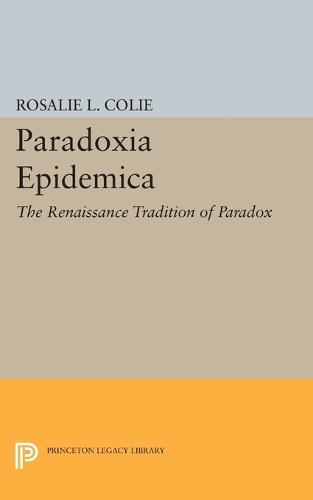
Paradoxia Epidemica is a broad-ranging critical study of Renaissance thought, showing how the greatest writers of the period from Erasmus and Rabelais to Donne, Milton, and Shakespeare made conscious use of paradox not only as a figure of speech but as a mode of thought, a way of perceiving the universe, God, nature, and man himself. The book consists of an introduction (historical and topological) and sixteen chapters grouped according to broad types of paradox: rhetorical, theological, ontological, epistemological. Within this framework the author interprets individual writings or art forms as parts of a rich tradition. Originally published in 1966. The Princeton Legacy Library uses the latest print-on-demand technology to again make available previously out-of-print books from the distinguished backlist of Princeton University Press. These editions preserve the original texts of these important books while presenting them in durable paperback and hardcover editions. The goal of the Princeton Legacy Library is to vastly increase access to the rich scholarly heritage found in the thousands of books published by Princeton University Press since its founding in 1905.
Full Product Details
Author: Rosalie Littell Colie
Publisher: Princeton University Press
Imprint: Princeton University Press
Volume: 2295
Dimensions:
Width: 12.70cm
, Height: 2.90cm
, Length: 20.30cm
Weight: 0.539kg
ISBN: 9780691623863
ISBN 10: 0691623864
Pages: 574
Publication Date: 08 December 2015
Audience:
College/higher education
,
Professional and scholarly
,
Tertiary & Higher Education
,
Professional & Vocational
Format: Paperback
Publisher's Status: Active
Availability: Manufactured on demand 
We will order this item for you from a manufactured on demand supplier.
Language: English
Table of Contents
"*Frontmatter, pg. i*Preface, pg. vii*Contents, pg. xix*Introduction: Problems of Paradoxes, pg. 1*1. ""The Puny Rhypographer"": Francois Rabelais and His Book, pg. 43*2. ""Pity the Tale of Me"": Logos and Art's Eternity, pg. 72*3. John Donne and the Paradoxes of Incarnation, pg. 96*4. Affirmations in the Negative Theology: the Infinite, pg. 145*5. Affirmations in the Negative Theology: Eternity, pg. 169*6. Logos in The Temple, pg. 190*7. ""Nothing is but what is not"": Solutions to the Problem of Nothing, pg. 219*8. Le pari: All or Nothing, pg. 252*9. Still Life: Paradoxes of Being, pg. 273*10. Being and Becoming: Paradoxes in the Language of Things, pg. 300*11. Being and Becoming in The Faerie Queene, pg. 329*12. ""I am that I am"": Problems of Self-Reference, pg. 355*13. The Rhetoric of Transcendent Know ledge, pg. 396*14. Burton's Anatomy of Melancholy and the Structure of Paradox, pg. 430*15. ""Reason in Madness"", pg. 461*16. ""Mine own Executioner"", pg. 482*Epilogue, pg. 508*Bibliography, pg. 521*Index, pg. 543"
Reviews
Author Information
Tab Content 6
Author Website:
Countries Available
All regions
|