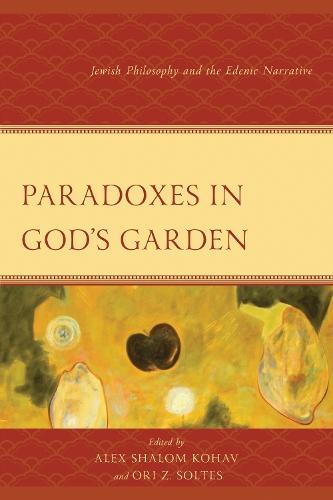
Full Product Details
Author: Alex S. Kohav ,
Ori Z. Soltes ,
Agata Bielik-Robson ,
Ori Z. Soltes
Publisher: Bloomsbury Publishing Plc
Imprint: Lexington Books
Dimensions:
Width: 15.20cm
, Height: 2.40cm
, Length: 22.90cm
Weight: 0.540kg
ISBN: 9781666969801
ISBN 10: 166696980
Pages: 244
Publication Date: 18 November 2024
Audience:
Professional and scholarly
,
Professional & Vocational
Format: Hardback
Publisher's Status: Active
Availability: Manufactured on demand

We will order this item for you from a manufactured on demand supplier.
Reviews
""Paradoxes in Godrsquo;s Garden offers a collection of essays that revolve in a sort of whirling dance around the enigmatic nature of the Edenic narrative in the Book of Genesis. Some of the apparent paradoxes that have provoked scholarly discussions are described in the introduction by coeditor Ori Z. Soltes and in a chapter by Agata Bielik-Robson: knowledge and life; good and evil; liberation and limitation; finite life versus immortality; idolatry versus representation; and methods of memory formation and maintenance of traditions. Coeditor Alex Shalom Kohav introduces the idea of secret knowledge transmitted in the Torah and interpreted variously, by the initiated and the uninitiated (respectively, the priestly and rabbinical streams). Several chapters extend beyond the immediate focus on Eden to look at related issues. The question of knowledge in Genesis is compared by Ori Z. Soltes to the Platonic theory of knowledge as recollection (chapter 2). Michael T. Miller introduces an interesting argument of the distinction between the infinite status of perfect Being and the nature of divine Becoming, as contrasted to the absolute singularity of God, considered in Kevin Hartrsquo;s chapter. Louis Heacute;bert offers a comparison of (primarily) the Christian notion of God and the spiritual attributes that Buddhism, one of only two nontheistic traditional religions, associates with the buddhas. Finally, Elana Gomel discusses the theme of forbidden knowledge as it has been refracted and reflected through literary history, including modern science fiction. In this multifaceted and absorbing collection, interested readers will find a helpful resource in developing their own understanding of a narrative that has been central to Western and Middle Eastern cultures.""--Burton Voorhees, Athabasca University
""Paradoxes in God's Garden offers a collection of essays that revolve in a sort of whirling dance around the enigmatic nature of the Edenic narrative in the Book of Genesis. Some of the apparent paradoxes that have provoked scholarly discussions are described in the introduction by coeditor Ori Z. Soltes and in a chapter by Agata Bielik-Robson: knowledge and life; good and evil; liberation and limitation; finite life versus immortality; idolatry versus representation; and methods of memory formation and maintenance of traditions. Coeditor Alex Shalom Kohav introduces the idea of secret knowledge transmitted in the Torah and interpreted variously, by the initiated and the uninitiated (respectively, the priestly and rabbinical streams). Several chapters extend beyond the immediate focus on Eden to look at related issues. The question of knowledge in Genesis is compared by Ori Z. Soltes to the Platonic theory of knowledge as recollection (chapter 2). Michael T. Miller introduces an interesting argument of the distinction between the infinite status of perfect Being and the nature of divine Becoming, as contrasted to the absolute singularity of God, considered in Kevin Hart's chapter. Louis Hébert offers a comparison of (primarily) the Christian notion of God and the spiritual attributes that Buddhism, one of only two nontheistic traditional religions, associates with the buddhas. Finally, Elana Gomel discusses the theme of forbidden knowledge as it has been refracted and reflected through literary history, including modern science fiction. In this multifaceted and absorbing collection, interested readers will find a helpful resource in developing their own understanding of a narrative that has been central to Western and Middle Eastern cultures."" --Burton Voorhees, Athabasca University
Author Information
Alex S. Kohav teaches in the Department of Philosophy at Metropolitan State University of Denver. Ori Z. Soltes teaches at Georgetown University across a range of disciplines, from theology and art history to philosophy and political history.