Overview
'Had God intended Women merely as a finer sort of cattle, he would not have made them reasonable.' Writing in 1673, Bathsua Makin was one of the first women to insist that girls should receive a scientific education. Despite the efforts of Makin and her successors, women were excluded from universities until the end of the nineteenth century, yet they found other ways to participate in scientific projects. Because these were being carried out inside private houses, rather than in universities or industrial laboratories, experiments often involved the whole family. As well as collaborating in this home- based research, women corresponded with internationally renowned scholars, hired tutors, and even published their own books. They played essential roles in work that was frequently attributed solely to their husbands, fathers or friends. Women, in this way, have not been written out of the history of science- they have never been written in. If mentioned at all, they appear in subservient roles as helpless admirers or menial assistants. Historians always decide which facts to emphasise, and they generally choose to depict a vision of scientific progress that ignores women's activities. By re- examining the lives of individuals, PANDORA'S BREECHES explores how women of the 17th and 19th century engaged in science and contributed to its rapid growth. It sets out a new and compelling version of science's past.
Full Product Details
Author: Patricia Fara
Publisher: Vintage Publishing
Imprint: Pimlico
Dimensions:
Width: 15.30cm
, Height: 2.10cm
, Length: 23.40cm
Weight: 0.361kg
ISBN: 9781844130825
ISBN 10: 1844130827
Pages: 288
Publication Date: 04 March 2004
Audience:
General/trade
,
General
Format: Paperback
Publisher's Status: Out of Print
Availability: In Print

Limited stock is available. It will be ordered for you and shipped pending supplier's limited stock.
Reviews
"""Excellent... Fascinating in its details, Pandora's Breeches is also groundbreaking in the way it reframes the history of science"" * Guardian * ""This illustrates different ways in which women have contributed powerfully to the growth of science...[with] fluent style and a determined attempt to make the history of science readily understood as a social construct"" * Times Higher Education Supplement * ""Cool in appraisal, balanced in argument and, in my book, an essential read"" -- Graeme Fife * BBC History Magazine *"
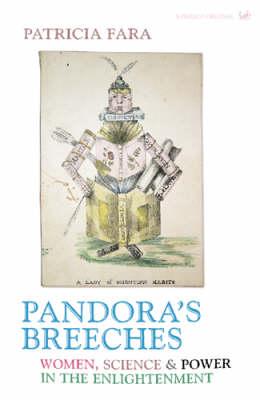
Fara's take on the role of women in science is beautifully and fortuitously timed given the recent gender-brain-difference conjectures of Harvard's president. Cambridge historian and philosopher of science scholar Fara (Newton: The Making of Genius, 2002, etc.) contends that far from the romantic vision of the (male) lonely genius striving to divest (mother) nature of her secrets, the geniuses, inventors and innovators glorified in science biographies and texts were aided and abetted by their womenfolk. Wives, lovers and sisters showed the intellectual curiosity and learned the math and science that enabled them to make creative observations, refine instruments, record the data, illustrate the texts and write popularizations of their menfolk's work. Fara concentrates on the 18th century-the age of enlightenment (but not so for women, those fragile inferiors forbidden access to universities and expected to devote themselves to the domestic arts). In a series of detailed chapters, she profiles Elisabetha Hevelius, Johannes's sister; Caroline Herschel, William's sister; Marie Paulze Lavoisier, Antoine's wife; along with some chapters that focus on earlier and later times and the women in the lives of Descartes, Leibniz and Newton, ending with an essay on Mary Shelley. It helped that these women almost always had a father or an elder brother who recognized their talents and encouraged them, and that the families were rich enough to provide the resources. To her credit, Fara does not in turn glorify them, but presents well-rounded portraits: women, sometimes humble and masochistic; other times vain, intemperate, even unfaithful. Her final essay on Shelley and Frankenstein is a gem in which she points out the many conflicts in Shelley's own mind about the role of women and about science itself, one that resonates only too well with today's growing ambivalence toward science as unleashing a Pandora's box of evils. (The breeches of the title is a reference to a caricature of a woman scientist devoid of all femininity.) A noble effort to change the record and the culture . . . but plus ca change.... (Kirkus Reviews)
Ask anyone to name a historical female scientist, and the chances are they would name Marie Curie... and then draw a blank. It is highly unlikely that they would cast their minds back as far as the eighteenth century, or earlier. Despite the ancient Greek depiction of Minerva as rational goddess of learning, and calls from the likes of Mary Wollstonecraft and Bathsua Makin, women were excluded from universities until the late nineteenth century, and those who favoured intellectual pursuits were oscorned. Some, however, found ways to circumvent these strictures, often by assisting their husbands or by acting as wealthy patrons. This lively account devotes chapters to Emilie du Chatelet, mistress of Voltaire, who translated and rewrote the work of Newton in French; Caroline Herschel, who worked with her astronomer brother, William; and Princess Elisabeth of Bohemia, confidante and mathematical sparring partner of Descartes. Fara does not pretend to provide the definitive word on the subject, but her characters leap from the page. (Kirkus UK)
Excellent... Fascinating in its details, Pandora's Breeches is also groundbreaking in the way it reframes the history of science Guardian This illustrates different ways in which women have contributed powerfully to the growth of science...[with] fluent style and a determined attempt to make the history of science readily understood as a social construct Times Higher Education Supplement Cool in appraisal, balanced in argument and, in my book, an essential read -- Graeme Fife BBC History Magazine 20041221
cool in appraisal, balanced in argument and, in my book, an essential read Graeme Fife, BBC History Magazine 20041221
Excellent... Fascinating in its details, Pandora's Breeches is also groundbreaking in the way it reframes the history of science Guardian This illustrates different ways in which women have contributed powerfully to the growth of science...[with] fluent style and a determined attempt to make the history of science readily understood as a social construct Times Higher Education Supplement Cool in appraisal, balanced in argument and, in my book, an essential read -- Graeme Fife BBC History Magazine
Author Information
Patricia Fara is a Fellow of Clare College, Cambridge, where she lectures on the history of science. She is the author of two books on scientific history for general readers, Newton- The Making of Genius (2002) and An Entertainment for Angels- Electricity and Enlightenment (2002), a well-received academic monograph, and numerous articles and reviews for academic and popular publications.