Overview
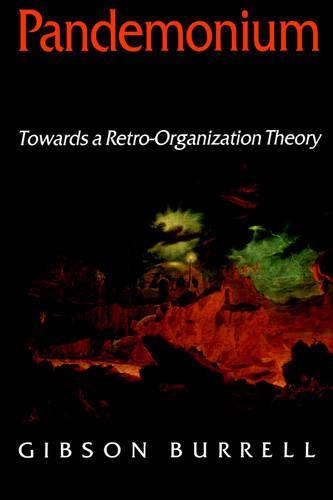
This irreverent but serious work systematically challenges the underlying assumptions and values of contemporary linear organization theory. The author looks at the pain, violence, death, failure and chaos hidden underneath, at the prison-like surveillance systems, the rotting structure - the organizational hell disregarded by conventional organization theory and practice. Disclaiming the voices of positivist science, the author presents a metaphor for the rejection of linearity, the reassertion of organizational creativity, and the return of actual human beings into the equations of organization theory and practice.
Full Product Details
Author: Mr Gibson Burrell
Publisher: SAGE Publications Inc
Imprint: SAGE Publications Inc
Dimensions:
Width: 15.60cm
, Height: 1.30cm
, Length: 23.40cm
Weight: 0.490kg
ISBN: 9780803977778
ISBN 10: 0803977778
Pages: 254
Publication Date: 13 February 1997
Audience:
College/higher education
,
Professional and scholarly
,
Tertiary & Higher Education
,
Professional & Vocational
Format: Paperback
Publisher's Status: Active
Availability: Manufactured on demand

We will order this item for you from a manufactured on demand supplier.
Reviews
Burrell has produced a retro-organization theory that seeks to describe the underbelly (or is it the reality?) of orgnizations in pre-enlightenment terms. Organizations are as pandemonium... Whether you agree with retro-organization theory or not, is up to you. Personnally I find it useful to view organizations where the rational andthe primordial interact and often confront each other... If we dare look deeply through pandemonium's lens, however, it has the potential to shed a disturbing light on the issues and challenges facing the design and introduction of information systems and technologies into healthcare organizations and the role of information, now and in the future. In retrospect it may also shed light on some fo the problems surrounding its past history' - British Journal of Healthcare Computing & Information Management 'Pandemonium is an irreverent and critical look at management, education and the so-called gurus. It takes as its basic premise the fact that in real organizations there is chaos, even pain, torture, death and destruction, if you look hard enough. More importantly it points out the continuing failure of organizations to recognise the real contributors - the workforce. It is a well researched and written book' - Professional Manager 'A truly bizarre and sometimes filthy historical canter through abatoirs, satyriasis and Noel Edmonds' House Party, among other things, towards a theory of organization' - The Times 'The author pursues a vigorous polemic on organizational development' - Financial Times 'Two volumes in one, Pandemonium is a disorganisationally challenging contribution to the postmodern theory of organisations which systematically questions the underlying assumptions and values of contemporary administrative science and organization theory. The MBA will never be the same again' - Bryan S Turner, Deakin University 'Pandemonium is a dark, gothic place, full of danger and enchantment for all who enter its labyrinth, a retro-vision that seeks to ensnare, disarm and disturb all who enter, whatever sense they make from the many opportunities it provides' - Stewart R Clegg, University of Technology, Sydney 'Undoubtedly, Burrell, through Paradigms, has been one of the main contributors to contemporary organizational thinking, and indeed, to a not insignificant degree, has influenced the way the subject has developed' - British Journal of Industrial Relations
Burrell has produced a retro-organization theory that seeks to describe the underbelly (or is it the reality?) of orgnizations in pre-enlightenment terms. Organizations are as pandemonium... Whether you agree with retro-organization theory or not, is up to you. Personnally I find it useful to view organizations where the rational andthe primordial interact and often confront each other... If we dare look deeply through pandemonium's lens, however, it has the potential to shed a disturbing light on the issues and challenges facing the design and introduction of information systems and technologies into healthcare organizations and the role of information, now and in the future. In retrospect it may also shed light on some fo the problems surrounding its past history' - British Journal of Healthcare Computing & Information Management 'Pandemonium is an irreverent and critical look at management, education and the so-called gurus. It takes as its basic premise the fact that in real organizations there is chaos, even pain, torture, death and destruction, if you look hard enough. More importantly it points out the continuing failure of organizations to recognise the real contributors - the workforce. It is a well researched and written book' - Professional Manager 'A truly bizarre and sometimes filthy historical canter through abatoirs, satyriasis and Noel Edmonds' House Party, among other things, towards a theory of organization' - The Times 'The author pursues a vigorous polemic on organizational development' - Financial Times 'Two volumes in one, Pandemonium is a disorganisationally challenging contribution to the postmodern theory of organisations which systematically questions the underlying assumptions and values of contemporary administrative science and organization theory. The MBA will never be the same again' - Bryan S Turner, Deakin University 'Pandemonium is a dark, gothic place, full of danger and enchantment for all who enter its labyrinth, a retro-vision that seeks to ensnare, disarm and disturb all who enter, whatever sense they make from the many opportunities it provides' - Stewart R Clegg, University of Technology, Sydney 'Undoubtedly, Burrell, through Paradigms, has been one of the main contributors to contemporary organizational thinking, and indeed, to a not insignificant degree, has influenced the way the subject has developed' - British Journal of Industrial Relations
Burrell has produced a retro-organization theory that seeks to describe the underbelly (or is it the reality?) of orgnizations in pre-enlightenment terms. Organizations are as pandemonium.... Whether you agree with retro-organization theory or not, is up to you. Personnally I find it useful to view organizations where the rational andthe primordial interact and often confront each other.... If we dare look deeply through pandemonium's lens, however, it has the potential to shed a disturbing light on the issues and challenges facing the design and introduction of information systems and technologies into healthcare organizations and the role of information, now and in the future. In retrospect it may also shed light on some fo the problems surrounding its past history' - British Journal of Healthcare Computing & Information Management `Pandemonium is an irreverent and critical look at management, education and the so-called gurus. It takes as its basic premise the fact that in real organizations there is chaos, even pain, torture, death and destruction, if you look hard enough. More importantly it points out the continuing failure of organizations to recognise the real contributors - the workforce. It is a well researched and written book' - Professional Manager `A truly bizarre and sometimes filthy historical canter through abatoirs, satyriasis and Noel Edmonds' House Party, among other things, towards a theory of organization' - The Times 'The author pursues a vigorous polemic on organizational development' - Financial Times `Two volumes in one, Pandemonium is a disorganisationally challenging contribution to the postmodern theory of organisations which systematically questions the underlying assumptions and values of contemporary administrative science and organization theory. The MBA will never be the same again' - Bryan S Turner, Deakin University `Pandemonium is a dark, gothic place, full of danger and enchantment for all who enter its labyrinth, a retro-vision that seeks to ensnare, disarm and disturb all who enter, whatever sense they make from the many opportunities it provides' - Stewart R Clegg, University of Technology, Sydney `Undoubtedly, Burrell, through Paradigms, has been one of the main contributors to contemporary organizational thinking, and indeed, to a not insignificant degree, has influenced the way the subject has developed' - British Journal of Industrial Relations
Author Information
Gibson Burrell is Professor of Organizational Behaviour at the University of Warwick. He is also co-editor of Organization: the interdisciplinary journal of organization, theory and society published by Sage. With Gareth Morgan, he co-authored the path-breaking book Sociological Paradigms and Organizational Analysis in 1979 and has since published numerous articles in books and journals.