Overview
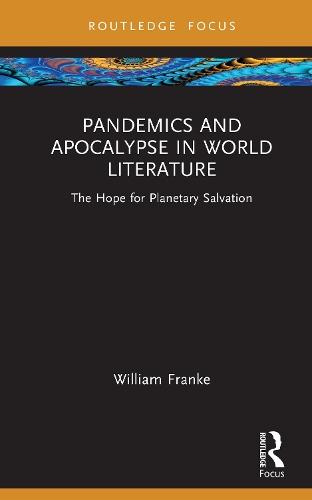
Pandemics and Apocalypse rereads classical narratives of plague from the Bible (Exodus) and classical antiquity, both Greek (Homer, Thucydides, Sophocles) and Roman (Lucretius, Virgil, Ovid), through the Middle Ages (Dante, Boccaccio) and Modernity (Defoe, Manzoni, Artaud, Camus) as a basis for contemplating the significance of the recent Covid-19 pandemic. It concerns how we are to confront future pandemics and other inextricably related crises, notably those of an ecological nature. Responses to Covid-19 typically set everything on defeating this “enemy,” but actually we cannot eliminate viruses without eliminating ourselves. We need to see the pandemic as revealing us to ourselves in our inherently vulnerable condition as a first step to admitting the infinite openness to one another and to our Ground—physical and metaphysical—that alone can save our world by engendering a different attitude, open and engaged, to one another and to the Earth as sources of our collective life.
Full Product Details
Author: William Franke
Publisher: Taylor & Francis Ltd
Imprint: Routledge
Weight: 0.450kg
ISBN: 9781032895857
ISBN 10: 1032895853
Pages: 146
Publication Date: 19 February 2025
Audience:
College/higher education
,
Tertiary & Higher Education
Format: Hardback
Publisher's Status: Active
Availability: In Print

This item will be ordered in for you from one of our suppliers. Upon receipt, we will promptly dispatch it out to you. For in store availability, please contact us.
Reviews
Pandemics and Apocalypse in World Literature is not just a scholarly survey but a constructive approach that gives itself the task to wrest possibilities of an eschatological hope from the night of apocalyptic despair. Written at the wake of the recent pandemics, the work deploys negative theology at its most creative possibility: it consists of an infinite affirmation of the unconditioned which nevertheless remains irreducibly ineffable. Franke brings together, without reducing their disparate character, the agonal traits of the end and the beginning, of despair and hope, of the abyss of the night and the first morning glow; and he shows, through rigorous exegesis of some of the very difficult texts, that perhaps the only task that is worthy today is to see the possibility of the radical, incalculable alterity that our history never ceases exposing us to. Dense, profound, thought-provoking… -Prof. Saitya Brata Das, Associate Professor, JNU, Delhi
William Franke delves into how disease and death force humanity to confront its deepest vulnerabilities in this profound exploration of pandemics in literature. Much like apocalyptic events, Pandemics raise fundamental questions about the viability of human society, the fragility of life, and the structures that bind us together. These crises level all distinctions, revealing the often-ignored truths about inequality, mortality, and our shared existence. Yet amidst the despair, the text argues for hope—not as a solution to our vulnerability, but as an openness to life in all its uncertainty. This hope inspires us to transcend self-preservation, fostering solidarity and collective action toward a more meaningful life. The book illuminates the inexpressible dimensions of these world-shattering experiences through personal witness and reflection, offering a powerful meditation on the human condition. -Prof. Massimo Lollini, Professor Emeritus of Italian, University of Oregon, USA Pandemics and Apocalypse in World Literature is not just a scholarly survey but a constructive approach that gives itself the task to wrest possibilities of an eschatological hope from the night of apocalyptic despair. Written at the wake of the recent pandemics, the work deploys negative theology at its most creative possibility: it consists of an infinite affirmation of the unconditioned which nevertheless remains irreducibly ineffable. Franke brings together, without reducing their disparate character, the agonal traits of the end and the beginning, of despair and hope, of the abyss of the night and the first morning glow; and he shows, through rigorous exegesis of some of the very difficult texts, that perhaps the only task that is worthy today is to see the possibility of the radical, incalculable alterity that our history never ceases exposing us to. Dense, profound, thought-provoking… -Prof. Saitya Brata Das, Associate Professor, JNU, India William Franke's history of pandemic literature, from the ancient world to COVID, helps us understand what we are all still wondering about: what exactly happened to the us in 2020? The pandemic made us all more aware of the contingency of order, and the religious significance of this awarness, while overlooked by many, is for Franke the big take away. An eye-opener. -Prof. Sean J. McGrath, Professor, Memorial University, Canada
Author Information
William Franke is Professor of Comparative Literature at Vanderbilt University. He is currently Francesco de Dombrowski Professor in Residence at the Harvard University Center for Renaissance Studies (Villa I Tatti) in Florence, Italy, and Senior Fellow of the International Institute for Hermeneutics. He has been Research Fellow of the Alexander von Humboldt-Stiftung, Professor of Philosophy at the University of Macao, Visiting Professor of Philosophy at the University of Navarra, and Fulbright Distinguished Chair in Intercultural Theology and the Study of Religions at the University of Salzburg. His books include On What Cannot Be Said (2007); Poetry and Apocalypse (2009); Dante and the Sense of Transgression (2013); A Philosophy of the Unsayable (2014); The Revelation of Imagination (2015); Secular Scriptures (2016); A Theology of Literature (2018); The Universality of What Is Not (2020); The Divine Vision of Dante’s Paradiso (2021); The Vita Nuova and the New Testament (2021); Dante's Paradiso and the Theological Origins of Modern Thought (2021); Dantologies (2024); Don Quixote and the Quest for the Absolute in Literature (2024); and others.