Awards
- Winner of Outsider Theory 2019
Overview
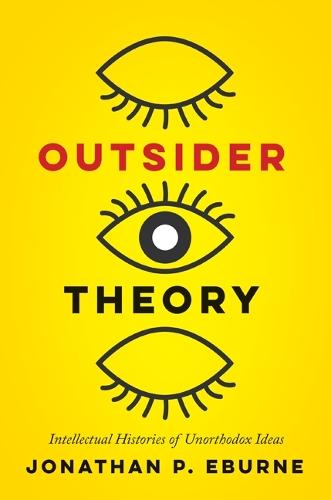
A vital and timely reminder that modern life owes as much to outlandishthinking as to dominant ideologies. What do the Nag Hammadi library, Dan Brown's The Da Vinci Code, speculativefeminist historiography, Marcus Garvey's finances, and maps drawn by asylumpatients have in common? Jonathan P. Eburne explores this question as never beforein Outsider Theory, a timely book about outlandish ideas. Eburne brings readers onan adventure in intellectual history that stresses the urgency of taking seriously- especially in an era of fake news - ideas that might otherwise be discarded orregarded as errant, unfashionable, or even unreasonable. Examining the role of such thinking in contemporary intellectual history, Eburnechallenges the categorical demarcation of good ideas from flawed, wild, or bad ones,addressing the surprising extent to which speculative inquiry extends beyond thework of professional intellectuals to include that of nonprofessionals as well, whetheramateurs, unfashionable observers, or the clinically insane. Considering the work of a variety of such figures - from popular occult writers andgnostics to so-called outsider artists and pseudoscientists - Eburne argues that anunderstanding of its circulation and recirculation is indispensable to the history ofideas. He devotes close attention to ideas and texts usually omitted from ormarginalized within orthodox histories of literary modernism, critical theory, andcontinental philosophy, yet which have long garnered the critical attention ofspecialists in religion, science studies, critical race theory, and the history of theoccult. In doing so he not only sheds new light on a fascinating body of creativethought but also proposes new approaches for situating contemporary humanitiesscholarship within the history of ideas. However important it might be to protect ourselves from ""bad"" ideas, Outsider Theoryshows how crucial it is for us to know how and why such ideas have left theirFall 2018 University of Minnesota Pressimpression on modern-day thinking and continue to shape its evolution.
Full Product Details
Author: Jonathan Eburne
Publisher: University of Minnesota Press
Imprint: University of Minnesota Press
Dimensions:
Width: 15.60cm
, Height: 5.10cm
, Length: 23.50cm
ISBN: 9781517905552
ISBN 10: 1517905559
Pages: 424
Publication Date: 18 September 2018
Audience:
General/trade
,
Professional and scholarly
,
General
,
Professional & Vocational
Format: Paperback
Publisher's Status: Active
Availability: Available To Order

We have confirmation that this item is in stock with the supplier. It will be ordered in for you and dispatched immediately.
Reviews
A bracing challenge to academic squeamishness, Outsider Theory is a learned, mischievous, and fascinating book that makes a compelling argument for the positive role of fraud, failure, and error in knowledge production. Outsider art, writing, and thinking can no longer be neatly quarantined in isolated and eccentric individuals, but must be recognized as thoroughly implicated in mass culture, scholarship, laboratory work, and critical theory. -John Wilkinson, University of Chicago Jonathan P. Eburne has written a generous, curious, rigorous book about ideas often dismissed as ridiculous, embarrassing, and even dangerous. Outsider Theory takes them seriously, which means subjecting them to the same caliber of historical analysis and philosophical critique usually reserved for 'good' ideas. In doing so, he launches us on several fascinating voyages across what he calls 'the oceanic expanse of modern intellectual history.' -Evan Kindley, author of Poet-Critics and the Administration of Culture This timely book is not only genuinely interesting, but makes a strong and original contribution to the discussion concerning the future of the humanities. Jonathan P. Eburne's study of questions of method is itself an achievement of method, engaging with the outsiders not as a cabinet of curiosities, but in a way that troubles thinking, and especially thinking about thinking. -Margret Grebowicz, Tyumen State University Scholars will find much to consider in Eburne's methodological innovations, and students will find Eburne's case studies of outsider theory to be fascinating explorations of how ideas, once discarded, often have had a subterranean influence on contemporary intellectual life. -CHOICE Jonathan Eburne's book encourages a resolve to take as seriously and generously as he entertains every strange invention and its productive errancy, even one's drifting thoughts on finally putting the book aside. -SubStance
""A bracing challenge to academic squeamishness, Outsider Theory is a learned, mischievous, and fascinating book that makes a compelling argument for the positive role of fraud, failure, and error in knowledge production. Outsider art, writing, and thinking can no longer be neatly quarantined in isolated and eccentric individuals, but must be recognized as thoroughly implicated in mass culture, scholarship, laboratory work, and critical theory.""-John Wilkinson, University of Chicago ""Jonathan P. Eburne has written a generous, curious, rigorous book about ideas often dismissed as ridiculous, embarrassing, and even dangerous. Outsider Theory takes them seriously, which means subjecting them to the same caliber of historical analysis and philosophical critique usually reserved for ‘good’ ideas. In doing so, he launches us on several fascinating voyages across what he calls ‘the oceanic expanse of modern intellectual history.’""-Evan Kindley, author of Poet-Critics and the Administration of Culture ""This timely book is not only genuinely interesting, but makes a strong and original contribution to the discussion concerning the future of the humanities. Jonathan P. Eburne's study of questions of method is itself an achievement of method, engaging with the outsiders not as a cabinet of curiosities, but in a way that troubles thinking, and especially thinking about thinking.""-Margret Grebowicz, Tyumen State University ""Scholars will find much to consider in Eburne’s methodological innovations, and students will find Eburne’s case studies of outsider theory to be fascinating explorations of how ideas, once discarded, often have had a subterranean influence on contemporary intellectual life.""-CHOICE ""Jonathan Eburne’s book encourages a resolve to take as seriously and generously as he entertains every strange invention and its productive errancy, even one’s drifting thoughts on finally putting the book aside.""-SubStance
A bracing challenge to academic squeamishness, Outsider Theory is a learned, mischievous, and fascinating book that makes a compelling argument for the positive role of fraud, failure, and error in knowledge production. Outsider art, writing, and thinking can no longer be neatly quarantined in isolated and eccentric individuals, but must be recognized as thoroughly implicated in mass culture, scholarship, laboratory work, and critical theory. -John Wilkinson, University of Chicago Jonathan P. Eburne has written a generous, curious, rigorous book about ideas often dismissed as ridiculous, embarrassing, and even dangerous. Outsider Theory takes them seriously, which means subjecting them to the same caliber of historical analysis and philosophical critique usually reserved for `good' ideas. In doing so, he launches us on several fascinating voyages across what he calls `the oceanic expanse of modern intellectual history.' -Evan Kindley, author of Poet-Critics and the Administration of Culture This timely book is not only genuinely interesting, but makes a strong and original contribution to the discussion concerning the future of the humanities. Jonathan P. Eburne's study of questions of method is itself an achievement of method, engaging with the outsiders not as a cabinet of curiosities, but in a way that troubles thinking, and especially thinking about thinking. -Margret Grebowicz, Tyumen State University
Author Information
Jonathan P. Eburne is associate professor of comparative literature, English, and French and Francophone studies at the Pennsylvania State University. He is author of Surrealism and the Art of Crime, coauthor of four other books, and editor of ASAP/Journal.