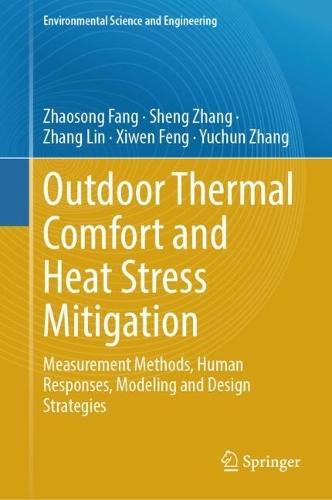
Full Product Details
Author: Zhaosong Fang ,
Sheng Zhang ,
Zhang Lin ,
Xiwen Feng
Publisher: Springer Verlag, Singapore
Imprint: Springer Verlag, Singapore
ISBN: 9789819588985
ISBN 10: 9819588987
Pages: 463
Publication Date: 23 May 2026
Audience:
Professional and scholarly
,
College/higher education
,
Professional & Vocational
,
Postgraduate, Research & Scholarly
Format: Hardback
Publisher's Status: Active
Availability: Not yet available

This item is yet to be released. You can pre-order this item and we will dispatch it to you upon its release.
Author Information
Dr. Zhaosong Fang received his B.E. degree in Building Environment and Equipment Engineering from Guangzhou University in 2005, his M.E. and Ph.D. degree in the same field from Chongqing University in 2008 and 2014, respectively. From May 2015 to May 2017, he served as a Postdoctoral Research Fellow at the City University of Hong Kong. Since July 2014, he has been with the School of Civil Engineering at Guangzhou University, now as a Professor and Deputy Director of the Building Equipment Engineering Department. Dr. Fang’s research focuses on thermal comfort and thermal safety evaluation in built environments, energy-efficient HVAC systems, and enhanced heat transfer mechanisms. His recent research includes studying human thermal stress adaptation in high-temperature environments, optimization of air-source heat pump systems, and the development of sustainable HVAC technologies. He contributed to the 2019 Guangdong Residential Building Energy-Saving Standards. Dr. Sheng Zhang received his B.E. degree in Energy and Environment Application Engineering from Zhejiang University in 2014, and his Ph.D. degree in Building Services from City University of Hong Kong in 2020. He has been at Xi’an Jiaotong University as a professor since February 2021. Dr. Zhang’ research interest focuses on indoor environment quality oriented low-carbon building technology, and his academic achievements include developing adaptive – rational thermal comfort models; developing systematic ventilation performance indices; proposing control principles and methods of non-uniform collective thermal environment for individual thermal preferences; proposing mechanisms and methods for non-pandemic and pandemic ventilation control; air source and ground source based renewable heating and cooling energy systems. Prof. Zhang Lin is the Chair Professor in Built Environment at City University of Hong Kong. Prof. Lin received his B.E. degree in Air Conditioning from Tsinghua University in 1983 and his Ph.D. degree in Processing and Environmental Technology from Massey University in 1995. Prof. Lin’s research interests are Built Environment and Renewable Energy Systems, including advanced air distribution, indoor and outdoor thermal comfort, indoor air quality, solar energy systems, etc. Prof. Lin is among the world’s Top 2% scientists. He is a member of the American Society of Heating, Refrigeration, and Air Conditioning Engineers, the Institution of Engineers of Australia, the Hong Kong Institution of Engineers, the Extended Building Committee, Building Department, the Hong Kong SAR government, etc. Prof. Lin is an editorial board member of the journals Building Simulation, and Buildings. Dr. Xiwen Feng received his B.Eng. and M.Eng. degree from Guangzhou University in 2015 and 2018, respectivel, and his Ph.D. in Heating, Ventilation, Air Conditioning, and Gas Supply Engineering at Tongji University, Shanghai, China, in 2023. Dr. Feng's research focuses on outdoor thermal environment, outdoor thermal comfort, and heat radiation transfer. He received National Scholarship, the Outstanding Graduate Award from Tongji University, and the Outstanding Design Award at the 15th MDV Central Air Conditioning Design Application Competition. Ms. Yuchun Zhang received her B.E. and M.E. degrees from Guangzhou University in 2018 and 2021, respectively and is currently pursuing her Ph.D. degree in Architecture and Civil Engineering at City University of Hong Kong, under the supervision of Professor John Z. Lin. She focuses on the research of thermal comfort and thermal safety evaluation in built environments, particularly in ventilation systems and airflow organization. Her recent research interests include: human thermal comfort under dynamic metabolic conditions, optimization of thermal index models, and the performance of ventilation systems in transitional and stratified environments.