Overview
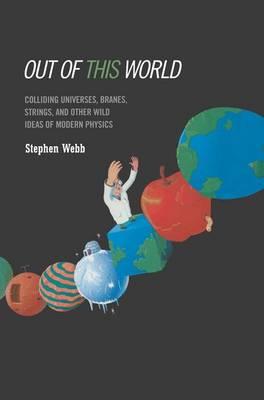
In ""Out of this World"", Stephen Webb examines these theories. After introducing general relativity and quantum mechanics - the twin foundations of 20th-century physics - he explains how these two theories simply cannot both be true. Then, in a series of chapters, he introduces us to the seemingly outlandish and bizarre ideas that astronomers and physicists have come up with to account for this apparent theoretical inconsistency, ultimately leading us to wholly new realms of understanding that many scientists and mathematicians are now proposing.
Full Product Details
Author: Stephen Webb
Publisher: Springer-Verlag New York Inc.
Imprint: Springer-Verlag New York Inc.
Edition: 2004 ed.
Dimensions:
Width: 15.50cm
, Height: 1.90cm
, Length: 23.50cm
Weight: 0.670kg
ISBN: 9780387029306
ISBN 10: 0387029303
Pages: 308
Publication Date: 25 May 2004
Audience:
General/trade
,
General
Format: Hardback
Publisher's Status: Active
Availability: In Print

This item will be ordered in for you from one of our suppliers. Upon receipt, we will promptly dispatch it out to you. For in store availability, please contact us.
Reviews
From the reviews: <p> For more than 20 years, the physical theory of the fundamental nature of matter and force has stood almost motionless. It describes everything and explains nothing, and now a group of researchers is playing with radical revisions a ] in order to get ideas moving again. a ] Webb writes clearly and exactly, and is obviously in close touch with recent developments. (D. Park, CHOICE, Vol. 42(3), November, 2004) <p> After introducing general relativity and quantum mechanics a ] . Then, in a series of increasingly astonishing chapters, he introduces us to the seemingly outlandish and bizarre proposals a from almost unbelievably small particles to huge membranes that may envelope our Universe a ] ultimately leading to us to wholly new realms of understanding. Webb makes these strange and wonderful goings-on accessible, engaging and enjoyable a ] . <p>a ~Webb helps readers understand whata (TM)s involved by defining the concepts of symmetry and space-time a ] . Webb presents these ideas so that even nonspecialists can grasp the basics of topics as esoteric as alternative dimensions and particle physics.a (TM) <p> Webba (TM)s latest book is a look at strings and other things that might underlie the structure of the Universe. Unlike other books a ] this one manages to take on the subject in a truly accessible way a ] . it is perhaps the best introduction available at this level of the subject. (Richard Wentk, Focus, September, 2004) <p> This book explores colliding universes, branes, strings and other wild ideas of modern physics. It is aimed at the non-mathematical reader. a ] The style a ] is lively and engaging. a ] Webb, employed by the Open University in theU.K. has a bright and breezy style, which enlivens the most tortuous of subject matter. Highly recommended as a laymana (TM)s non-mathematical introduction to some of the weirdest physics around, the book is complete with a necessary glossary and bibliography, with recommended further reading. (Roger Feasey, Journal of the Auckland Astronomical Society, June, 2005) <p> Stephen Webba (TM)s a ] a ~Out of this Worlda (TM), is a challenge to those of us who might suspect branes to be a typo and have only a utilitarian view of strings a ] . Webb skillfully conveys the meaning of many advanced concepts of theoretical physics, such as renormalisation and gauge symmetries. a ] the book has a useful glossary and index. Webb is good on the history of modern thought on the mysteries of nature, introducing the original thinkers. a ] a nice book for us non-theoreticians. (Colin Keay, The Physicist, Vol. 41 (6), November/December, 2004) <p> After introducing general relativity and quantum mechanics a the twin foundations of twentieth century physics a he explains how they are fundamentally incompatible. a ] Webb makes these strange and wonderful goings-on accessible, engaging, and enjoyable, conveying not just what theories have begun to believe about the cosmos, but the awe and excitement felt by scientists as this new picture of the Universe slowly emerges. (www.firstscience.com, October, 2004)
From the reviews: For more than 20 years, the physical theory of the fundamental nature of matter and force has stood almost motionless. It describes everything and explains nothing, and now a group of researchers is playing with radical revisions ... in order to get ideas moving again. ... Webb writes clearly and exactly, and is obviously in close touch with recent developments. (D. Park, CHOICE, Vol. 42(3), November, 2004) After introducing general relativity and quantum mechanics ... . Then, in a series of increasingly astonishing chapters, he introduces us to the seemingly outlandish and bizarre proposals - from almost unbelievably small particles to huge membranes that may envelope our Universe ... ultimately leading to us to wholly new realms of understanding. Webb makes these strange and wonderful goings-on accessible, engaging and enjoyable ... . 'Webb helps readers understand what's involved by defining the concepts of symmetry and space-time ... . Webb presents these ideas so that even nonspecialists can grasp the basics of topics as esoteric as alternative dimensions and particle physics.' Webb's latest book is a look at strings and other things that might underlie the structure of the Universe. Unlike other books ... this one manages to take on the subject in a truly accessible way ... . it is perhaps the best introduction available at this level of the subject. (Richard Wentk, Focus, September, 2004) This book explores colliding universes, branes, strings and other wild ideas of modern physics. It is aimed at the non-mathematical reader. ... The style ... is lively and engaging. ... Webb, employed by the Open University in the U.K. has a bright and breezy style, which enlivens the most tortuous of subject matter. Highly recommended as a layman's non-mathematical introduction to some of the weirdest physics around, the book is complete with a necessary glossary and bibliography, with recommended further reading. (Roger Feasey, Journal of the Auckland Astronomical Society, June, 2005) Stephen Webb's ... 'Out of this World', is a challenge to those of us who might suspect branes to be a typo and have only a utilitarian view of strings ... . Webb skillfully conveys the meaning of many advanced concepts of theoretical physics, such as renormalisation and gauge symmetries. ... the book has a useful glossary and index. Webb is good on the history of modern thought on the mysteries of nature, introducing the original thinkers. ... a nice book for us non-theoreticians. (Colin Keay, The Physicist, Vol. 41 (6), November/December, 2004) After introducing general relativity and quantum mechanics - the twin foundations of twentieth century physics - he explains how they are fundamentally incompatible. ... Webb makes these strange and wonderful goings-on accessible, engaging, and enjoyable, conveying not just what theories have begun to believe about the cosmos, but the awe and excitement felt by scientists as this new picture of the Universe slowly emerges. (www.firstscience.com, October, 2004)
Author Information
Stephen Webb works in Learning and Teaching Solutions at the Open University, England, and is the author of WHERE IS EVERYBODY? (Copernicus Books, 2002.)