Overview
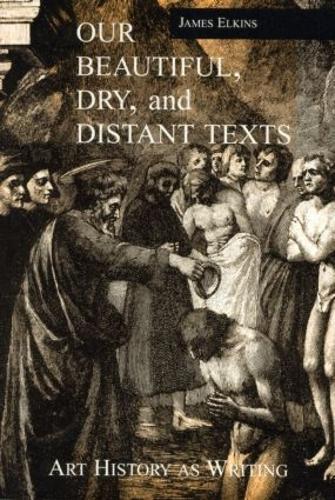
Our Beautiful, Dry and Distant Texts examines art historical writing as an expressive medium, capable of emotion and reflection - and therefore deserving of serious consideration for its own sake, as the testament of art history and of individual historians. Drawing on analyses of texts by Derrida, Deleuze, and other leading critics, as well as illustrations of artworks from various cultures, Elkins constructs an eloquent plea for circumspection in the entire endeavour of trying to force images into words, and in the curious vocation of writing the history of art.
Full Product Details
Author: James Elkins (School of the Art Institute of Chicago, USA)
Publisher: Taylor & Francis Ltd
Imprint: Routledge
Edition: New edition
Dimensions:
Width: 15.20cm
, Height: 2.00cm
, Length: 22.90cm
Weight: 0.600kg
ISBN: 9780415926638
ISBN 10: 0415926637
Pages: 324
Publication Date: 10 February 2000
Audience:
College/higher education
,
Professional and scholarly
,
Undergraduate
,
Postgraduate, Research & Scholarly
Format: Paperback
Publisher's Status: Out of Print
Availability: In Print

Limited stock is available. It will be ordered for you and shipped pending supplier's limited stock.
Reviews
Concerned with the rhetorical dimensions of artwriting, Elkins identifies the ways in which immediate questions about the truth of interpretation are inevitably deflected by awareness of the stylistic qualities of art historians' texts... Wildly imaginative at making connections, his highly original book inevitably will be one necessary starting point for all future discussion. -David Carrier, Carnegie Mellon University
Concerned with the rhetorical dimensions of artwriting, Elkins identifies the ways in which immediate questions about the truth of interpretation are inevitably deflected by awareness of the stylistic qualities of art historians' texts... Wildly imaginative at making connections, his highly original book inevitably will be one necessary starting point for all future discussion. <br>-David Carrier, Carnegie Mellon University <br>
Concerned with the rhetorical dimensions of artwriting, Elkins identifies the ways in which immediate questions about the truth of interpretation are inevitably deflected by awareness of the stylistic qualities of art historians' texts... Wildly imaginative at making connections, his highly original book inevitably will be one necessary starting point for all future discussion. -David Carrier, Carnegie Mellon University
Author Information
James Elkins is Professor of Art History, Theory and Criticism at the School of the Art Institute of Chicago. He is the author of many books, including How to Use YourEyes (1999), What Painting Is (1998), and Why are OurPictures Puzzles? (1999), all published by Routledge.