Overview
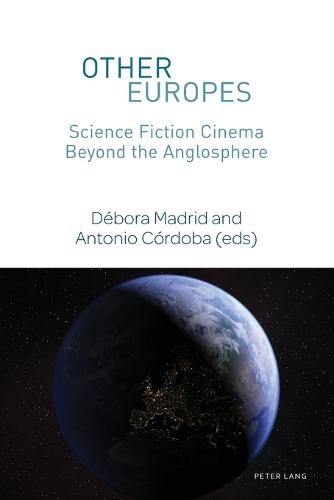
This volume analyzes how science fiction tropes are used by non-Anglophone European filmmakers to explore national and global issues. The essays participate in the increasingly productive scholarly discussion of how speculative aesthetics helps us understand our present and envision possible futures. They explore how science fiction films from these societies tackle a wide range of modern and contemporary topics, from the actual possibility of human-made planetary apocalypse to the tension of the Cold War, outer space exploration, new discourses on colonialism, gender and sexualities, formulation of new transhumanist and posthumanist identities, and more. The films analyzed in this volume come from more than a dozen European countries and were produced from the 1960s to the 2010s.
Full Product Details
Author: Débora Madrid , Antonio Córdoba
Publisher: Peter Lang International Academic Publishers
Imprint: Peter Lang International Academic Publishers
Edition: New edition
Volume: 4
Weight: 0.570kg
ISBN: 9781803744100
ISBN 10: 1803744103
Pages: 384
Publication Date: 10 March 2026
Audience:
Professional and scholarly
,
Professional & Vocational
Format: Paperback
Publisher's Status: Active
Availability: Manufactured on demand 
We will order this item for you from a manufactured on demand supplier.
Table of Contents
Introduction, Débora Madrid and Antonio Córdoba - Part I Reimagining the Future, Reimagining the Nation - Futurology, Ideology, and the Grotesque: Polish Cinematic Adaptations of Stanisław Lem’s Works (1959-1989), Dariusz Brzostek - Strange Adventures in Socialist Television: on a 1973 Popular Hungarian Science Fiction-Cartoon Series, Áron Domokos - Fantascienza all’italiana: Sci-Fi Tropes and Social Criticism in 1960s Italian Cinema, Stefano Oddi - Transnational Parody in Turkish Science Fiction: Cem Yılmaz and G.O.R.A. (2004), Ada Beliz Özduran, Colleen Kennedy-Karpat - Part II Gendered, Posthuman and Non-Human Subjectivities - An Alien Gaze on Female Bodies: Two European Coproductions in the Context of Spanish Cinema, Débora Madrid - Oppressing the Other: Non-normativity in Swedish Speculative Fiction The Unliving and Borders, María Gil Poisa - Post-Yugoslav Sci-Fi Cinema: Machines, Monsters, and Traumatic Memory in the “Other Europe”, Dragoslav Momcilovic - What She doesn’t See When She Closes Her Eyes: Retro to the Women’s Future in Eva by Kike Maíllo, María José Gutiérrez - Life Extensions and Posthuman Endings in Cargo and Oxygen, Julia A. Empey -Masculinity, Transhumanism, and the Gothic in Pedro Almodóvar’s The Skin I Live In, Antonio Córdoba - Part III History and Dystopia - The Representation of the Factory in 1960s Italian Science Fiction Cinema: From Omicron (1963) to H2S (1969), Daniele Comberati - Chronicles of the Dystopian: Yugoslav Sci-fi Cinema, Tijana Rupcic -Post-apocalyptic noir and pessimism as critique in Nikos Nikolaidis’ Morning Patrol (1987), Evdokia Stefanopoulou - Part IV Extinction and Survival - The Prototype of the (Post-) Apocalyptic Film: August Blom’s The End of the World as a Grand Finale to Political Ideologies?, Dirk Hoyer - Narratives of Human Extinction in Late-Soviet Russophone Science Fiction, Maya Vinokour - Arthouse or Adventure: The Post-Apocalyptic Survival Narrative in Die Wand (2012), Steffen Hantke - Return to the Seed: The Eco-Dystopia Imagined by Bigas Luna for Second Origin (2015), Gonzalo M. Pavés
Reviews
Author Information
Débora Madrid is Associate Professor in Fine Arts at Universidad de La Laguna (Spain). Her research interests include science fiction film, Spanish film, contemporary art and visual culture. She is also the author of the monograph Creaciones (In)humanas. Alteraciones y suplantaciones del ser humano en el cine español (2023). Antonio Córdoba is a teacher of Spanish as a second language and Spanish and Latin American cultures. He was previously a professor of Iberian and Latin American studies and has published on Latin American modern and contemporary literature, Utopian studies, the fantastic, and science fiction. His most recent book is the co-edited collection Posthumanism and Latin(x) American Science Fiction (2023).
Tab Content 6
Author Website:
Countries Available
All regions
|