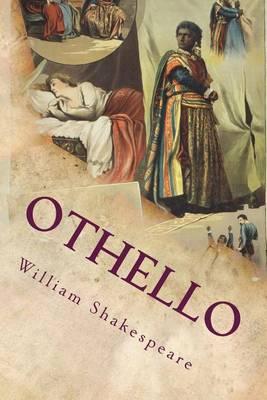
Overview
The most beautiful aspect of the play is Iago's ingenious deception of Othello. In every phrase, Iago knows just what to say to swing his Moor closer to the belief in Desdemona's infidelity. The subtle strategist to his general (and the puppeteer to Roderigo and Cassio), Iago is in full glory practicing his art of insinuation. Iago is the master of duplicity. However, while in Macbeth the devious instruments of darkness were netherworldly creatures, here Iago himself takes on devil's work. Treachery plays here the most insidious part: it lays the ground for murder. Treachery itself takes its roots in hatred. While Richard III and Macbeth are murderers for their own advancement, Iago's guiding star in his hunt is hatred. His I hate the Moor at the end of the 1st act, breaking the flow of the soliloquy in which he derides Roderigo is the essence of Iago in a line. The reasons for his hatred are not as clear cut. Iago knows that his being cuckolded by Othello is a mere suspicion (but willfully decides that he does not want to know for sure and will act as if it were true). This is his private (false) excuse for hating Othello. His public one, or at least the one he presents to Roderigo, is having been passed over in the pecking order of military ranking. But he only gives this argument to Roderigo and never repeats it in any soliloquies. With all his hatred and scheming, Iago is another spectacular Shakespearean villain endowed with inspired language. His art of intrigue ensures him a place among Shakespeare's leading characters (villains for the most part) and will entertain our enduring fascination with human nature's dark side...
Full Product Details
Author: William Shakespeare
Publisher: Createspace
Imprint: Createspace
Dimensions:
Width: 15.20cm
, Height: 0.70cm
, Length: 22.90cm
Weight: 0.177kg
ISBN: 9781463728519
ISBN 10: 1463728514
Pages: 126
Publication Date: 14 July 2011
Format: Paperback
Publisher's Status: Active
Availability: Available To Order

We have confirmation that this item is in stock with the supplier. It will be ordered in for you and dispatched immediately.
Author Information
William Shakespeare (1564-1616) was an English poet and playwright, widely regarded as the greatest writer in the English language and the world's pre-eminent dramatist. He is often called England's national poet and the Bard of Avon. His surviving works, including some collaborations, consist of about 38 plays, 154 sonnets, two long narrative poems, and several other poems. His plays have been translated into every major living language and are performed more often than those of any other playwright. Shakespeare was born and raised in Stratford-upon-Avon. At the age of 18, he married Anne Hathaway, with whom he had three children: Susanna, and twins Hamnet and Judith. Between 1585 and 1592, he began a successful career in London as an actor, writer, and part owner of a playing company called the Lord Chamberlain's Men, later known as the King's Men. He appears to have retired to Stratford around 1613, where he died three years later. Shakespeare produced most of his known work between 1589 and 1613. His early plays were mainly comedies and histories, genres he raised to the peak of sophistication and artistry by the end of the 16th century. He then wrote mainly tragedies until about 1608, including Hamlet, King Lear, and Macbeth, considered some of the finest works in the English language. In his last phase, he wrote tragicomedies, also known as romances, and collaborated with other playwrights. Many of his plays were published in editions of varying quality and accuracy during his lifetime. In 1623, two of his former theatrical colleagues published the First Folio, a collected edition of his dramatic works that included all but two of the plays now recognised as Shakespeare's. Shakespeare was a respected poet and playwright in his own day, but his reputation did not rise to its present heights until the 19th century. The Romantics, in particular, acclaimed Shakespeare's genius, and the Victorians worshipped Shakespeare with a reverence that George Bernard Shaw called bardolatry. In the 20th century, his work was repeatedly adopted and rediscovered by new movements in scholarship and performance. His plays remain highly popular today and are constantly studied, performed and reinterpreted in diverse cultural and political contexts throughout the world.