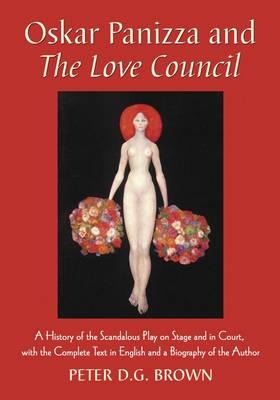
Full Product Details
Author: Peter D.G. Brown
Publisher: McFarland & Co Inc
Imprint: McFarland & Co Inc
Dimensions:
Width: 17.80cm
, Height: 1.50cm
, Length: 25.40cm
Weight: 0.499kg
ISBN: 9780786442737
ISBN 10: 0786442735
Pages: 292
Publication Date: 31 March 2010
Recommended Age: From 18 years
Audience:
Professional and scholarly
,
Professional & Vocational
Format: Paperback
Publisher's Status: Active
Availability: In Print

This item will be ordered in for you from one of our suppliers. Upon receipt, we will promptly dispatch it out to you. For in store availability, please contact us.
Reviews
"""[T]his scandalous play was not just banned time and again, it has also been republished again and again--and translated into foreign languages. A new English translation has now been presented by the renowned Panizza scholar Peter D.G. Brown, who only recently gained prominence with the publication of the facsimile edition of the play's manuscript. Like the former publication, his translation is welcome in several respects. First of all, Oreste Pucciani's 1973 translation has been out of print for some time. Brown is the first to have consulted Panizza's 1893 manuscript of the work. Additionally, the current volume contains all the key material on the play, along with extensive and updated supplemental material on its author, including documents and information regarding the numerous court proceedings initiated against The Love Council, its contemporary and later reception, as well as a performance history. It can only be hoped that this book will find numerous readers in England and especially in the United States, which, as Brown noted with a touch of irony, is a relatively enlightened and advanced country.""--Rolf L�chel, Philipps-Universit�t, Marburg, Germany, literaturkritik.de; ""[This] new English translation of The Love Council, along with contextual materials, is superior to previous English versions because it is the first to be based on the 1893 manuscript of the play. Possessing profound knowledge of his source material, especially of the many linguistic peculiarities and irregularities of the author (apparent, for example, in Panizza's increasing use of sometimes bizarre orthographical forms), Brown has mastered the difficult task of translating the drama's text into comprehensible English, and, despite an inevitable degree of standardization, he still manages to preserve many of the characteristics of the original. The volume also includes a fairly detailed biography of the author as well as material on Panizza's trials and the worldwide reception and stage history of the play (with some photographs). Brown's edition reveals not only Panizza's personal eccentricities but also his polemic and artistic energy, which he used to protest manically against obscurantism, the Catholic Church and its followers, opportunism, sexual inhibitions, and a hypocritical bourgeoisie that he saw as concentrated in Munich. The edition also documents Panizza's attempt to overcome the traditional theatre, which he regarded as obsolete. In ways similar to those of Wedekind and early Brecht, he tried to do so by systematically integrating versatile forms, such as parody, satire, caricature, variety show, cabaret, vaudeville, and commedia dell'arte. Thanks to a skillful selection of texts, Brown manages to trace Panizza's development from naturalism, the first explicitly modernist literary movement in Europe, to an innovative combination of heterogeneous elements from so-called low and high culture.""--Johannes G. Pankau, Universit�t Oldenburg, Modern Drama."
[T]his scandalous play was not just banned time and again, it has also been republished again and again--and translated into foreign languages. A new English translation has now been presented by the renowned Panizza scholar Peter D.G. Brown, who only recently gained prominence with the publication of the facsimile edition of the play's manuscript. Like the former publication, his translation is welcome in several respects. First of all, Oreste Pucciani's 1973 translation has been out of print for some time. Brown is the first to have consulted Panizza's 1893 manuscript of the work. Additionally, the current volume contains all the key material on the play, along with extensive and updated supplemental material on its author, including documents and information regarding the numerous court proceedings initiated against <i>The Love Council</i>, its contemporary and later reception, as well as a performance history. It can only be hoped that this book will find numerous readers in England and especially in the United States, which, as Brown noted with a touch of irony, is a relatively enlightened and advanced country. --Rolf Lochel, Philipps-Universitat, Marburg, Germany, <i>literaturkritik.de</i>; [This] new English translation of <i>The Love Council</i>, along with contextual materials, is superior to previous English versions because it is the first to be based on the 1893 manuscript of the play. Possessing profound knowledge of his source material, especially of the many linguistic peculiarities and irregularities of the author (apparent, for example, in Panizza's increasing use of sometimes bizarre orthographical forms), Brown has mastered the difficult task of translating the drama's text into comprehensible English, and, despite an inevitable degree of standardization, he still manages to preserve many of the characteristics of the original. The volume also includes a fairly detailed biography of the author as well as material on Panizza's trials and the worldwide reception and stage history of the play (with some photographs). Brown's edition reveals not only Panizza's personal eccentricities but also his polemic and artistic energy, which he used to protest manically against obscurantism, the Catholic Church and its followers, opportunism, sexual inhibitions, and a hypocritical bourgeoisie that he saw as concentrated in Munich. The edition also documents Panizza's attempt to overcome the traditional theatre, which he regarded as obsolete. In ways similar to those of Wedekind and early Brecht, he tried to do so by systematically integrating versatile forms, such as parody, satire, caricature, variety show, cabaret, vaudeville, and <i>commedia dell'arte</i>. Thanks to a skillful selection of texts, Brown manages to trace Panizza's development from naturalism, the first explicitly modernist literary movement in Europe, to an innovative combination of heterogeneous elements from so-called low and high culture. --Johannes G. Pankau, Universitat Oldenburg, <i>Modern Drama</i>.
[T]his scandalous play was not just banned time and again, it has also been republished again and again--and translated into foreign languages. A new English translation has now been presented by the renowned Panizza scholar Peter D.G. Brown, who only recently gained prominence with the publication of the facsimile edition of the play's manuscript. Like the former publication, his translation is welcome in several respects. First of all, Oreste Pucciani's 1973 translation has been out of print for some time. Brown is the first to have consulted Panizza's 1893 manuscript of the work. Additionally, the current volume contains all the key material on the play, along with extensive and updated supplemental material on its author, including documents and information regarding the numerous court proceedings initiated against The Love Council, its contemporary and later reception, as well as a performance history. It can only be hoped that this book will find numerous readers in England and especially in the United States, which, as Brown noted with a touch of irony, is a relatively enlightened and advanced country. --Rolf Loechel, Philipps-Universitat, Marburg, Germany, literaturkritik.de; [This] new English translation of The Love Council, along with contextual materials, is superior to previous English versions because it is the first to be based on the 1893 manuscript of the play. Possessing profound knowledge of his source material, especially of the many linguistic peculiarities and irregularities of the author (apparent, for example, in Panizza's increasing use of sometimes bizarre orthographical forms), Brown has mastered the difficult task of translating the drama's text into comprehensible English, and, despite an inevitable degree of standardization, he still manages to preserve many of the characteristics of the original. The volume also includes a fairly detailed biography of the author as well as material on Panizza's trials and the worldwide reception and stage history of the play (with some photographs). Brown's edition reveals not only Panizza's personal eccentricities but also his polemic and artistic energy, which he used to protest manically against obscurantism, the Catholic Church and its followers, opportunism, sexual inhibitions, and a hypocritical bourgeoisie that he saw as concentrated in Munich. The edition also documents Panizza's attempt to overcome the traditional theatre, which he regarded as obsolete. In ways similar to those of Wedekind and early Brecht, he tried to do so by systematically integrating versatile forms, such as parody, satire, caricature, variety show, cabaret, vaudeville, and commedia dell'arte. Thanks to a skillful selection of texts, Brown manages to trace Panizza's development from naturalism, the first explicitly modernist literary movement in Europe, to an innovative combination of heterogeneous elements from so-called low and high culture. --Johannes G. Pankau, Universitat Oldenburg, Modern Drama.
[T]his scandalous play was not just banned time and again, it has also been republished again and again--and translated into foreign languages. A new English translation has now been presented by the renowned Panizza scholar Peter D.G. Brown, who only recently gained prominence with the publication of the facsimile edition of the play's manuscript. Like the former publication, his translation is welcome in several respects. First of all, Oreste Pucciani's 1973 translation has been out of print for some time. Brown is the first to have consulted Panizza's 1893 manuscript of the work. Additionally, the current volume contains all the key material on the play, along with extensive and updated supplemental material on its author, including documents and information regarding the numerous court proceedings initiated against The Love Council, its contemporary and later reception, as well as a performance history. It can only be hoped that this book will find numerous readers in England and especially in the United States, which, as Brown noted with a touch of irony, is a relatively enlightened and advanced country. --Rolf L chel, Philipps-Universit t, Marburg, Germany, literaturkritik.de; [This] new English translation of The Love Council, along with contextual materials, is superior to previous English versions because it is the first to be based on the 1893 manuscript of the play. Possessing profound knowledge of his source material, especially of the many linguistic peculiarities and irregularities of the author (apparent, for example, in Panizza's increasing use of sometimes bizarre orthographical forms), Brown has mastered the difficult task of translating the drama's text into comprehensible English, and, despite an inevitable degree of standardization, he still manages to preserve many of the characteristics of the original. The volume also includes a fairly detailed biography of the author as well as material on Panizza's trials and the worldwide reception and stage history of the play (with some photographs). Brown's edition reveals not only Panizza's personal eccentricities but also his polemic and artistic energy, which he used to protest manically against obscurantism, the Catholic Church and its followers, opportunism, sexual inhibitions, and a hypocritical bourgeoisie that he saw as concentrated in Munich. The edition also documents Panizza's attempt to overcome the traditional theatre, which he regarded as obsolete. In ways similar to those of Wedekind and early Brecht, he tried to do so by systematically integrating versatile forms, such as parody, satire, caricature, variety show, cabaret, vaudeville, and commedia dell'arte. Thanks to a skillful selection of texts, Brown manages to trace Panizza's development from naturalism, the first explicitly modernist literary movement in Europe, to an innovative combination of heterogeneous elements from so-called low and high culture. --Johannes G. Pankau, Universit t Oldenburg, Modern Drama.
"""[T]his scandalous play was not just banned time and again, it has also been republished again and again--and translated into foreign languages. A new English translation has now been presented by the renowned Panizza scholar Peter D.G. Brown, who only recently gained prominence with the publication of the facsimile edition of the play's manuscript. Like the former publication, his translation is welcome in several respects. First of all, Oreste Pucciani's 1973 translation has been out of print for some time. Brown is the first to have consulted Panizza's 1893 manuscript of the work. Additionally, the current volume contains all the key material on the play, along with extensive and updated supplemental material on its author, including documents and information regarding the numerous court proceedings initiated against The Love Council, its contemporary and later reception, as well as a performance history. It can only be hoped that this book will find numerous readers in England and especially in the United States, which, as Brown noted with a touch of irony, is a relatively enlightened and advanced country.""--Rolf Löchel, Philipps-Universität, Marburg, Germany, literaturkritik.de; ""[This] new English translation of The Love Council, along with contextual materials, is superior to previous English versions because it is the first to be based on the 1893 manuscript of the play. Possessing profound knowledge of his source material, especially of the many linguistic peculiarities and irregularities of the author (apparent, for example, in Panizza's increasing use of sometimes bizarre orthographical forms), Brown has mastered the difficult task of translating the drama's text into comprehensible English, and, despite an inevitable degree of standardization, he still manages to preserve many of the characteristics of the original. The volume also includes a fairly detailed biography of the author as well as material on Panizza's trials and the worldwide reception and stage history of the play (with some photographs). Brown's edition reveals not only Panizza's personal eccentricities but also his polemic and artistic energy, which he used to protest manically against obscurantism, the Catholic Church and its followers, opportunism, sexual inhibitions, and a hypocritical bourgeoisie that he saw as concentrated in Munich. The edition also documents Panizza's attempt to overcome the traditional theatre, which he regarded as obsolete. In ways similar to those of Wedekind and early Brecht, he tried to do so by systematically integrating versatile forms, such as parody, satire, caricature, variety show, cabaret, vaudeville, and commedia dell'arte. Thanks to a skillful selection of texts, Brown manages to trace Panizza's development from naturalism, the first explicitly modernist literary movement in Europe, to an innovative combination of heterogeneous elements from so-called low and high culture.""--Johannes G. Pankau, Universität Oldenburg, Modern Drama."