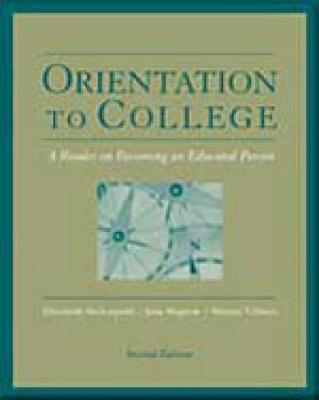
Orientation to College: A Reader

Author:   Sharon Villines (SUNY, Empire State College) ,  Elizabeth Steltenpohl (SUNY, Empire State College) ,  Jane Shipton (SUNY, Empire State College)
Publisher:   Cengage Learning, Inc
Edition:   2nd edition
ISBN:  

9780534599584


Pages:   256
Publication Date:   06 May 2003
Format:   Paperback
Availability:   Awaiting stock   Availability explained


Our Price $258.59 Quantity:  
Add to Cart

Share |

Orientation to College: A Reader


Overview

Full Product Details

Author:   Sharon Villines (SUNY, Empire State College) ,  Elizabeth Steltenpohl (SUNY, Empire State College) ,  Jane Shipton (SUNY, Empire State College)
Publisher:   Cengage Learning, Inc
Imprint:   Wadsworth Publishing Co Inc
Edition:   2nd edition
Dimensions:   Width: 18.80cm , Height: 1.20cm , Length: 23.40cm
Weight:   0.420kg
ISBN:  

9780534599584


ISBN 10:   0534599583
Pages:   256
Publication Date:   06 May 2003
Audience:   Primary & secondary/elementary & high school ,  Secondary
Format:   Paperback
Publisher's Status:   Out of Print
Availability:   Awaiting stock   Availability explained

Table of Contents

1. THE PURPOSES OF COLLEGE. Introduction: What Is College? Two Essential Goals (Ernest L. Boyer). The Baccalaureate Degree: What Does It Mean? What Should It Mean? (Howard R. Bowen). What Does Society Need from Higher Education? (David R. Pierce). What Does Society Need from Higher Education? (Robert H. Atwell). The Educated Person: A Changing Ideal? (Henry J. Perkinson). Universities and Their Function (Alfred North Whitehead). Summary. 2. THE ROLE OF THE LIBERAL ARTS IN A COLLEGE EDUCATION. Introduction: Joining the Academic Conversation. The Earthly Use of a Liberal Education (A. Bartlett Giamatti). What Is an Idea? (Wayne C. Booth). The Liberal Studies (Carey W. Brush). The Purposes of a Liberal Education (Henry Rosovsky). Beyond the Machine: Liberal Education for an Information Society (Bruce E. Strasser). Having a Degree and Being Educated (Edmund D. Pellegrino). Summary. 3. EDUCATION AND THE IDEA OF CULTURE. Introduction: The Meaning of Culture. Beyond Tribalism (Laurent A. Daloz). Cultural Literacy (Alan C. Purves). An Educated and Culturally Literate Person Must Study America''''s Multicultural Reality (Ronald Takaki). Multicultural Education for Freedom''''s Sake (James A. Banks). Diversity, Community, and the University (Joan Wallach Scott). Defining a Global Perspective (Rita Weathersby). Summary. 4. EDUCATION AND PERSONAL DEVELOPMENT. Introduction: Learning and Self. Erickson''''s Eight Stages of Life (David Elkind). Maslow''''s Theory of Self-Actualization (Gerald Corey and Marianne Schneider Corey). The Life Structure and Its Development in Adulthood (Daniel Levinson). Life Stages and Learning Interests (Rita Weathersby). Individual Identity Versus Identity Confusion (Barbara M. Newman and Philip R. Newman). Summary. 5. THINKING AND LEARNING. Introduction: The Discovery of Meaning. Learning and Brain Development (National Research Council). Learning from Everyday Experience (Robert M. Smith). Developmental Foundations of Critical Thinking (Joanne Gainen Kurfiss). Learning to Make Reflective Judgements (Patricia King). Changing Concepts of Learning (Graham Gibbs). Peak Learning: The Flow State (Ronald Gross). Summary. 6. LEARNING HOW TO LEARN. Introduction: Ways of Learning. Your Preferred Learning Style (Arthur W. Chickering and Nancy K. Schlossberg). Competence in Self-Directed Learning (Malcolm S. Knowles). Exploring Self-Directedness in Learning (Stephen D. Brookfield). The Learning Group (Robert M. Smith). Collaborative Learning (Kenneth A. Bruffee). Team Learning, Dialogue, and Discussion (Peter Senge). Summary. 7. EDUCATION AND WORK. Introduction: Becoming Employable. Report of the Secretary''''s Commission on Achieving Necessary Skills (U.S. Department of Labor, Employment and Training Administration). 21st Century Workplace Trends and Their Implications (Joseph H. Boyett). Liberal Education and a New Generation of Corporate Leadership (Michael Useem). Holland''''s Theory of Vocational Personalities and Environments (Nancy C. Evans, Deanna S. Forney, and Florence Guido-DiBrito). Liberal Education, Work, and Human Development (Arthur W. Chickering). Summary.

Reviews

The readings are substantive but short; this piques students' interests without overwhelming them. The collection of readings in each chapter model diverse thought processes instead of advocating one view of an issue. This diversity is essential for moving toward increasingly complex ways of thinking.


The readings are substantive but short; this piques studentsa interests without overwhelming them. The collection of readings in each chapter model diverse thought processes instead of advocating one view of an issue. This diversity is essential for moving toward increasingly complex ways of thinking.


Author Information

Sharon Villines was educated at The Kansas City Art Institute, the University of Illinois, and Union Theological Seminary. As an artist, she understands the ways in which a strong liberal arts background contributes to her work and that of her students. Now Mentor Emeritus from SUNY Empire State College, she writes and coaches artists and others who are developing and changing careers. Elizabeth Steltenpohl earned both a Bachelor of Arts degree with a major in English and a Master of Arts with a concentration in Education at the University of Detroit. She began a career in teaching in the Detroit Public Schools. To further her career, she moved to New York and completed a doctoral degree at Teachers College, Columbia University. She susequently taught in teacher education programs at Manhattanville College and at Empire State College of the State University of New York. Ms. Steltenpohl developed a special interest in the entry experience of college students. She designed and taught a college entry course for ten years at Empire State College with her colleague Jane Shipton. Ms. Steltenpohl resides in New York City. Jane Shipton (d. 1998) held a Bachelor of Arts degree from Iowa State University and a Master of Arts degree from New York University. After experience in the fields of advertising and broadcasting, she became an administrator of student affairs at Barnard College of Columbia University and later at New York University. In the 1970's she joined the faculty of Empire State College in New York where she was Professor of Community and Human Services. She directed students in degree program planning and,with colleague Elizabeth Steltenpohl, developed and taught an innovative college entry course upon which this book is based.

Tab Content 6

Author Website:  

Countries Available

All regions
Latest Reading Guide

NOV RG 20252


Shopping Cart
Your cart is empty
Shopping cart
Mailing List