Overview
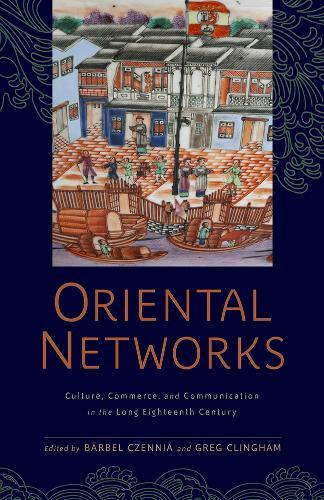
Oriental Networks explores forms of interconnectedness between Western and Eastern hemispheres during the long eighteenth century, a period of improving transportation technology, expansion of intercultural contacts, and the emergence of a global economy. In eight case studies and a substantial introduction, the volume examines relationships between individuals and institutions, precursors to modern networks that engaged in forms of intercultural exchange. Addressing the exchange of cultural commodities (plants, animals, and artifacts), cultural practices and ideas, the roles of ambassadors and interlopers, and the literary and artistic representation of networks, networkers, and networking, contributors discuss the effects on people previously separated by vast geographical and cultural distance. Rather than idealizing networks as inherently superior to other forms of organization, Oriental Networks also considers Enlightenment expressions of resistance to networking that inform modern skepticism toward the concept of the global network and its politics. In doing so the volume contributes to the increasingly global understanding of culture and communication. Published by Bucknell University Press. Distributed worldwide by Rutgers University Press.
Full Product Details
Author: Bärbel Czennia ,
Greg Clingham ,
Bärbel Czennia ,
Greg Clingham
Publisher: Bucknell University Press,U.S.
Imprint: Bucknell University Press,U.S.
Dimensions:
Width: 14.00cm
, Height: 2.50cm
, Length: 21.60cm
Weight: 0.463kg
ISBN: 9781684482726
ISBN 10: 1684482720
Pages: 340
Publication Date: 18 December 2020
Recommended Age: From 18 to 99 years
Audience:
General/trade
,
College/higher education
,
Professional and scholarly
,
General
,
Tertiary & Higher Education
Format: Hardback
Publisher's Status: Active
Availability: In Print

This item will be ordered in for you from one of our suppliers. Upon receipt, we will promptly dispatch it out to you. For in store availability, please contact us.
Reviews
"""Oriental Networks provides ample evidence that the networked worlds of the twenty-first century descend, in crucial ways, from eighteenth-century European experiments in global interconnection, both material and conceptual, with a particular focus on the East. The ambivalence of eighteenth-century orientalisms lends itself to the complex and sometimes unpredictable dynamics of transculturation and exchange within emergent paradigms of empire. These case studies invite response from non-Eurocentric sites of knowledge and thus initiate an important conversation.""--Eugenia Zuroski ""author of A Taste for China: English Subjectivity and the Prehistory of Orientalism"" ""The topic is clearly timely, as questions surrounding globalization and networks continue to be some of the most pressing of the twenty-first century. Such questions thus continue to demand historical investigation that is both substantial in its scholarship and innovative in its approach - a dual hurdle that Oriental Networks clears with ease, even panache. The editors are to be commended on their choice of contributions, which impressively encompass canonical and non-canonical writers, and contain an embarrassment of archival riches. The fact that the collection is lavishly, intelligently illustrated is a real bonus, too!""--Evan Gottlieb ""author of Romantic Globalism: British Literature and Modern World Order, 1750-1830"""
Oriental Networks provides ample evidence that the networked worlds of the twenty-first century descend, in crucial ways, from eighteenth-century European experiments in global interconnection, both material and conceptual, with a particular focus on the East. The ambivalence of eighteenth-century orientalisms lends itself to the complex and sometimes unpredictable dynamics of transculturation and exchange within emergent paradigms of empire. These case studies invite response from non-Eurocentric sites of knowledge and thus initiate an important conversation. --Eugenia Zuroski author of A Taste for China: English Subjectivity and the Prehistory of Orientalism The topic is clearly timely, as questions surrounding globalization and networks continue to be some of the most pressing of the twenty-first century. Such questions thus continue to demand historical investigation that is both substantial in its scholarship and innovative in its approach - a dual hurdle that Oriental Networks clears with ease, even panache. The editors are to be commended on their choice of contributions, which impressively encompass canonical and non-canonical writers, and contain an embarrassment of archival riches. The fact that the collection is lavishly, intelligently illustrated is a real bonus, too! --Evan Gottlieb author of Romantic Globalism: British Literature and Modern World Order, 1750-1830
The topic is clearly timely, as questions surrounding globalization and networks continue to be some of the most pressing of the twenty-first century. Such questions thus continue to demand historical investigation that is both substantial in its scholarship and innovative in its approach - a dual hurdle that Oriental Networks clears with ease, even panache. The editors are to be commended on their choice of contributions, which impressively encompass canonical and non-canonical writers, and contain an embarrassment of archival riches. The fact that the collection is lavishly, intelligently illustrated is a real bonus, too! --Evan Gottlieb author of Romantic Globalism: British Literature and Modern World Order, 1750-1830 Oriental Networks provides ample evidence that the networked worlds of the twenty-first century descend, in crucial ways, from eighteenth-century European experiments in global interconnection, both material and conceptual, with a particular focus on the East. The ambivalence of eighteenth-century orientalisms lends itself to the complex and sometimes unpredictable dynamics of transculturation and exchange within emergent paradigms of empire. These case studies invite response from non-Eurocentric sites of knowledge and thus initiate an important conversation. --Eugenia Zuroski author of A Taste for China: English Subjectivity and the Prehistory of Orientalism
Author Information
BÄRBEL CZENNIA has served as associate professor of English at McNeese State University in Lake Charles, Louisiana, and as tenured senior lecturer of English literature at Georg-August-UniversitÄt GÖttingen, Germany, for more than 25 years. She is the author or editor of many essays and two books, including Celebrities: The Idiom of a Modern Era. GREG CLINGHAM is emeritus professor of English at Bucknell University, a life member of Clare Hall, Cambridge, and the author or editor of ten books, including Johnson, Writing, and Memory. From 1996 to 2018, he was director of the Bucknell University Press.