Overview
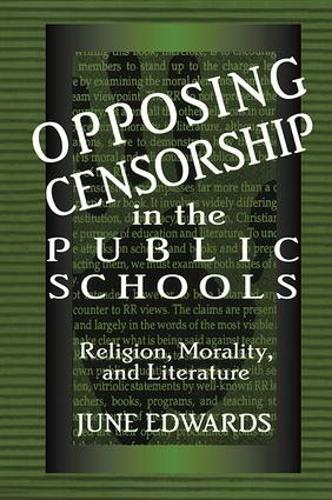
In the past several years, hundreds of challenges a year to books used in public schools have been reported across the nation. Most of these have come from the Religious Right. This book confronts the attacks on public education and commonly used literature books by challenging the religious assumptions, the biblical interpretations, and the intimidation tactics of the Religious Right. Part I counters the claims of these censors by presenting opposing views on democracy, secular humanism, religion, the Bible, morality, and the purposes of literature. In Part II, six books frequently taught in high school classes are analyzed. Edwards shows why they have been challenged by the Religious Right, and presents a case for their moral and religious virtues as well as their literary worth. The book differs from other anti-censorship works because it deals primarily and directly with the religious and moral aspects that educators often tend to avoid. This book offers teachers and school administrators scholarly conterarguments that can help confront with literature challenges from the Religious Right.
Full Product Details
Author: June Edwards
Publisher: Taylor & Francis Ltd
Imprint: Routledge
Weight: 0.453kg
ISBN: 9781138423343
ISBN 10: 1138423343
Pages: 174
Publication Date: 11 July 2017
Audience:
Professional and scholarly
,
Professional & Vocational
Format: Hardback
Publisher's Status: Active
Availability: In Print

This item will be ordered in for you from one of our suppliers. Upon receipt, we will promptly dispatch it out to you. For in store availability, please contact us.
Reviews
""...well balanced, thoughtful, and informative."" —CHOICE ""Edwards cuts through the smoke-screen rhetoric of Religious Right censors and clarifies the overriding purposes, attitudes, and arguments that drive their challenges against public schools and books; she quotes meaningfully from Religious Right spokespersons to present their case, including their use of biblical references. She builds the case against these positions and arguments forthrightly and fully; her point-counterpoint structure is expressive and effective as is her use of biblical references to support her arguments....The organization of the whole volume and interior structure allows readers easy access into the material, even if they do not have much prior experience."" —Nicholas J. Karolides University of Wisconsin, River Falls ""Helps teachers and administrators defend works of literature against charges by censors that the works are harmful to students....Addresses major issues first and then applies that thinking to particular texts....I can imagine teachers consulting the chapters on individual books....And I think a principal might find them useful when asked to defend a teacher's choice."" —Daniel Sheridan University of North Dakota ""No one else has approached the problem of censorship this way in a book....Edwards certainly is high up among the commentators on censorship and may be the leading person on censorship and biblical issues and biblical morality....A marvelous book."" —Ken Donelson Arizona State University ""This book can become the definitive look at the problem....The scholarship is especially impressive, particularly in the fact that the author allows the censors to speak in their own words....The topic is a vital one for students in teacher education, library education, educational administration, book publishing and selling....lawyers and law makers, the clergy, and really, any educated person. The fact that this book is so clearly written and inviting in style will make it usable with readers at many levels of sophistication."" —Robert C. Small, Jr. Radford University ""An important book....Useful for teachers, school board members, attorneys, schools of education, and journalists."" —Daniel C. Maquire Marquette University
...well balanced, thoughtful, and informative. -CHOICE Edwards cuts through the smoke-screen rhetoric of Religious Right censors and clarifies the overriding purposes, attitudes, and arguments that drive their challenges against public schools and books; she quotes meaningfully from Religious Right spokespersons to present their case, including their use of biblical references. She builds the case against these positions and arguments forthrightly and fully; her point-counterpoint structure is expressive and effective as is her use of biblical references to support her arguments....The organization of the whole volume and interior structure allows readers easy access into the material, even if they do not have much prior experience. -Nicholas J. Karolides University of Wisconsin, River Falls Helps teachers and administrators defend works of literature against charges by censors that the works are harmful to students....Addresses major issues first and then applies that thinking to particular texts....I can imagine teachers consulting the chapters on individual books....And I think a principal might find them useful when asked to defend a teacher's choice. -Daniel Sheridan University of North Dakota No one else has approached the problem of censorship this way in a book....Edwards certainly is high up among the commentators on censorship and may be the leading person on censorship and biblical issues and biblical morality....A marvelous book. -Ken Donelson Arizona State University This book can become the definitive look at the problem....The scholarship is especially impressive, particularly in the fact that the author allows the censors to speak in their own words....The topic is a vital one for students in teacher education, library education, educational administration, book publishing and selling....lawyers and law makers, the clergy, and really, any educated person. The fact that this book is so clearly written and inviting in style will make it usable with readers at many levels of sophistication. -Robert C. Small, Jr. Radford University An important book....Useful for teachers, school board members, attorneys, schools of education, and journalists. -Daniel C. Maquire Marquette University
"""...well balanced, thoughtful, and informative."" —CHOICE ""Edwards cuts through the smoke-screen rhetoric of Religious Right censors and clarifies the overriding purposes, attitudes, and arguments that drive their challenges against public schools and books; she quotes meaningfully from Religious Right spokespersons to present their case, including their use of biblical references. She builds the case against these positions and arguments forthrightly and fully; her point-counterpoint structure is expressive and effective as is her use of biblical references to support her arguments....The organization of the whole volume and interior structure allows readers easy access into the material, even if they do not have much prior experience."" —Nicholas J. Karolides University of Wisconsin, River Falls ""Helps teachers and administrators defend works of literature against charges by censors that the works are harmful to students....Addresses major issues first and then applies that thinking to particular texts....I can imagine teachers consulting the chapters on individual books....And I think a principal might find them useful when asked to defend a teacher's choice."" —Daniel Sheridan University of North Dakota ""No one else has approached the problem of censorship this way in a book....Edwards certainly is high up among the commentators on censorship and may be the leading person on censorship and biblical issues and biblical morality....A marvelous book."" —Ken Donelson Arizona State University ""This book can become the definitive look at the problem....The scholarship is especially impressive, particularly in the fact that the author allows the censors to speak in their own words....The topic is a vital one for students in teacher education, library education, educational administration, book publishing and selling....lawyers and law makers, the clergy, and really, any educated person. The fact that this book is so clearly written and inviting in style will make it usable with readers at many levels of sophistication."" —Robert C. Small, Jr. Radford University ""An important book....Useful for teachers, school board members, attorneys, schools of education, and journalists."" —Daniel C. Maquire Marquette University"