Overview
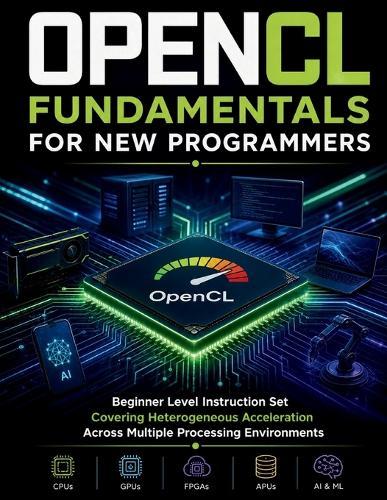
Have you ever wondered how modern applications manage to run complex computations so quickly across different types of hardware? What really happens behind the scenes when your CPU and GPU seem to ""work together"" effortlessly? And more importantly-have you ever asked yourself how you could actually harness that power as a beginner without feeling overwhelmed? OpenCL Fundamentals for New Programmers invites you into that exact conversation. Instead of throwing you into a sea of jargon, it starts by asking the same questions you might already be thinking. What is heterogeneous computing, really? Why does it matter? And how can you, as someone new to this space, begin to use it confidently? This book doesn't assume you already know the answers. It walks with you step by step, breaking down the core ideas behind OpenCL in a way that feels approachable and logical. You'll explore how different processing environments-CPUs, GPUs, and other accelerators-can be coordinated to handle tasks more efficiently. But rather than simply telling you what happens, it constantly nudges you to think: why does this approach work better? What changes when tasks are distributed? How do these decisions impact performance? As you move forward, you'll begin to see patterns emerge. You'll question how data moves between systems, how kernels are structured, and how execution models are designed. Ever been curious why some programs scale beautifully across hardware while others struggle? Or why certain workloads benefit more from parallelization than others? This guide doesn't just give you definitions-it helps you connect those dots. What makes this journey different is its focus on clarity without oversimplification. You're not shielded from real concepts-you're guided through them. Each section builds naturally on the last, encouraging you to pause and reflect. Does this make sense? Can you see how this applies to real-world problems? Could you begin to experiment with this yourself? And what about the practical side? How do you actually begin writing OpenCL programs? How do you structure your code so that it communicates effectively with multiple devices? The book anticipates these questions and meets you right there, offering structured explanations that help you move from curiosity to capability. You might even find yourself thinking ahead. Once you understand these fundamentals, what could you build? Faster simulations? More responsive applications? Efficient data processing systems? The possibilities begin to feel less abstract and more within reach. By the time you reach the later chapters, you won't just be following along-you'll be thinking critically. You'll start asking your own questions about optimization, performance trade-offs, and system design. And that's where real growth begins. So, where do you want to go with your programming skills? Do you want to stay within familiar limits, or are you ready to explore the power of computing beyond a single processor? If you've been waiting for a guide that speaks your language while still challenging you to think deeper, this is your moment. OpenCL Fundamentals for New Programmers is more than an introduction-it's an invitation to think differently about how programs run and how you can control that process. Are you ready to stop wondering and start building? Then turn the page and begin your journey today.
Full Product Details
Author: Julien S Roderic
Publisher: Independently Published
Imprint: Independently Published
Dimensions:
Width: 21.60cm
, Height: 1.10cm
, Length: 27.90cm
Weight: 0.508kg
ISBN: 9798195670580
Pages: 214
Publication Date: 05 May 2026
Audience:
General/trade
,
General
Format: Paperback
Publisher's Status: Active
Availability: Available To Order

We have confirmation that this item is in stock with the supplier. It will be ordered in for you and dispatched immediately.