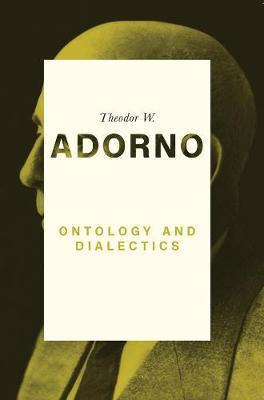
Overview
Adorno’s lectures on ontology and dialectics from 1960–61 comprise his most sustained and systematic analysis of Heidegger’s philosophy. They also represent a continuation of a project that he shared with Walter Benjamin – ‘to demolish Heidegger’. Following the publication of the latter’s magnum opus Being and Time, and long before his notorious endorsement of Nazism at Freiburg University, both Adorno and Benjamin had already rejected Heidegger’s fundamental ontology. After his return to Germany from his exile in the United States, Adorno became Heidegger’s principal intellectual adversary, engaging more intensively with his work than with that of any other contemporary philosopher. Adorno regarded Heidegger as an extremely limited thinker and for that reason all the more dangerous. In these lectures, he highlights Heidegger’s increasing fixation with the concept of ontology to show that the doctrine of being can only truly be understood through a process of dialectical thinking. Rather than exploiting overt political denunciation, Adorno deftly highlights the connections between Heidegger’s philosophy and his political views and, in doing so, offers an alternative plea for enlightenment and rationality. These seminal lectures, in which Adorno dissects the thought of one of the most influential twentieth-century philosophers, will appeal to students and scholars in philosophy and critical theory and throughout the humanities and social sciences.
Full Product Details
Author: Theodor W. Adorno (Frankfurt School) ,
Nick Walker
Publisher: John Wiley and Sons Ltd
Imprint: Polity Press
Dimensions:
Width: 15.00cm
, Height: 3.10cm
, Length: 22.60cm
Weight: 0.658kg
ISBN: 9780745693125
ISBN 10: 0745693121
Pages: 384
Publication Date: 23 November 2018
Audience:
Professional and scholarly
,
Professional & Vocational
Format: Hardback
Publisher's Status: Active
Availability: Available To Order

We have confirmation that this item is in stock with the supplier. It will be ordered in for you and dispatched immediately.
Reviews
`Ontology and Dialectics is a work of the highest importance. These lectures allow us not only to gain a clearer understanding of Adorno's critique of Heidegger but also to understand more fully the project of a German-Jewish thinker who, having returned to Germany after the Second World War, wonders if philosophy after Auschwitz is still possible. The course shows Adorno developing and assembling many of the major concepts that would inform the mature phase of his thinking, right up to his untimely death in August 1969.' Gerhard Richter, Brown University
'Ontology and Dialectics is a work of the highest importance. These lectures allow us not only to gain a clearer understanding of Adorno's critique of Heidegger but also to understand more fully the project of a German-Jewish thinker who, having returned to Germany after the Second World War, wonders if philosophy after Auschwitz is still possible. The course shows Adorno developing and assembling many of the major concepts that would inform the mature phase of his thinking, right up to his untimely death in August 1969.' Gerhard Richter, Brown University Adorno's wider remarks about heteronomous thinking and the inimical socio-political effects this can have are of vital importance. Marx & Philosophy Review of Books
'Ontology and Dialectics is a work of the highest importance. These lectures allow us not only to gain a clearer understanding of Adorno's critique of Heidegger, but also to understand more fully the project of a German-Jewish thinker who, having returned to Germany after World War II, wonders if philosophy after Auschwitz is still possible. The course shows Adorno developing and assembling many of the major concepts that would inform the mature phase of his thinking, right up to his untimely death in August 1969.' Gerhard Richter, Brown University
‘Ontology and Dialectics is a work of the highest importance. These lectures allow us not only to gain a clearer understanding of Adorno’s critique of Heidegger but also to understand more fully the project of a German-Jewish thinker who, having returned to Germany after the Second World War, wonders if philosophy “after Auschwitz” is still possible. The course shows Adorno developing and assembling many of the major concepts that would inform the mature phase of his thinking, right up to his untimely death in August 1969.’ Gerhard Richter, Brown University “Adorno’s wider remarks about heteronomous thinking and the inimical socio-political effects this can have are of vital importance.” Marx & Philosophy Review of Books
Author Information
Theodor W. Adorno (1903–1969), a prominent member of the Frankfurt School, was one of the most influential thinkers of the twentieth century in the areas of social theory, philosophy and aesthetics.