Full Product Details
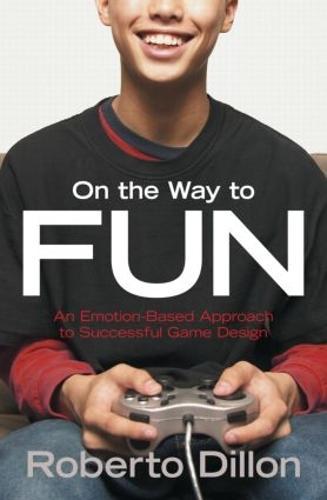
Author: Roberto Dillon
Publisher: Taylor & Francis Inc
Imprint: A K Peters
Dimensions:
Width: 13.30cm
, Height: 1.30cm
, Length: 20.30cm
Weight: 0.249kg
ISBN: 9781568815824
ISBN 10: 1568815824
Pages: 200
Publication Date: 08 March 2010
Audience:
Professional and scholarly
,
College/higher education
,
Professional & Vocational
,
Tertiary & Higher Education
Format: Paperback
Publisher's Status: Active
Availability: In Print

This item will be ordered in for you from one of our suppliers. Upon receipt, we will promptly dispatch it out to you. For in store availability, please contact us.
Reviews
On the Way to Fun outlines a fine framework linking human emotions and instincts to successful game design, blending a theoretical framework with keys to analyzing game play. The framework is then applied to both successful and unsuccessful games to make for a fine survey for any who want to properly design and develop ideas to maximum benefit. --Midwest Book Review, January 2011 I love the '6-11 Framework'. It's a brilliant analysis. Wish I'd thought of it. Emotion is essential to establishing a deep connection with games. So many games lack it, and this book shows the way. The analyses of retro and indie games, and how they invoke emotion through instincts, are insightful and well thought out. --Tom Sloper, March 2010 Looking at early games and how they created fun without many resources, and how some modern games can miss it, Roberto Dillon provides a thoughtful and solid analysis. On the Way to Fun is a choice pick for any would-be game designer. --Carl Logan, The Midwest Book Review, June 2010 Through diagrams, screenshots, and dissections of each evaluated game, the author builds an admirable case for what amounts to a viable, tangible toolset for game designers to use in their never-ending pursuit of successfully injecting fun into their games. Such power is concentrated in this short, concise, and ultimately refreshing handbook ... Highly recommended. --CHOICE Magazine, November 2010 Vol. 48 No. 03
I love the '6-11 Framework'. It's a brilliant analysis. Wish I'd thought of it. Emotion is essential to establishing a deep connection with games. So many games lack it, and this book shows the way. The analyses of retro and indie games, and how they invoke emotion through instincts, are insightful and well thought out. -Tom Sloper, March 2010 Looking at early games and how they created fun without many resources, and how some modern games can miss it, Roberto Dillon provides a thoughtful and solid analysis. 'On the Way to Fun' is a choice pick for any would-be game designer. -Carl Logan, The Midwest Book Review, June 2010
On the Way to Fun outlines a fine framework linking human emotions and instincts to successful game design, blending a theoretical framework with keys to analyzing game play. The framework is then applied to both successful and unsuccessful games to make for a fine survey for any who want to properly design and develop ideas to maximum benefit. -Midwest Book Review, January 2011 I love the '6-11 Framework'. It's a brilliant analysis. Wish I'd thought of it. Emotion is essential to establishing a deep connection with games. So many games lack it, and this book shows the way. The analyses of retro and indie games, and how they invoke emotion through instincts, are insightful and well thought out. -Tom Sloper, March 2010 Looking at early games and how they created fun without many resources, and how some modern games can miss it, Roberto Dillon provides a thoughtful and solid analysis. On the Way to Fun is a choice pick for any would-be game designer. -Carl Logan, The Midwest Book Review, June 2010 Through diagrams, screenshots, and dissections of each evaluated game, the author builds an admirable case for what amounts to a viable, tangible toolset for game designers to use in their never-ending pursuit of successfully injecting fun into their games. Such power is concentrated in this short, concise, and ultimately refreshing handbook ... Highly recommended. -CHOICE Magazine, November 2010 Vol. 48 No. 03
Author Information
Roberto Dillon holds a Masters and Ph.D in Electrical and Computer Engineering from the University of Genoa, Italy. Dillon worked as a programmer/analyst before moving to Stockholm, Sweden as a guest researcher at the Department of Speech, Music and Hearing within the Royal Institute of Technology. In 2005, he moved to Singapore where he taught at Nanyang Technological University and Nanyang Polytechnic before joining DigiPen Singapore as an Assistant Professor in the Computer Science/Game Software Design and Production department.