Overview
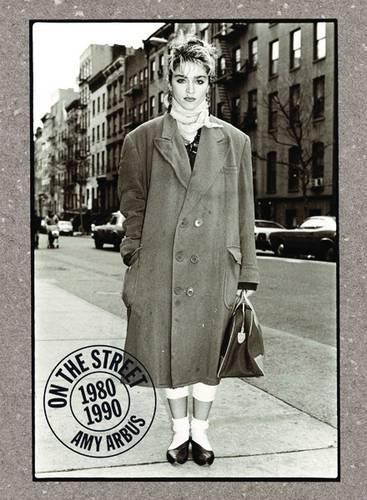
"Between 1980 and 1990, over five hundred of photographer Amy Arbus's impromptu and edgy portraits of New Yorkers appeared in the Village Voice's monthly fashion feature, ""On the Street."" The column's missive was to document the city's most adventurous trednsetters as they lived their lives. But Arbus's photographs tell much more than a style story. From the friendliest to the grittiest, every one of these images is a potent tribute to self-expression. Taken as a whole, they reflect an era of contradictions, a time in America when urban individualism and raw creativity were courageously fighting for breathing room and holding their own in a culture ruled by wealthy conservatism and Republican politics."
Full Product Details
Author: Amy Arbus
Publisher: Rizzoli International Publications
Imprint: Welcome Enterprises, Inc
Dimensions:
Width: 26.70cm
, Height: 2.20cm
, Length: 35.50cm
Weight: 1.590kg
ISBN: 9781599620152
ISBN 10: 1599620154
Pages: 104
Publication Date: 19 September 2006
Audience:
General/trade
,
General
Format: Hardback
Publisher's Status: Out of Stock Indefinitely
Availability: In Print

Limited stock is available. It will be ordered for you and shipped pending supplier's limited stock.
Reviews
Everybody has a life. Everybody has a sensibility. Everybody has yearnings. Everybody has a cause to plead. And everybody has a camera. It takes an intelligence bold as Amy Arbus to turn these universal commonplaces not just into works of art, but works of insight. - Richard Avedon, photographer Arbus's style is so casual it feels effortless, and every picture has wit, soul, and graphic snap. Roaming the East and West Village streets, she foundand recorded many of the era's most idiosyncratic icons, including John Sex, Ann Magnuson, Joey Arias, Phoebe Legere, and, inevitably Madonna, whose stained camel-hair coat and scarily prescient bowling bag still look likethe very definition of downtown chic. Arbus clearly understands the power of cloths to express personality, so the best of her work is a seamless blendof fashion and portraiture. - Vince Aletti, The Village Voice When the street becomes a stage normal people become players in a one act play which never ends. When the director is Amy Arbus, the plot thickens, not only is it the external shakings but she perceives and activates the internal quakings. Each person's moment becomes an equivalent...a poetic revelation. Amy is our visual scribe. We trust her avidity, since she speaks of all of us. -Larry Fink, photographer
Everybody has a life. Everybody has a sensibility. Everybody has yearnings. Everybody has a cause to plead. And everybody has a camera. It takes an intelligence bold as Amy Arbus to turn these universal commonplaces not just into works of art, but works of insight. <br> - Richard Avedon, photographer <br> Arbus's style is so casual it feels effortless, and every picture has wit, <br>soul, and graphic snap. Roaming the East and West Village streets, she found<br>and recorded many of the era's most idiosyncratic icons, including John Sex, <br>Ann Magnuson, Joey Arias, Phoebe Legere, and, inevitably Madonna, whose stained camel-hair coat and scarily prescient bowling bag still look like<br>the very definition of downtown chic. Arbus clearly understands the power of cloths to express personality, so the best of her work is a seamless blend<br>of fashion and portraiture. <br>- Vince Aletti, The Village Voice <p> When the street becomes a stage normal people become players in a
Everybody has a life. Everybody has a sensibility. Everybody has yearnings. Everybody has a cause to plead. And everybody has a camera. It takes an intelligence bold as Amy Arbus to turn these universal commonplaces not just into works of art, but works of insight. <br> - Richard Avedon, photographer <br> Arbus's style is so casual it feels effortless, and every picture has wit, <br>soul, and graphic snap. Roaming the East and West Village streets, she found<br>and recorded many of the era's most idiosyncratic icons, including John Sex, <br>Ann Magnuson, Joey Arias, Phoebe Legere, and, inevitably Madonna, whose stained camel-hair coat and scarily prescient bowling bag still look like<br>the very definition of downtown chic. Arbus clearly understands the power of cloths to express personality, so the best of her work is a seamless blend<br>of fashion and portraiture. <br>- Vince Aletti, The Village Voice <p> When the street becomes a stage normal people become players in a one act play which never ends. When the director is Amy Arbus, the plot thickens, not only is it the external shakings but she perceives and activates the internal quakings. Each person' s moment becomes an equivalent...a poetic revelation. Amy is our visual scribe. We trust <br>her avidity, since she speaks of all of us. <br>-Larry Fink, photographer
Author Information
Amy Arbus has been photographing professionally for twenty-four years. She is a contributing photographer to New York Magazine theater section. Her photographs have appeared in over one hundred periodicals around the world including The New Yorker, Aperture, People, ESPN and The New York Times Magazine. Her first book, No Place Like Home, portraits of people who live in unusual homes, was published in 1986. Her second book, The Inconvenience of Being Born, a photo essay on the extreme emotional nature of infants, received an Award of Excellence from Communication Arts. She has had thirteen one-woman exhibitions worldwide, and her photographs are a part of the collection of The Museum of Modern Art in New York. A.M. Homes is the author of the novel The End of Alice as well as many short-story collections. Her fiction and nonfiction appear in magazines such as The New Yorker and Artforum, among others, and she is a contributing editor at Vanity Fair and Mirabella.