Overview
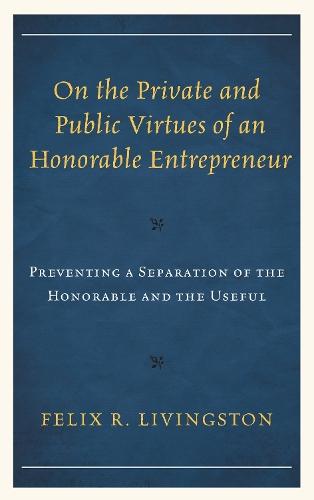
Alexis de Tocqueville’s writings on honor, and his observation that a democracy’s definition of honor “stands for the peculiar individual character of that nation before the world,” provide inspiration for an ideal entrepreneurial innovator discussed in this book. Beginning with Aristotle, contributions of the giants of moral, political, and economic thinking are aggregated in a Credo for honorable entrepreneurs who are dedicated to freedom and general human flourishing. The Credo’s maxims and duties can help entrepreneurs prevent a separation of the honorable and the useful, which is a moral challenge faced by many leaders in all parts of society. Like-minded individuals who share this vision can rebalance power and repair America’s triune social order, while creating wealth and a surplus that can benefit the poorest among us.
Full Product Details
Author: Felix R. Livingston
Publisher: Bloomsbury Publishing Plc
Imprint: Lexington Books
Dimensions:
Width: 15.90cm
, Height: 1.70cm
, Length: 23.20cm
Weight: 0.399kg
ISBN: 9781498575577
ISBN 10: 1498575579
Pages: 140
Publication Date: 15 September 2018
Audience:
Professional and scholarly
,
Professional & Vocational
Format: Hardback
Publisher's Status: Active
Availability: Manufactured on demand

We will order this item for you from a manufactured on demand supplier.
Reviews
At a time when so many are tempted to use the power of government to achieve their personal ends, Felix Livingston's fine new book is an important reminder of the importance of keeping entrepreneurship honorable. Livingston draws upon the full western tradition to explain the logic and virtue of entrepreneurship that springs from persons of character serving others through innovation. -- Gerald A Gunderson, Trinity College In this clever and insightful book, Livingston uses enlivening stories and arguments from western philosophy to buttress the claim that entrepreneurs can and should be ethical stalwarts, providing meaning and virtue to society. This is an exciting new way to reach business students. A flourishing society surely needs the wisdom in Honorable Entrepreneurs. -- Jonathan B Wright, author of Ethics in Economics: An Introduction to Moral Frameworks
This very interesting short book takes readers from Aristotle to Alexis de Tocqueville to the present day in explaining the important role of honorable entrepreneurs. The problem that has emerged in modern times is crony capitalism, in which powerful interest groups use government to protect vested interests to the detriment of society as a whole. This is not the world of free enterprise and laissez faire, as the author makes clear. Self-interest is an important motivator for entrepreneurs, but so is an awareness that the welfare of others is important for the social order. Adam Smith understood these aspects of human behavior. Three categories of entrepreneurs are found today: those who are ignorant of their impact on the social order, those who understand the impact but ignore it, and those who are unscrupulous and willingly violate the law to achieve their ends. The author argues that honorable entrepreneurs are guided by ethical beliefs, traditions, and aesthetic value judgments. The concluding chapter reflects on how a shared vision of honorable entrepreneurship can help create a better society. A worthwhile read recommended for all. Summing Up: Recommended. Lower-division undergraduates through faculty. * Choice Reviews * At a time when so many are tempted to use the power of government to achieve their personal ends, Felix Livingston’s fine new book is an important reminder of the importance of keeping entrepreneurship honorable. Livingston draws upon the full western tradition to explain the logic and virtue of entrepreneurship that springs from persons of character serving others through innovation. -- Gerald A Gunderson, Trinity College In this clever and insightful book, Livingston uses enlivening stories and arguments from western philosophy to buttress the claim that entrepreneurs can and should be ethical stalwarts, providing meaning and virtue to society. This is an exciting new way to reach business students. A flourishing society surely needs the wisdom in this book. -- Jonathan B Wight, author of Ethics in Economics: An Introduction to Moral Frameworks
This very interesting short book takes readers from Aristotle to Alexis de Tocqueville to the present day in explaining the important role of honorable entrepreneurs. The problem that has emerged in modern times is crony capitalism, in which powerful interest groups use government to protect vested interests to the detriment of society as a whole. This is not the world of free enterprise and laissez faire, as the author makes clear. Self-interest is an important motivator for entrepreneurs, but so is an awareness that the welfare of others is important for the social order. Adam Smith understood these aspects of human behavior. Three categories of entrepreneurs are found today: those who are ignorant of their impact on the social order, those who understand the impact but ignore it, and those who are unscrupulous and willingly violate the law to achieve their ends. The author argues that honorable entrepreneurs are guided by ethical beliefs, traditions, and aesthetic value judgments. The concluding chapter reflects on how a shared vision of honorable entrepreneurship can help create a better society. A worthwhile read recommended for all. Summing Up: Recommended. Lower-division undergraduates through faculty. * CHOICE * At a time when so many are tempted to use the power of government to achieve their personal ends, Felix Livingston's fine new book is an important reminder of the importance of keeping entrepreneurship honorable. Livingston draws upon the full western tradition to explain the logic and virtue of entrepreneurship that springs from persons of character serving others through innovation. -- Gerald A Gunderson, Trinity College In this clever and insightful book, Livingston uses enlivening stories and arguments from western philosophy to buttress the claim that entrepreneurs can and should be ethical stalwarts, providing meaning and virtue to society. This is an exciting new way to reach business students. A flourishing society surely needs the wisdom in this book. -- Jonathan B Wight, author of Ethics in Economics: An Introduction to Moral Frameworks
Author Information
Felix R. Livingston is professor of economics and director of the Honorable Entrepreneurship Program at Flagler College.