|
|
|||
|
||||
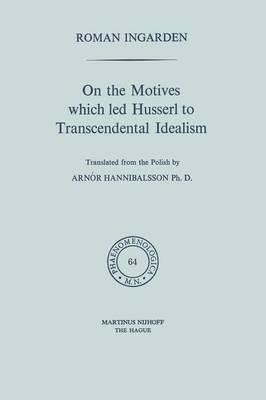
OverviewRoman Ingarden studied under Husserl before and during the first world war. He belonged to the so-called Gottingen group of Husserl's pupils. Husserl's doctrine was accepted by them and interpreted in a realist vein. Ingarden defended this view all his life. He opposed the development of phenomenology towards idealism. A considerable part of Ingarden's great creative effort is dedicated to the construction of a realist phenomenology and thus, according to him, to continuing the erection of the theoret ical structure whose foundations were laid by Husserl in his Logical Investigations. From Ingarden's standpoint the question of idealism versus realism was a crucial one. Ingarden published several studies on Husserl. The first one was written in 1918 and the last one was published posthumously. The present essay was printed in Ingarden's book Z badan nad filozofi:t wsp61czesn:t- (Inquiries into Contemporary Philosophy 1963) along with a number of other essays on Husserl and his philoso phy. This one is representative for Ingarden's positions. It is a good example of his contribution to an important controversy in the history of phenomenology, and it gives the reader an idea of Ingarden's critique of Husserlian idealism against the background of his argument for realism. Thanks and acknowledgements are due to Mr. J. E. Llewelyn of Edinburgh University. This translation was undertaken in collaboration with him. Arn6r Hannibalsson K6pavogur, Iceland 2I. II. Full Product DetailsAuthor: Roman S. Ingarden , Arnór HannibalssonPublisher: Springer Imprint: Kluwer Academic Publishers Edition: Softcover reprint of the original 1st ed. 1975 Volume: 64 Dimensions: Width: 15.50cm , Height: 0.40cm , Length: 23.30cm Weight: 0.146kg ISBN: 9789024717514ISBN 10: 9024717515 Pages: 72 Publication Date: 31 October 1975 Audience: Professional and scholarly , Professional & Vocational Format: Paperback Publisher's Status: Active Availability: Out of stock The supplier is temporarily out of stock of this item. It will be ordered for you on backorder and shipped when it becomes available. Table of ContentsI: Husserl’s Position.- 1. The original realist standpoint.- 2. The concept of philosophy as rigorous science.- 3. Postulates determining the appropriate method of epistemology.- 4. The results of the investigations into outer perception and the constitutive analysis of objects of the real world.- 5. The formal-ontological foundations of the idealist solution.- II: Critical Remarks.- 1. Must the concept of philosophy as rigorous science lead to transcendental idealism ?.- 2. The limits of the applicability of the phenomenological reduction.- 3. Critical remarks on particular results of the analysis of outer perception and the theory of constitution.- 4. Critical remarks on the formal-ontological sources of the Husserlian idealism.ReviewsAuthor InformationTab Content 6Author Website:Countries AvailableAll regions |
||||