Overview
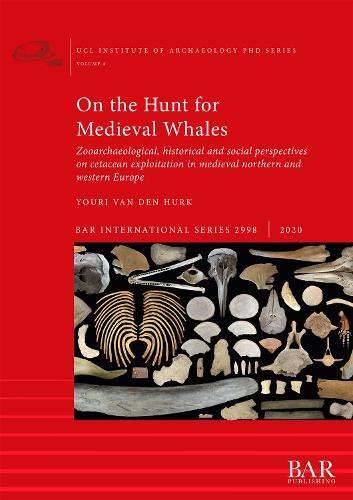
Medieval cetacean (whales, dolphins, and porpoises) exploitation has frequently been connected to various medieval societies, including the Basques, Norse, Normans, and Flemish. Primarily for the ninth to the twelfth centuries AD, it has been argued that the symbolic significance of cetaceans surpassed their utilitarian value and that their consumption was restricted to the social elite. The extent to which active whaling was practised remains unclear. The identification of zooarchaeological cetacean fragments to the species level is hard and as a result they are frequently merely identified as 'whale', resulting in a poor understanding of human-cetacean interaction in the past. Zooarchaeological research as part of this study has revealed that medieval cetacean exploitation was widespread and especially the harbour porpoise (Phocoena phocoena), common bottlenose dolphin (Tursiops truncatus), and the North Atlantic right whale (Eubalaena glacialis) were frequently targeted. The exploitation additionally seems to have often been restricted to the social elite.
Full Product Details
Author: Youri van den Hurk
Publisher: BAR Publishing
Imprint: BAR Publishing
ISBN: 9781407357201
ISBN 10: 1407357204
Pages: 256
Publication Date: 27 August 2020
Audience:
Professional and scholarly
,
Professional & Vocational
Format: Paperback
Publisher's Status: Active
Availability: Available To Order

We have confirmation that this item is in stock with the supplier. It will be ordered in for you and dispatched immediately.
Reviews
'Van den Hurk's book offers a new perspective on premodern cetacean use through his comprehensive analysis of archaeological whale bone across Western Europe. His case studies of English and Dutch whale use, with particular focus on class and consumption, will help scholars reframe medieval economies with heightened attention to marine resources.' Dr Vicki Ellen Szabo, Western Carolina University 'This wide-ranging study is the first to survey medieval cetacean exploitation on such a broad geographical and chronological canvas. It introduces new tools for species identification based on extensive comparative research and provides a fundamental baseline for future research on sea mammal exploitation. It addresses key questions pertinent to a wide academic readership: regarding the social role of cetacean exploitation, the development of active whaling and early human impacts on whale populations.' Dr J.M. Barrett, University of Cambridge 'Youri's book is a truly ground breaking study that examines for the first time in a comprehensive way the exploitation of cetaceans across the European Middle Ages. The geographical range is impressive and the depth and detail of the research sets the standard for others to follow. Human interactions with these extraordinary creatures are studied from a fully interdisciplinary perspective and this volume will remain a standard work of reference and interpretation for many years to come.' Andrew Reynolds, Professor of Medieval Archaeology, Institute of Archaeology, University College London
{\rtf1\fbidis\ansi\ansicpg1252\deff0\deflang2057{\fonttbl{\f0\fswiss\fprq2\fcharset0 Calibri;}{\f1\fnil\fcharset0 Calibri;}{\f2\fnil\fcharset0 Verdana;}} {\colortbl ;\red0\green0\blue0;} \viewkind4\uc1\pard\ltrpar\sa160\sl252\slmult1\lang1033\kerning2\f0\fs22\lquote van den Hurk\rquote s research provides the essential first step in making previously \lquote invisible whales\rquote visible across Europe, while his regional case studies demonstrate the importance of documenting specific patterns of whale exploitation at the local/regional level.\rquote Camilla Speller, ICAZ Newsletter, Vol 21:2\lang2057\kerning0\par \lquote Van den Hurk\rquote s book offers a new perspective on premodern cetacean use through his comprehensive analysis of archaeological whale bone across Western Europe. His case studies of English and Dutch whale use, with particular focus on class and consumption, will help scholars reframe medieval economies with heightened attention to marine resources.\rquote Dr Vicki Ellen Szabo, Western Carolina University\par \pard\ltrpar\lquote This wide-ranging study is the first to survey medieval cetacean exploitation on such a broad geographical and chronological canvas. It introduces new tools for species identification based on extensive comparative research and provides a fundamental baseline for future research on sea mammal exploitation. It addresses key questions pertinent to a wide academic readership: regarding the social role of cetacean exploitation, the development of active whaling and early human impacts on whale populations.\rquote \f1 Dr J.M. Barrett, University of Cambridge\par \par \cf1\lquote Youri\rquote s book is a truly ground breaking study that examines for the first time in a comprehensive way the exploitation of cetaceans across the European Middle Ages. The geographical range is impressive and the depth and detail of the research sets the standard for others to follow. Human interactions with these extraordinary creatures are studied from a fully interdisciplinary perspective and this volume will remain a standard work of reference and interpretation for many years to come.\rquote Andrew Reynolds, Professor of Medieval Archaeology, Institute of Archaeology, University College London\cf0\i\f0\par \i0\par \par \f2\fs17\par }
Author Information
Youri van den Hurk is a zooarchaeologist and is currently a research and education assistant at the University of Groningen. His primary research interest is the relation between humans and cetaceans (whales, dolphins, and porpoises) in the past, especially in medieval Europe.