Overview
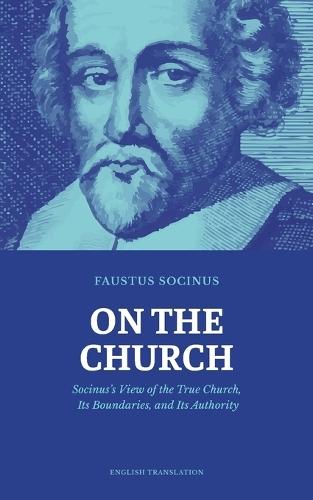
Faustus Socinus's De Ecclesia is presented here in English translation. Faustus Socinus (1539-1604) is among the formative thinkers of Socinianism; his works are marked by a consistently Scripture-based and sober, argumentative examination of dogma and claims of ecclesiastical authority. At the center of the treatise stands a controversy that remains pressing to this day: ecclesiastical authorities often secure doctrines, rites, and practical decisions by appealing to ""the Church,"" thereby deriving a claim to be incapable of error in matters of faith. Socinus targets precisely this shortcut. He opens up the seemingly conclusive formula (""The Church cannot err-and we are the Church"") and makes its assumptions visible: What is meant by ""Church"" in the first place? How can unity be conceived when Christians are scattered across countries and centuries? And what scope could any claim to freedom from error reasonably have? The argument proceeds through clear distinctions: between the visible church (as an identifiable community of confession) and the totality of true believers, whose condition cannot be reliably determined by outward marks. From this follows a sober limitation of ""infallibility"" if it applies at all, it concerns what is necessary for salvation-not every historical doctrinal decision, not every rite, not every form of church order. Another focus is the critique of so-called ""marks"" of the Church that are meant to replace the demanding task of examining Scripture. Socinus shows why such catalogues of marks remain uncertain or lead into circular reasoning: anyone who grounds such marks in Scripture must interpret Scripture-and cannot evade testing everything against the Word of God. The treatise also deals extensively with ministry and the sacraments: apostolic mission (a unique, foundational authority) is distinguished from later forms of church leadership and ecclesiastical order. A concluding excursus on Matthew 16 (""Peter,"" ""the keys of the kingdom of heaven,"" ""binding and loosing"") serves as a case study: the disputed passages are read in such a way that they establish neither institutional infallibility nor a transferable ruling power, but rather an authority bound to the Gospel-an authority to proclaim and to discern belonging.
Full Product Details
Author: Marcin Poholski ,
Faustus Socinus
Publisher: Independently Published
Imprint: Independently Published
Dimensions:
Width: 12.70cm
, Height: 1.40cm
, Length: 20.30cm
Weight: 0.240kg
ISBN: 9798259372733
Pages: 238
Publication Date: 29 April 2026
Audience:
General/trade
,
General
Format: Paperback
Publisher's Status: Active
Availability: Available To Order

We have confirmation that this item is in stock with the supplier. It will be ordered in for you and dispatched immediately.