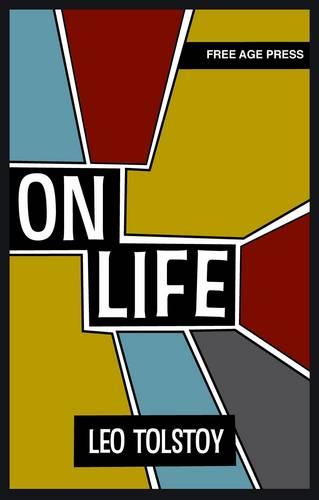
Full Product Details
Author: Leo Tolstoy
Publisher: White Crow Productions
Imprint: White Crow Books
Edition: Free Age Press ed
Dimensions:
Width: 21.60cm
, Height: 1.40cm
, Length: 14.00cm
Weight: 0.366kg
ISBN: 9781907661242
ISBN 10: 1907661247
Pages: 180
Publication Date: 01 March 2010
Audience:
General/trade
,
General
Format: Hardback
Publisher's Status: Active
Availability: In Print

This item will be ordered in for you from one of our suppliers. Upon receipt, we will promptly dispatch it out to you. For in store availability, please contact us.
Reviews
CONTENTS INTRODUCTION. 1. The essential contradiction inherent in human life. 2. Humanity has recognized from the earliest days the contradiction of life. Wise men who have enlightened humanity, have given to the world definitions of life explaining this intrinsic contradiction, but the Pharisees and Scribes conceal it. 3. The errors of the Scribes. 4. The doctrine of the Scribes substitutes the visible manifestation of man's animal existence for the conception of the complete life of man, and draws from these manifestations deductions as to the aim of life. 5. The false doctrines of the Pharisees and Scribes no more explain the true meaning of life than they give guidance in it. Custom without any reasonable explanation is the sole guide of life. 6. The division in the consciousness of the men of our time. 7. The division of consciousness proceeds from the confusion of the animal life with the human. 8. The division and the contradiction are only apparent they are the consequence of false doctrine. 9. The birth of the true life in man. 10. Reason is the law recognized by man, in conformity with which his life must be perfected. 11. False direction of knowledge. 12. The cause of false knowledge is the false perspective in which objects appear. 13. The possibility of understanding objects increases not in proportion to their manifestation in time and space, but rather by reason of the unity of the law governing the objects we are studying, and ourselves. 14. The true human life is not that which is lived in time and space. 15. The renunciation of the well being of the animal individuality is the law of human life. 16. The animal individuality is the instrument of life. 17. Birth by the Spirit. 18. The demands of the reasonable consciousness. 19. Confirmation of the demands of the reasonable consciousness. 20. The demands of the individuality appear incompatible with those of the reasonable consciousness. 21. What is required is not renunciation of our individuality but the subjugation of individuality to the reasonable consciousness. 22. The feeling of love is the manifestation of the activity of the individuality subjected to the reasonable consciousness. 23. The manifestation of the feeling of love is impossible to men who do not understand the meaning of their life. 24. True love is a consequence of the renunciation of the welfare of the individuality. 25. Love is the sole and complete activity of the true life. 26. The efforts of men, directed to the impossible amelioration of their existence, deprive them of the possibility of living the one true life. 27. The fear of death is only the consciousness of the unsolved contradiction of life. 28. Carnal death destroys the body limited in space and the consciousness limited in time, but cannot destroy that which constitutes the foundation of life: the special relationship of each being to the world. 29. Men fear death because they have restricted life by their false conception, taking a part of life to be the whole. 30. Life is a relationship to the world. The movement of life is the establishment of new and loftier relationships; hence death is the introduction to a new relationship. 31. The life of men when they are dead does not cease in this world. 32. The dread of death proceeds from man's confusion of his different relationships to the world. 33. The visible life is a part of the infinite movement of life. 34. The incomprehensibility of the sufferings of earthly existence proves to man more convincingly than anything that his life is not that of the individuality which begins at birth and ends at death. 35. Physical sufferings constitute an indispensable condition of the life and welfare of men. CONCLUSION. Appendix I. Appendix II. Appendix III. Mr. H. W. Massingham on Life.
Author Information
Count Lev Nikolayevich Tolstoy, better known as Leo Tolstoy, is rightly regarded as one of the greatest writers in the history of literature and his masterpieces, 'War And Peace' and 'Anna Karenina', are considered by many to be two of the most important novels ever written. He was born in 1828 in Yasnaya, Polyana, in what was then the Russian Empire, into a noble family with old and established links to the highest echelons of the Russian aristocracy. His parents died while he was young leaving relatives to raise him and after a brief and disappointing time at University, where enrolled in 1844, he spent time gambling, and losing, in St. Petersburg and Moscow before joining the army in 1851. He began writing whilst in the army and upon leaving took it up as his occupation with his first books detailing his life story as well as another, 'Sevastopol Sketches', discussing his experiences in the Crimean War. By the time he had completed 'Sevastopol Sketches' he had returned from the first of two trips abroad which would change his outlook on life and consequentially his writing approach and the content of his work. A trip to Europe in 1861 and a meeting with Victor Hugo, who had just completed 'Les Miserables', which had a marked influence on 'War And Peace', would further push Tolstoy towards the mindset that would lead him to write his most famous works. On the same trip he also met Pierre-Joseph Proudhon, a French anarchist, with whom he discussed the importance of the need for education for all rungs of society. This revelation lead Tolstoy to open up 13 schools in Russia for the children of the working class, further highlighting his continuing separation from his noble roots. 'War And Peace', published in 1869, and 'Anna Karenina', published in 1878, were universally recognised as great works, but not long after the publication of the latter Tolstoy began to slip into an existentialist crisis. Although not suicidal in the literal sense of the term he did, however, decide that if he could find no reason or purpose for his existence he would rather die and so went about searching for a reason to live. He consulted his many friends in high places who espoused various intellectual theories but none of these sat well with him. Just as he was beginning to give up he had a dream that proved to be a moment of clarity and decided that God in a spiritual sense was the reason to keep on, though he was wary of the church and those that abused religion as a tool of oppression. He published 'A Confession' in 1882 which explained his crisis and his resolution and how it came about. Two subsequent novels, 'The Death of Ivan Ilyich' and 'What Then Must We Do?', further re-enforced his views in which he criticised the Russian Orthodox Church. The culmination of his 30 years of religious and philosophical thinking was 'The Kingdom Of God Is Within you' which was published in 1894. In the book he outlined the abuses of those in power in both the church and the government and this would eventually lead to his excommunication from the Russian Orthodox Church in 1901. Tolstoy's main point derived from Jesus' teachings to 'turn the other cheek' and Tolstoy believed that this was the key to Christ's message which can be found in the Gospels and the 'Sermon On The Mount' in particular. This theory of 'non-violence' that dominated the book would make a profound impact on Mahatma Gandhi who read it as a young man whilst living in South Africa. In 1908 Tolstoy wrote 'A Letter To A Hindu' in which he told the Indian people that only through non-violent reaction and love could they overcome their British colonial masters. The letter was published in an Indian paper and Gandhi not only read it but also wrote to Tolstoy to ask permission to translate it into his own native Gujarati. 'The Kingdom Of God Is Within You' and 'A Letter To A Hindu' solidified Gandhi's non-violent idea of rebellion which he implemented and which came to fruition in 1947 when British rule came to an end and India became independent. Gandhi and Tolstoy would continue their correspondence up until Tolstoy's death in 1910.