Overview
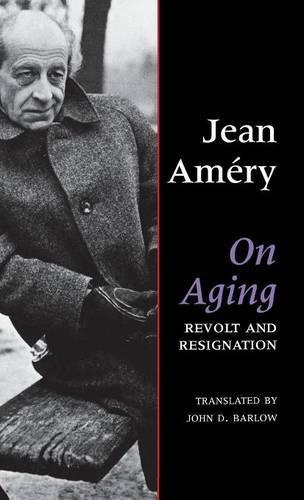
""On Aging"", the first of Jean Amry's books after ""At the Mind's Limits"", is a powerful and profound book about the process of aging and the limited, but real defenses available to those experiencing the process. Each essay covers a set of issues about growing old. ""Existence and the Passage of Time"" focuses on the way aging makes the old progressively see time as the essence of their existence. ""Stranger to Oneself"" is a meditation on the ways the aging are alienated from themselves. ""The Look of Others"" treats social aging - the realization that it is no longer possible to live according to one's potential or possibilities. ""Not to Understand the World Anymore"" deals with the loss of the ability to understand new developments in the arts and in the changing values of society. The fifth essay, ""To Live with Dying,"" argues that everyone compromises with death in old age (the time in life when we feel the death that is in us). Here, Amry's intention, as encapsulated by John D. Barlow, becomes most clear: ""to disturb easy and cheap compromises and to urge his readers to their own individual acts of defiance and acceptance.""
Full Product Details
Author: Jean Amery ,
John D. Barlow
Publisher: Indiana University Press
Imprint: Indiana University Press
Dimensions:
Width: 21.60cm
, Height: 1.20cm
, Length: 14.00cm
Weight: 0.330kg
ISBN: 9780253306753
ISBN 10: 0253306752
Pages: 162
Publication Date: 22 September 1994
Audience:
Professional and scholarly
,
Professional & Vocational
Format: Hardback
Publisher's Status: Out of Print
Availability: Out of print, replaced by POD

We will order this item for you from a manufatured on demand supplier.
Language: German
Reviews
... if Amery's pessimism disparages life, his humanism reaffirms it. By trying to make sense of our existence, Amery reminds us of why human life is precious. Alan Wolfe, The New Republic The pessimistic tone of this book is provocative and should interest students and faculty involved with issues of aging. Choice The writing challenges and searches, trying to cut beneath conventional language and expectations, seeking to delineate qualities of lived experience in their most essential dimensions. Contemporary Gerontology
Searing, albeit depressing, reflections on the process of aging. Born in Vienna in 1911, Amery fled Austria at the time of the Anschluss, joined the Belgian Resistance, and was eventually captured by the Germans and shipped to Auschwitz. Making his home in Belgium after the war, he produced At the Mind's Limits, a collection of essays on the meaning of the concentration camp experience. On Aging was his second book, written when he was 55. Originally a series of radio lectures, it consists of five pieces on the depredations age brings to the human body, mind, and spirit. Fiercely determined not to grow old, the author assumes an attitude that, as the subtitle suggests, is one of both resistance and resignation to the inevitable. Literature forms the springboard for many of his ruminations. Taking its cue from Proust, the first essay, Existence and the Passage of Time, discusses how the aged come to see time as the essence of their existence. Following de Beauvoir, the second article, Stranger to Oneself, details the infirmities of body brought on by growing old. The third piece, The Look of Others, draws heavily upon Sartre, considering the death of dreams: The old realize that they no longer will abe able to make it to the top of the hill and are forced to sit down and make do with the view from where they are. The fourth, Not to Understand the World Anymore, looks at the increasing inability of the old to grasp and accept new developments and ideas. The final essay, To Live with Dying, considers the approach of death itself as the culmination of the aging process. Shortly after this book's original publication in Europe, Amery wrote a companion volume, By One's Own Hand - A Discourse on Voluntary Death. Two years later, at age 65, apparently unable to accept growing old, he took his own life. On Aging is a record of a brilliant and tormented soul. (Kirkus Reviews)
Author Information
JEAN AMERY was born in Vienna in 1911 as Hanns Mayer. As a young man, he studied philosophy and wanted to be a novelist. When the Nazis came to power in Austria in 1938, he fled to Belgium and joined the resistance there. He was caught distributing leaflets, tortured, and sent to Auschwitz. He survived Auschwitz and after the war made his home in Brussels, changing his name to Jean Amery. In 1966, he published Jenseits von Schuld und Suhne (At the Mind's Limits), a series of essays about his experiences in Auschwitz, which made him famous. JOHN D. BARLOW is Dean of the School of Liberal Arts at Indiana University-Purdue University at Indianapolis. He is a professor of English and German and author German Expressionist Film.