Overview
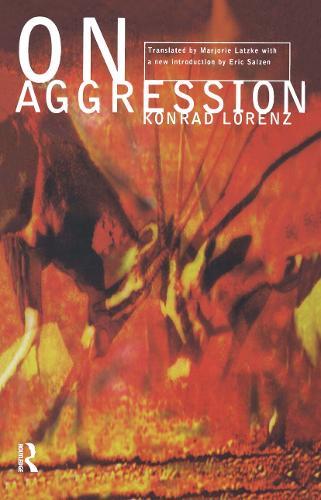
First published in the 1960s, On Aggression has been the target of criticism and controversy ever since. It is not Lorenz's careful descriptions of animal behaviour that are contentious, but his extrapolations to the human world that have caused reverberations resulting in a statement adopted by UNESCO in 1989 and subsequently endorsed by the American Psychological Association that appears to condemn his work. But does On Aggression actually make the claims implicit in the Seville statement? In a new introduction by Professor Eric Salzen, the debate about Lorenz's work is set in its social and political context and his claims and those of his critics reassessed. Human aggression has not lessened since this seminal work first appeared and there are no convincing new solutions. On Aggression should be read by all new students and re-read by more experienced scholars so that the important evidence he presents from ethnology may be reappraised in the light of the most recent research.
Full Product Details
Author: Konrad Lorenz ,
Marjorie Latzke ,
Eric Salzen
Publisher: Taylor & Francis Ltd
Imprint: Routledge
Edition: 2nd edition
Weight: 0.453kg
ISBN: 9780415136594
ISBN 10: 0415136598
Pages: 304
Publication Date: 01 January 1968
Audience:
General/trade
,
Professional and scholarly
,
General
,
Postgraduate, Research & Scholarly
Format: Paperback
Publisher's Status: Active
Availability: In Print

This item will be ordered in for you from one of our suppliers. Upon receipt, we will promptly dispatch it out to you. For in store availability, please contact us.
Reviews
In this remarkable study, Professor Lorenz, naturalist by profession and Darwinian by conviction, presents the results of his inquiry into the aggressive behavior of animals. And, in so doing, relates his findings to the complicated nature of man and modern society. By exploring each species on an ascending scale, he admirably demonstrates that aggressive tendencies are an essential part of the life-preserving process: i.e. the intra-specific or fights within a group which allows for a normal distribution of abilities comparable to the practical effect of having only the necessary number of doctors within a small town. He particularizes about animals whose behavioral patterns are most analogous to man's - the rat with its transmission of experience and the astonishingly comparable Greylag Goose whose norms of behavior, right down to the absurd details of falling in love, strife for ranking order, jealousy, grieving etc., are the same. But the author views man as perhaps less fortunate since we are in the dangerous position of too much, too soon, and nature's safeguards, the inhibiting mechanisms against aggression which generally accompany increased power among the lower orders, have not caught up with man's means for destruction. We lack this and/or adequate catharsis for our essential aggressive tendencies. But the author offers some intelligent solutions as the hope that the long-sought missing link between animals and the really humane being is ourselves. Provocative, educational and genuinely readable. (Kirkus Reviews)
Author Information
Konrad Lorenz (1903-89). Pioneering and world-renowned scientist of animal behaviour. He was awarded the Nobel Prize for Medicine and Psychology in 1973.