Overview
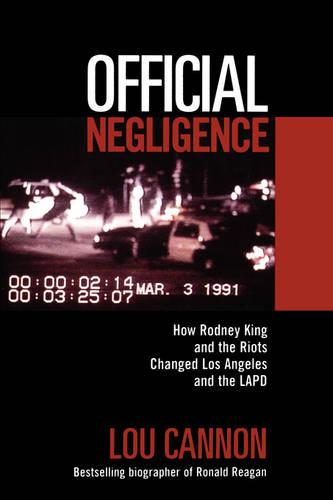
In the Spring of 1992 five days of rioting laid waste to South Central Los Angeles, took scores of lives, cost the city more than $900 million in property damages and captured the attention of horrified people worldwide. Lou Cannon, veteran journalist, combines extensive research with interviews from hundreds of survivors, offering the only definitive story behind what happened and why. Official Negligence takes a hard look at the circumstances leading up to the riots. Cannon reveals how the videotape of the brutal beating of Rodney King had been sensationally edited by a local TV station, how political leaders required LAPD officers to carry metal batons despite evidence linking them to the rising toll of serious injury in the community, and how poorly prepared the city was for the violence that erupted.
Full Product Details
Author: Lou Cannon
Publisher: Taylor & Francis Inc
Imprint: Westview Press Inc
Dimensions:
Width: 15.30cm
, Height: 3.80cm
, Length: 22.90cm
Weight: 0.500kg
ISBN: 9780813337258
ISBN 10: 0813337259
Pages: 720
Publication Date: 15 October 1999
Audience:
General/trade
,
College/higher education
,
Professional and scholarly
,
General
,
Undergraduate
Format: Paperback
Publisher's Status: Active
Availability: Awaiting stock

The supplier is currently out of stock of this item. It will be ordered for you and placed on backorder. Once it does come back in stock, we will ship it out for you.
Reviews
This reporter's ambitious reconstruction of the Rodney King case presents a sobering image, not just of Los Angeles, but of judicial mayhem and political exploitation. Cannon (President Reagan: The Role of a Lifetime, 1991, etc.) was L.A. bureau chief of the Washington Post from 1990 to 1993. He repeatedly says that the beating of Rodney King was a Rashomon-like event in which every observer came away with a different perception of even the bare facts. Cannon's chronicle of the legal and political saga - from the night of the beating through the trial of the rioters who attacked Reginald Denny - is almost entirely drawn from the point of view of police officers. Within this particular framework, it is certainly authoritative, though the reader will almost always be nagged by a feeling of not having the whole story. He does show that the King incident was not representative of what it's like to be a suspect in the hands of the LAPD, and that only because it was videotaped did the world take it to be so. Cannon's masterful narrative, with tight control over its vast scope and incredible detail, overflows his own restriced frame, allowing readers copious material with which to weigh his implicit conviction regarding the innocence of the officers of the charges brought against them, and the LAPD's (and the judicial system's) broader guilt - the negligence of the title (such as lack of training of police officers in the proper use of the baton to subdue a suspect). He creates an often complicated but always crystal-clear chronicle, seeming to recount years of turmoil almost minute-by-minute. Along with the major players, every juror and witness is introduced with extensive biographical background. Seemingly small legal issues and lawyerly subtexts of the trials are zealously pursued; by the time Cannon gets to the Denny trial, readers may be exhausted, but they will have achieved some clarity. As indispensable as it is incomplete. (Kirkus Reviews)
Author Information
Lou Cannon, a longtime political reporter and White House correspondent for The Washington Post, was the paper's Los Angeles bureau chief from 1977 to 1980 and again from 1991 to 1993. He is currently a special correspondent for The Post in the West.