Overview
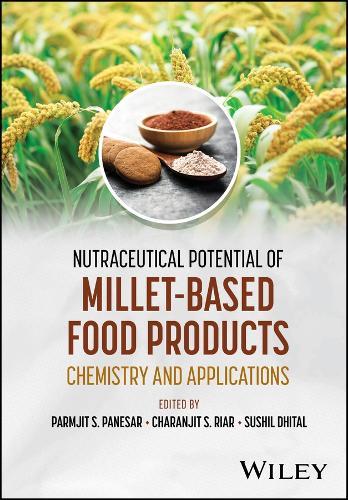
Comprehensive coverage of the classification, production, distribution, nutritional composition, and commercialization of millets and millet-based food products Nutraceutical Potential of Millet-Based Food Products: Chemistry and Applications delivers comprehensive knowledge on the production, distribution, and nutrition of millets, with detailed insights on the current state of millet processing, millet-based food products, and the commercialization of millets. The book also reviews various bioavailability studies of millet bioactives and methods to enhance their bio-accessibility. Section I provides an introduction to millets, covering their classification, production, and distribution along with their nutritional composition. Section II covers the classification, chemical profiling, and existence of phenolics in millet grain along with its antimicrobial and antiradical properties and in vitro and in vivo antioxidative characteristics. This section also reviews the extraction, modification, quality assessment, and health benefits of millet polyphenols and millet fibers, proteins, and starches. Section III discusses emerging technologies in millet processing, the commercial preparation of millet-based products, the nutritional and health benefits of millet-based fermented food products, and the bioactive composition of millet by-products and their value addition. Nutraceutical Potential of Millet-Based Food Products includes information on: Types of millets including sorghum, pearl millet, finger millet, foxtail millet, proso millet, kodo millet, barnyard millet, little millet, and brown top millet Antidiabetic, anti-cancerous, anti-artherosclerogenic, and antiaging properties of millets Intake of millet protein as a solution to reduce body weight and increase the liver’s relative weight The potential of millets to contribute to nutritional security in developing countries due to their status as “miracle grains” The effects of climate change and public awareness on the production of millets Nutraceutical Potential of Millet-Based Food Products: Chemistry and Applications is a highly valuable resource for professionals working in food grain processing, technology, and engineering, as well as those involved in post-harvest technology development. The book is also appropriate for students and academics in related areas of study.
Full Product Details
Author: Parmjit S. Panesar (Sant Longowal Institute of Engineering and Technology Sangrur, India) , Charanjit S. Riar (Sant Longowal Institute of Engineering and Technology Sangrur, India) , Sushil Dhital (Bioresource Processing Institute of Australia (BioPRIA), Australia)
Publisher: John Wiley & Sons Inc
Imprint: John Wiley & Sons Inc
Weight: 0.680kg
ISBN: 9781394294701
ISBN 10: 1394294700
Pages: 384
Publication Date: 27 February 2026
Audience:
Professional and scholarly
,
Professional & Vocational
Format: Hardback
Publisher's Status: Active
Availability: Awaiting stock 
The supplier is currently out of stock of this item. It will be ordered for you and placed on backorder. Once it does come back in stock, we will ship it out for you.
Table of Contents
List of Contributors xv Preface xix Section I Fundamental Aspects of Millets 1 1 Classification and Production of Millets 3 Charanjit S. Riar and Parmjit S. Panesar 1.1 Introduction 3 1.2 Changing Eating Habits Globally 4 1.3 Millets' Unique Characteristics 5 1.4 Classification of Millets 6 1.5 Millets Distribution and Its Production in India 19 1.6 Indian Government Schemes to Promote Millets 34 1.7 India Government's Steps to Intensify Millet Production 37 1.8 The Company's Business Associated with Millet Processing 38 1.9 Conclusion 39 2 Millets as Nutri-cereals: Nutritional Composition and Health Benefits 47 Muskan Dawra, Jaspreet Kaur, Vikas Kumar, and Prasad Rasane 2.1 Introduction 47 2.2 Nutritional Composition of Different Types of Millets 48 2.3 Importance of Millets 48 2.4 Nutrients from Millets 51 2.5 Health Benefits of Millets 54 2.6 Culinary Uses and Cultural Relevance 59 2.7 Conclusion 60 3 Antinutritional Factors in Millets and Their Elimination Methods 65 Amandeep Singh, Tejinder Kaur, Souvik Giri, Kawaljit S. Sandhu, and Charanjit S. Riar 3.1 Introduction 65 3.2 Nutritional Composition of Millets 66 3.3 Antinutrients in Millets 66 3.4 Techniques of Elimination of Millet Grain Antinutritional Factors 72 3.5 Conclusions 77 Section II Millet Bioactive Compounds and Characterization 85 4 Millet Grain Phenolics: Classification, Chemical Profiling 87 Gurjeet Kaur, Kanchan Suri, Anu Sharma, and Zakir Showkat Khan 4.1 Introduction 87 4.2 Major Millet Grain Phenolics 89 4.3 Minor Millet Grain Phenolics 92 4.4 Phytochemical Profiling of Millets 96 4.5 Conclusion 102 5 Millet Polyphenols: Extraction, Quality Assessment, and Therapeutic Benefits 109 José de Jesús Lira-Ricárdez and Lucía Ortega Cabello 5.1 Introduction 109 5.2 Nutritional and Therapeutic Uses of Millet 110 5.3 Role of Polyphenols in the Therapeutic Activity of Millets 114 5.4 Pretreatment of Millets and Their Polyphenol Extraction 117 5.5 Characterization of Phenolic Extracts from Millets 121 5.6 Conclusion 127 6 Millets Dietary Fibers: Extraction, Quality Characteristics, and Health Benefits 135 Farhan M. Bhat and Charanjit S. Riar 6.1 Introduction 135 6.2 Methods of Extraction of Dietary Fibers from Millets 138 6.3 Quality Characteristics of Dietary Fiber from Millets 143 6.4 Functional Role of Fibers Isolated from Millets 144 6.5 Conclusion 145 7 Millet Proteins: Extraction and Nutritional Characteristics 151 Qun Shen, Qingyu Zhao, Liangxing Zhao, and Luman Sang 7.1 Cultivation and Distribution of Millet 151 7.2 Nutritional Value of Millet 152 7.3 Millet Proteins Composition and Their Amino Acid Profiles 154 7.4 Properties of Millet Proteins 155 7.5 Isolation of Millet Protein Fractions 156 7.6 Properties and Structure of Proteins in Millet 156 7.7 Health Benefits of Millet Proteins 161 7.8 Conclusion and Future Perspectives 165 8 Millet Starch: Extraction, Structure, and Functional Properties 171 Chuanjie Chen and Fan Zhu 8.1 Introduction 171 8.2 Isolation and Composition of Millet Starch 171 8.3 Chemical Composition of Millet Starch 173 8.4 Structures of Millet Starch 176 8.5 Physicochemical Properties of Millet Starch 181 8.6 Modifications of Millet Starch for Improved Functionality and Their Applications 188 8.7 Conclusions 195 9 Millet Bioactives: Bioavailability and Enhancement of Their Bioaccessibility 203 Divyanshi Thakur, Tejinder Kaur, Amandeep Singh, Charanjit S. Riar, and Parmjit S. Panesar 9.1 Introduction 203 9.2 Bioactive Compounds in Millet 205 9.3 Bioaccessibility of Bioactive Compounds in Millet 210 9.4 Processing Techniques for Enhancement of Bioaccessibility and Bioavailability of Millet Bioactives 214 9.5 Conclusion 219 Section III Millet Processing and Applications 227 10 Emerging Technologies in Millet Processing 229 Shiva Bakshi, Durga S. Bunkar, Vinod K. Paswan, Suneel K. Goyal, and Vishal Kumar 10.1 Introduction 229 10.2 Traditional Millet Processing Meets Modern Equipment Innovations 230 10.3 Novel Thermal Processing Technologies of Millets 238 10.4 Emerging Nonthermal Processing of Millets 246 10.5 Conclusion 255 11 Millet-Based Products and Commercialization 271 Narender K. Chandla, Nitin Wakchaure, Gajanan P. Deshmukh, and Sunil K. Khatkar 11.1 Introduction 271 11.2 History 272 11.3 Nutritional Values 273 11.4 Types of Millets and Their Nutritional Value 275 11.5 Comparison of Millet Grains with Other Staple Grains 276 11.6 Bioactive Components in Millet and Bioavailability of These Compounds 277 11.7 Processing and Formulation of Millet-Based Food 279 11.8 Millet-Based Value-Added and Nutraceutical Food Products 281 11.9 Market Trends and Consumer Perspectives 284 11.10 Current Market Trends for Millet-Based Nutraceuticals 286 11.11 Market of Millet-Based Nutraceutical Foods 287 11.12 Innovations in Product Development and Processing Technologies 288 11.13 Scope for Millet-Based Nutraceuticals in Addressing Diseases 288 11.14 Research Gaps and Future Prospects 289 11.15 Challenges in Millet Food Product Development 290 11.16 Global Initiatives Promoting Millet Consumption 291 11.17 Conclusions 292 12 Millet-Based Fermented Food Products: Nutritional and Health Benefits 299 Priyanka Thakur, Sachin Sharma, Vikas Kumar, Ritesh Verma, Tanveen Kaur, Abhishek Rana, and Satish Kumar 12.1 Introduction 299 12.2 Primary Processing of Millets 301 12.3 Millets as Nutrient-Dense Fermented Food Ingredient 302 12.4 Diversity of Millet-Based Fermented Food Products 307 12.5 Health Benefit/Functional Properties 311 12.6 Antinutritional Factors (ANFs) and Related Safety Aspects 313 12.7 Conclusion and Future Perspectives 315 13 Millet By-products: Bioactive Composition and Value Addition 321 Neha Goyal, Parmjit S. Panesar, Charanjit S. Riar, and Durga S. Bunkar 13.1 Introduction 321 13.2 Millet By-products 322 13.3 Bioactive Composition of Millet By-products 327 13.4 Value Addition of Millet By-products 335 13.5 Conclusions and Future Perspectives 340 References 341 Index 353
Reviews
Author Information
PARMJIT S. PANESAR, Professor, Department of Food Engineering and Technology, Sant Longowal Institute of Engineering and Technology, India. Professor Panesar has been included in the list of World’s Top 2% Scientists published by Stanford University, USA, in 2020, 2021, 2022, and 2023. CHARANJIT S. RIAR, Professor, Department of Food Engineering and Technology, Sant Longowal Institute of Engineering and Technology, Longowal, India. SUSHIL DHITAL, Associate Professor, Department of Chemical and Biological Engineering at the Monash University, Australia.
Tab Content 6
Author Website:
Countries Available
All regions
|