Awards
- Winner of Chosen as one of the CHOICE Outstanding Academic Books of 2004.
- Winner of Chosen as one of the ^ICHOICE^R Outstanding Academic Books of 2004.
Overview
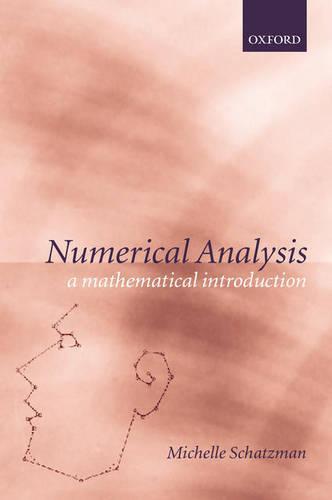
Numerical analysis explains why numerical computations work, or fail. This book is divided into four parts. Part I starts with a guided tour of floating number systems and machine arithmetic. The exponential and the logarithm are constructed from scratch to present a new point of view on questions well-known to the reader, and the needed knowledge of linear algebra is summarized. Part II starts with polynomial approximation (polynomial interpolation, mean-square approximation, splines). It then deals with Fourier series, providing the trigonometric version of least square approximations, and one of the most important numerical algorithms, the fast Fourier transform. Any scientific computation program spends most of its time solving linear systems or approximating the solution of linear systems, even when trying to solve non-linear systems. Part III is therefore about numerical linear algebra, while Part IV treats a selection of non-linear or complex problems: resolution of linear equations and systems, ordinary differential equations, single step and multi-step schemes, and an introduction to partial differential equations. The book has been written having in mind the advanced undergraduate students in mathematics who are interested in the spice and spirit of numerical analysis. The book does not assume previous knowledge of numerical methods. It will also be useful to scientists and engineers wishing to learn what mathematics has to say about the reason why their numerical methods work - or fail.
Full Product Details
Author: Michelle Schatzman (Directeur de Recherche, Directeur de Recherche, CNRS, Universite de Claude Bernard - Lyon 1) ,
John Taylor
Publisher: Oxford University Press
Imprint: Oxford University Press
Dimensions:
Width: 17.40cm
, Height: 3.20cm
, Length: 24.90cm
Weight: 0.938kg
ISBN: 9780198502791
ISBN 10: 0198502796
Pages: 516
Publication Date: 17 October 2002
Audience:
College/higher education
,
Professional and scholarly
,
Undergraduate
,
Professional & Vocational
Format: Hardback
Publisher's Status: Active
Availability: To order

Stock availability from the supplier is unknown. We will order it for you and ship this item to you once it is received by us.
Reviews
It will be useful for scientists and engineers wishing to learn whether mathematicians can explain why their numerical methods work - or fail. EMS The presentation of the book is very good and sometimes original; in spite of teaching numerical courses for several years I found a few good ideas to improve my courses ... recommend[ed] for those who value mathematical rigour in numerical analysis. Zentralblatt Math The global conclusion is that this is a good textbook for the numerical analysis courses in an undergraduate mathematics curriculum. Zentralblatt Math ... the physical detail in which many problems are introduced is one of the strong points of the book. Another strong point is the mathematical rigour which is definitely above the average for a numerical analysis textbook. Zentralblatt Math
Author Information
Professor Michelle Schatzman, MAPLY, 21 Avenue Claude Bernard, UCBL, F-69622 Villeurbanne Cedex, Tel: +33 4 72 44 85 26, Fax: +33 4 74 22 80 53, Email: schatz@maply.univ-lyon1.fr