Overview
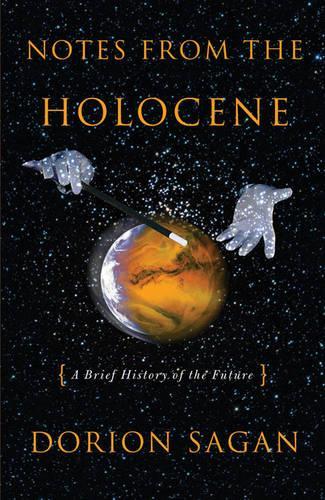
In a thought-provoking, humorous, and engaging style, Dorion Sagan combines philosophy, science, and an understanding of illusion to probe the deep questions of existence. Operating on the precept that the universe is far weirder than we might imagine, Sagan n son of acclaimed scientists Carl Sagan and Lynn Margulis n uses his knowledge of philosophy, science, sleight-of-hand magic, and the fantastical writings of Philip K. Dick to explore some of the deepest questions we face on Earth. He provides fresh insights as to why we are here, the nature of technology, the prognosis for humanity, the living nature of our planet, and a reasoned explanation to why our universe is probably just one of an infinite number. Notes from the Holocene is a prime example of the writing coming from a new generation of scientific writers. It will inspire readers to think for themselves while leaving them chuckling with tongue-in-cheek anecdotes - a rare combination that Sagan delivers with ease. And yes, as geneticist J.B.S. Haldane says, ithe universe is not only stranger than we imagine, but stranger than we can imagine.i
Full Product Details
Author: Dorion Sagan
Publisher: Chelsea Green Publishing Co
Imprint: Chelsea Green Publishing Co
Dimensions:
Width: 13.80cm
, Height: 1.40cm
, Length: 21.60cm
Weight: 0.281kg
ISBN: 9781933392325
ISBN 10: 1933392320
Pages: 224
Publication Date: 27 September 2007
Audience:
General/trade
,
General
Format: Paperback
Publisher's Status: Out of Print
Availability: In Print

Limited stock is available. It will be ordered for you and shipped pending supplier's limited stock.
Reviews
In Notes from the Holocene Dorion Sagan crosses freely that no man's land between science, religion, and philosophy. The result is a synthesis of ideas linking the peculiar to the universal, sleight-of-hand and the anthropic principle, science fiction and science faction. . . . Think the Symposium with Tallulah Bankhead, Derrida, and Philip K. Dick as dinner guests. This is Sagan's most personal book to date. Appropriately, since the subjective informality of Notes allows him latitude to advance the difficult questions, ones an academic approach would likely sidestep: Is the Earth an organism? What's our place in it all, and is it as central to the universe as we presume? The timeless reach here is matched by its timeliness: arguably no generation has more needed to understand its context in, and impact on, the big picture. Yet the broadest of speculations is still grounded in the science, where even the four elements of classical cosmology a the frame on which he stretches his canvas a find a contemporary gloss in his portrayal of thermodynamic systems. Like the master illusionists he details, Sagan conjures up a world whose magic is only augmented by knowing how the trick is done. It's a smart, daring book and I've come out the smarter for having read it.aSteve Shavel, author of How Small Brides Survive in Extreme Cold <p><br>
Publishers Weekly-This casual and lively book deals with some of the most basic philosophical questions we have: why are we here? How did life arise from nonliving particles? What is the fate of the earth? Sagan (What Is Life?), son of astronomer and science writer Carl Sagan, draws on, among others, science, philosophy and the speculations of science fiction in attempting to answer these questions. He begins with a quick introduction to James Lovelock's Gaia hypothesis, that the Earth is a living, self-regulating organism, and that life is not just a passenger on Earth but an integral part of the planet's systems. In chapters titled Earth, Water, Air and Fire, Sagan touches on the oceans and atmosphere, the evolution of life on Earth, the laws of thermodynamics and human consciousness, always circling back to Lovelock's theories. Sagan is equally comfortable discussing scientists like Richard Dawkins and Lewis Thomas, and science fiction authors like Philip K. Dick and A.E. van Vogt. The chatty style and ranging mind communicate a broad understanding and should appeal to inquisitive readers who want to know more about Earth and our relationship with it.
Author Information
Writer, editor, and sleight-of-hand artist Dorion Saganis articles have appeared in Wired, The New York Times, The New York Times Book Review, Natural History, The Sciences, Pabular, Cabinet, and other magazines. His books include What is Life, Origins of Sex, and Into the Cool.