Overview
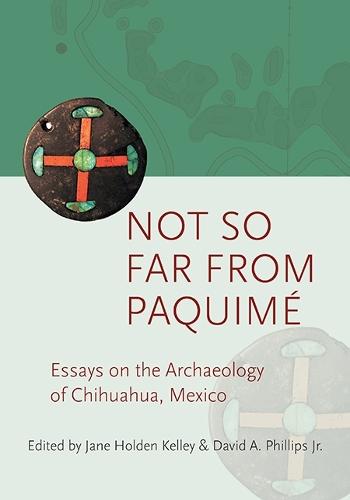
Archaeologists are slowly peeling back the mysteries surrounding the Casas Grandes culture of Mexico, although most of that work has focused on the principal site of Paquimé and its immediate vicinity. In this volume, Jane Kelley and her colleagues probe the southern edge of the Casas Grandes culture area—an area little explored by archaeologists until now. The book provides the first solid foundation for research on prehistoric west-central Chihuahua. Readers will find descriptions of the southern branch of the pottery-making, village dwelling farmers of the Casas Grandes culture and learn that, as Paquimé became the most complex site in the region, the southern Casas Grandes people mostly held back from the “Paquimé revolution.” The studies presented here confer a more nuanced understanding of the tremendous diversity within one of the region’s great prehistoric cultures, an area that extends unbroken from deep in Mexico north to central Utah.
Full Product Details
Author: Jane Holden Kelley ,
David A. Phillips
Publisher: University of Utah Press,U.S.
Imprint: University of Utah Press,U.S.
Dimensions:
Width: 17.80cm
, Height: 2.30cm
, Length: 25.40cm
Weight: 0.723kg
ISBN: 9781607815723
ISBN 10: 1607815729
Pages: 288
Publication Date: 30 October 2017
Audience:
Professional and scholarly
,
Professional & Vocational
Format: Hardback
Publisher's Status: Active
Availability: Out of stock

The supplier is temporarily out of stock of this item. It will be ordered for you on backorder and shipped when it becomes available.
Reviews
A concise, thoughtful, and comprehensive summary of many years of field work and subsequent research. Kelley's personal ruminations bring the reader insights and issues that enhance the volume and are, unfortunately, all too often missing in archaeological literature. --Michael S. Foster, archaeologist and editor of The Archaeology, Ethnohistory, and Environment of the Marismas Nacionales A tremendous contribution... I anticipate that well-thumbed versions of this volume will become a com mon feature on the desks of archaeologists interested in the prehistory of the Mexican Northwest and U.S. Southwest. The concise, accessible, data-driven chapters on over twenty years of fieldwork, when combined with Kelley's insightful chapters and conversational writing style, make this volume a delight to read, and a terrific final contribution from one of the trailblazers of North west/Southwest archaeology. --New Mexico Historical Review The work is rich in details about different topics, including the botanic, the architecture, and the ceramic. The authors use not only American publications but also Mexican sources--a remarkable issue, because rarely do American or Mexican scholars quote their colleagues on the other side of the border. --Jose Luis Punzo Diaz, profesor investigador, INAH Michoacan
This book is an excellent example of what post-colonial criticism was intended to be: a serious historical engagement with the texts that emerged in the encounter between the colonizer and the colonized in the postcolonial world. Mufti makes a powerful statement on the relationship between colonial governmentality and the poetics of empire, and a clear and sustained connection between the discourses surrounding the idea of civil war, the civilization claims of colonial rule, and the imbrication of texts in this arena. --Simon E. Gikandi, author of Reading the African Novel and Slavery and the Culture of Taste
Author Information
Jane Holden Kelley (1928–2016) joined the newly formed Department of Archaeology at the University of Calgary in 1968 and held multiple appointments there until (and after) her retirement in 1994. David A. Phillips Jr. is the director of the Maxwell Museum of Anthropology and a research associate professor in the Department of Anthropology at the University of New Mexico. Phillips has served as a principal investigator and program manager at the Museum of New Mexico and in the private sector.