Overview
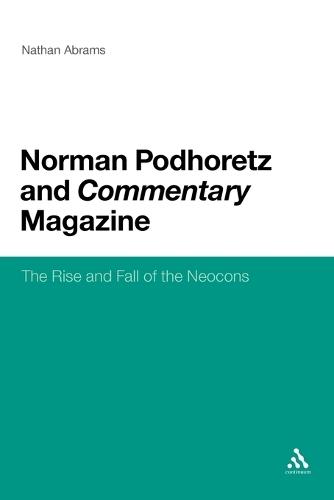
What does the term ""neoconservative"" mean? Who are we talking about and where did they come from? Abrams answers those very questions through a detailed and critical study of neoconservatism's leading thinker, Norman Podhoretz, and the magazine he edited for 35 years, Commentary. Podhoretz has been described as ""the conductor of the neocon orchestra"" and through Commentary Podhoretz powerfully shaped neoconservatism. Rich in research, the book is based upon a wide range of sources, including archival and other material never before published in the context of Commentary magazine, including Podhoretz's private papers. It argues that much of what has been said about neoconservatism is the product of willful distortion and exaggeration both by the neoconservatives themselves and their many enemies. From this unique perspective, Abrams examines the origins, rise, and fall of neoconservatism. In understanding Podhoretz, a figure often overlooked, this book sheds light on the origins, ideas, and intellectual pedigree of neoconservatism.
Full Product Details
Author: Professor Nathan Abrams (Bangor University, UK)
Publisher: Continuum Publishing Corporation
Imprint: Continuum Publishing Corporation
Edition: NIPPOD
Dimensions:
Width: 15.60cm
, Height: 1.90cm
, Length: 23.40cm
Weight: 0.527kg
ISBN: 9781441126580
ISBN 10: 1441126589
Pages: 376
Publication Date: 05 January 2012
Audience:
Professional and scholarly
,
Professional & Vocational
Format: Paperback
Publisher's Status: Active
Availability: Manufactured on demand

We will order this item for you from a manufactured on demand supplier.
Language: English
Reviews
...there is still more to say about Commentary magazine, one of the small-circulation journals with outsize influence that defined the post-World War II intellectual, political and artistic preoccupations, and about Norman Podhoretz, its larger-than-life former editor and a founder of neoconservatism. -The New York Times While the neoconservative movement was correctly understood as being highly influential in the second Bush administration, it remains, according to Abrams, poorly understood, in part because of willful distortion and exaggeration both by the neoconservatives themselves as well as their many enemies and detractors. He aims to improve our understanding through a case study of the movement's foremost intellectual, Norman Podhoretz, and the magazine he edited for 35 years, Commentary. He focuses on how Commentary dealt with those issues that he argues caused Podhoretz and others to break with liberalism and become neoconservatives: Judaism and American policy towards Israel; US foreign policy and American anti-communism; and the civil rights movement and race relations, including Jewish-black relations and debates over affirmative action. He also addresses cultural issues such as homosexuality, religion and politics, feminism, and abortion, and considers the legacy of Podhoretz in terms of the moral and ethical responsibilities of the intellectual's vocation, especially when intellectuals get involved in politics. -Eithne O'Leyne, BOOK NEWS, Inc. ... a major contribution to the study of neoconservatism... -- Cambridge Review of International Affairs, Vol 24, No, 1
"""...there is still more to say about Commentary magazine, one of the small-circulation journals with outsize influence that defined the post-World War II intellectual, political and artistic preoccupations, and about Norman Podhoretz, its larger-than-life former editor and a founder of neoconservatism.""-The New York Times ""While the neoconservative movement was correctly understood as being highly influential in the second Bush administration, it remains, according to Abrams, poorly understood, in part because of willful distortion and exaggeration both by the neoconservatives themselves as well as their many enemies and detractors. He aims to improve our understanding through a case study of the movement's ""foremost intellectual,"" Norman Podhoretz, and the magazine he edited for 35 years, Commentary. He focuses on how Commentary dealt with those issues that he argues caused Podhoretz and others to break with liberalism and become neoconservatives: Judaism and American policy towards Israel; US foreign policy and American anti-communism; and the civil rights movement and race relations, including Jewish-black relations and debates over affirmative action. He also addresses cultural issues such as homosexuality, religion and politics, feminism, and abortion, and considers the legacy of Podhoretz in terms of the moral and ethical responsibilities of the intellectual's vocation, especially when intellectuals get involved in politics."" -Eithne O'Leyne, BOOK NEWS, Inc. ... a major contribution to the study of neoconservatism... -- Cambridge Review of International Affairs, Vol 24, No, 1"
...there is still more to say about Commentary magazine, one of the small-circulation journals with outsize influence that defined the post-World War II intellectual, political and artistic preoccupations, and about Norman Podhoretz, its larger-than-life former editor and a founder of neoconservatism. (The New York Times) While the neoconservative movement was correctly understood as being highly influential in the second Bush administration, it remains, according to Abrams, poorly understood, in part because of willful distortion and exaggeration both by the neoconservatives themselves as well as their many enemies and detractors. He aims to improve our understanding through a case study of the movement's foremost intellectual, Norman Podhoretz, and the magazine he edited for 35 years, Commentary. He focuses on how Commentary dealt with those issues that he argues caused Podhoretz and others to break with liberalism and become neoconservatives: Judaism and American policy towards Israel; US foreign policy and American anti-communism; and the civil rights movement and race relations, including Jewish-black relations and debates over affirmative action. He also addresses cultural issues such as homosexuality, religion and politics, feminism, and abortion, and considers the legacy of Podhoretz in terms of the moral and ethical responsibilities of the intellectual's vocation, especially when intellectuals get involved in politics. (Eithne O'Leyne, BOOK NEWS, Inc.)
Author Information
Dr. Nathan Abrams is a Senior Lecturer and Director of Graduate Studies at the School of Creative Studies and Media, Bangor University, UK. He is the author of 3 books and many journal articles.