|
|
|||
|
||||
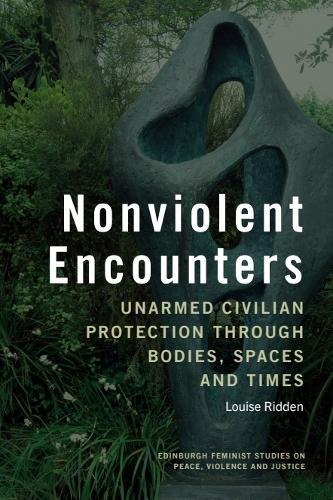
OverviewThis book takes the emerging practice of Unarmed Civilian Protection (UCP) as a case study of nonviolence to interrogate the roles of violence and nonviolence in conflict knowledge production. By focusing on nonviolent actors using UCP, it decentres violence, which is often so prominent in peace research. This approach creates space to fundamentally reimagine how the world might be when imagined and enacted through nonviolence. Drawing together feminist theorising from critical military studies, peace and conflict studies and international relations, Nonviolent Encounters argues that decentring violence in conflict knowledge production upsets the simple binaries of protector/protected and war/peace, underpinned by the 'one-world' onto-epistemology of much Western conflict knowledge. Instead, space is created to reconsider nonviolence, not as the binary opposite of violence, but as a way of knowing, doing and being as a way of producing alternative ontological worlds. Full Product DetailsAuthor: Louise Ridden (Tampere University)Publisher: Edinburgh University Press Imprint: Edinburgh University Press ISBN: 9781399548823ISBN 10: 1399548824 Pages: 184 Publication Date: 30 April 2026 Audience: College/higher education , Postgraduate, Research & Scholarly Format: Hardback Publisher's Status: Forthcoming Availability: Not yet available This item is yet to be released. You can pre-order this item and we will dispatch it to you upon its release. Table of ContentsAcknowledgements Introduction: Decentring Violence in Peace and Conflict 1. Nonviolence as a Relational Worlding Process 2. Unarmed Civilian Protection in Principle and Practice 3. Affective Embodiment 4. Emplacing Space 5. Temporal Disruptions 6. Embodied Space-Time: Synthesising Relational Worlds Conclusion: Undoing Binaries, Embracing the Pluriverse BibliographyReviewsThis book is an outstanding contribution to the literature on nonviolence. It is theoretically innovative and empirically grounded in the practice of unarmed civilian protection (UCP). It offers a new way of understanding embodied, spatial and temporal dimensions of nonviolent practice and shows how UCP operates productively within violence in ways that disrupt violent knowing, being and doing. -- Kimberly Hutchings, Queen Mary University of London Author InformationLouise Ridden is a Postdoctoral Research Fellow at Tampere University, Finland. Tab Content 6Author Website:Countries AvailableAll regions |
||||