Overview
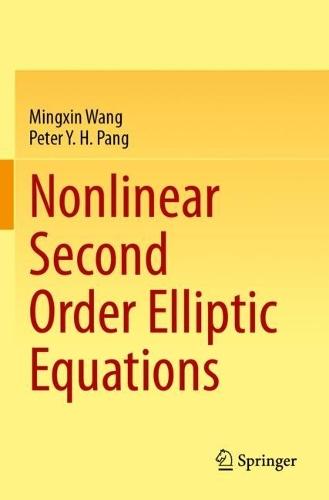
This book focuses on the following three topics in the theory of boundary value problems of nonlinear second order elliptic partial differential equations and systems: (i) eigenvalue problem, (ii) upper and lower solutions method, (iii) topological degree method, and deals with the existence of solutions, more specifically non-constant positive solutions, as well as the uniqueness, stability and asymptotic behavior of such solutions. While not all-encompassing, these topics represent major approaches to the theory of partial differential equations and systems, and should be of significant interest to graduate students and researchers. Two appendices have been included to provide a good gauge of the prerequisites for this book and make it reasonably self-contained. A notable strength of the book is that it contains a large number of substantial examples. Exercises for the reader are also included. Therefore, this book is suitable as a textbook for graduate students who havealready had an introductory course on PDE and some familiarity with functional analysis and nonlinear functional analysis, and as a reference for researchers.
Full Product Details
Author: Mingxin Wang ,
Peter Y. H. Pang
Publisher: Springer Verlag, Singapore
Imprint: Springer Verlag, Singapore
ISBN: 9789819986941
ISBN 10: 981998694
Pages: 314
Publication Date: 28 April 2025
Audience:
Professional and scholarly
,
Professional & Vocational
Format: Paperback
Publisher's Status: Active
Availability: Manufactured on demand

We will order this item for you from a manufactured on demand supplier.
Reviews
""A number of proposed exercises closes each chapter. … The bibliography cites more than 200 articles/monographies on the subject. The book is self-contained and represents a valuable tool for researchers and graduate students interested in the theory of elliptic equations."" (Giovanni Anello, zbMATH 1550.35001, 2025)
Author Information
Mingxin Wang received his PhD from the Beijing Institute of Technology. He is a prolific educator and researcher in the theory of partial differential equations. In the last two decades, he has made significant contributions to the study of diffusive systems arising in mathematical biology, especially population dynamics. Peter Y. H. Pang received his PhD from the University of Illinois at Urbana-Champaign. His research interests include partial differential equations and geometric analysis. In the past two decades, he has focused on parabolic and elliptic equations with applications in mathematical biology. The two authors have collaborated over a period of more than 15 years, and have co-authored 17 research papers. This book draws upon some key findings and examples resulting from this fruitful collaboration.