Overview
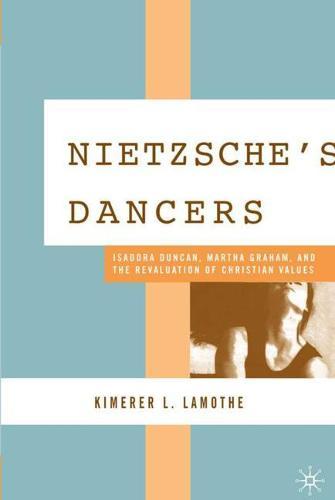
This book investigates the role Nietzsche's dance images play in his project of ""revaluing all values"" alongside the religious rhetoric and subject matter evident in the work of Isadora Duncan and Martha Graham, who found justification and guidance in Nietzsche's texts for developing dance as a medium of religious expression.
Full Product Details
Author: K. LaMothe
Publisher: Palgrave USA
Imprint: Palgrave Macmillan
Edition: 2006 ed.
Dimensions:
Width: 14.00cm
, Height: 2.10cm
, Length: 21.60cm
Weight: 0.516kg
ISBN: 9781403968258
ISBN 10: 140396825
Pages: 269
Publication Date: 22 February 2006
Audience:
College/higher education
,
Professional and scholarly
,
Tertiary & Higher Education
,
Undergraduate
Format: Hardback
Publisher's Status: Active
Availability: In Print

This item will be ordered in for you from one of our suppliers. Upon receipt, we will promptly dispatch it out to you. For in store availability, please contact us.
Reviews
LaMothe's succulent attention to the phenomenology of dance technique draws persuasive power from beyond the writing itself. Nietzsche's Dancers is not only a study in the recreation of religious values; it is an expression of the bodily conditions it explores. And, in this regard, the joyous engagement expressed on every page refers readers to lived practices of kinetic fluency as the basis for affirmation of life. -- Journal of the American Academy of Religion Strangely, Christianity, the religion of the incarnation--the Word made flesh --has failed to develop the implications of the intimate relationship between incarnation and dance. In this fascinating and important book, LaMothe addresses Christianity's hostility toward dance, an opposition between dance and religion reinforced by scholarship that consistently ignores one or the other. LaMothe shows that the dancers Isadora Duncan and Martha Graham responded to Nietzsche's advocacy for a dancing religion by creating dances designed to catalyze a renaissance of religion, especially Christianity. LaMothe argues passionately for awareness of the physiological conditions of meaning, and the realization of an incarnation grounded in breathing and movement. --Margaret R. Miles, Emerita Professor of Historical Theology, The Graduate Theological Union, Berkeley, and author of The Word Made Flesh: A History of Christian Thought <br>
"""LaMothe's succulent attention to the phenomenology of dance technique draws persuasive power from beyond the writing itself. Nietzsche's Dancers is not only a study in the recreation of religious values; it is an expression of the bodily conditions it explores. And, in this regard, the joyous engagement expressed on every page refers readers to lived practices of kinetic fluency as the basis for affirmation of life."" - Journal of the American Academy of Religion""Strangely, Christianity, the religion of the incarnation - the 'Word made flesh' - has failed to develop the implications of the intimate relationship between incarnation and dance. In this fascinating and important book, LaMothe addresses Christianity's hostility toward dance, an opposition between dance and religion reinforced by scholarship that consistently ignores one or the other. LaMothe shows that the dancers Isadora Duncan and Martha Graham responded to Nietzsche's advocacy for a 'dancing religion' by creating dances designed to 'catalyze a renaissance of religion, especially Christianity.' LaMothe argues passionately for awareness of the 'physiological conditions of meaning,' and the realization of an incarnation grounded in breathing and movement."" - Margaret R. Miles, Emerita Professor of Historical Theology, The Graduate Theological Union, Berkeley, and author of The Word Made Flesh: A History of Christian Thought"
LaMothe's succulent attention to the phenomenology of dance technique draws persuasive power from beyond the writing itself. Nietzsche's Dancers is not only a study in the recreation of religious values; it is an expression of the bodily conditions it explores. And, in this regard, the joyous engagement expressed on every page refers readers to lived practices of kinetic fluency as the basis for affirmation of life. - Journal of the American Academy of Religion Strangely, Christianity, the religion of the incarnation - the 'Word made flesh' - has failed to develop the implications of the intimate relationship between incarnation and dance. In this fascinating and important book, LaMothe addresses Christianity's hostility toward dance, an opposition between dance and religion reinforced by scholarship that consistently ignores one or the other. LaMothe shows that the dancers Isadora Duncan and Martha Graham responded to Nietzsche's advocacy for a 'dancing religion' by creating dances designed to 'catalyze a renaissance of religion, especially Christianity.' LaMothe argues passionately for awareness of the 'physiological conditions of meaning, ' and the realization of an incarnation grounded in breathing and movement. - Margaret R. Miles, Emerita Professor of Historical Theology, The Graduate Theological Union, Berkeley, and author of The Word Made Flesh: A History of Christian Thought
Author Information
KIMERER L. LAMOTHE is the author of Between Dancing and Writing: The Practice of Religious Studies, and of articles appearing in the Journal of the American Academy of Religion, Hypatia, and Soundings. Her teaching appointments in contemporary religious thought include positions at Brown and Harvard University, USA where she also co-ordinated the undergraduate programme in the Comparative Study of Religion.