Overview
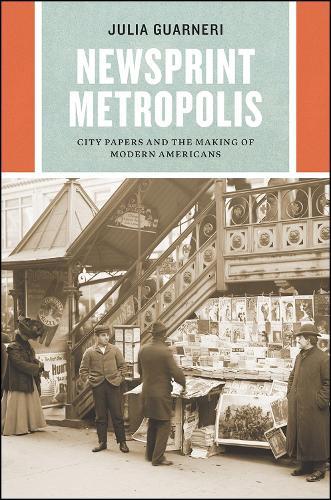
At the turn of the twentieth century, ambitious publishers like Joseph Pulitzer, William Randolph Hearst, and Robert McCormick produced the most spectacular newspapers Americans had ever read. Alongside current events and classified ads, publishers began running comic strips, sports sections, women’s pages, and Sunday magazines. Newspapers’ lavish illustrations, colorful dialogue, and sensational stories seemed to reproduce city life on the page. Yet as Julia Guarneri reveals, newspapers did not simply report on cities; they also helped to build them. Metropolitan sections and civic campaigns crafted cohesive identities for sprawling metropolises. Real estate sections boosted the suburbs, expanding metropolitan areas while maintaining cities’ roles as economic and information hubs. Advice columns and advertisements helped assimilate migrants and immigrants to a class-conscious, consumerist, and cosmopolitan urban culture. Newsprint Metropolis offers a tour of American newspapers in their most creative and vital decades. It traces newspapers’ evolution into highly commercial, mass-produced media, and assesses what was gained and lost as national syndicates began providing more of Americans’ news. Case studies of Philadelphia, New York, Chicago, and Milwaukee illuminate the intertwined histories of newspapers and the cities they served. In an era when the American press is under attack, Newsprint Metropolis reminds us how papers once hosted public conversations and nurtured collective identities in cities across America.
Full Product Details
Author: Julia Guarneri
Publisher: The University of Chicago Press
Imprint: University of Chicago Press
Dimensions:
Width: 1.60cm
, Height: 0.30cm
, Length: 2.40cm
Weight: 0.680kg
ISBN: 9780226341330
ISBN 10: 022634133
Pages: 368
Publication Date: 16 November 2017
Audience:
Professional and scholarly
,
Professional & Vocational
Format: Hardback
Publisher's Status: Active
Availability: Out of stock

The supplier is temporarily out of stock of this item. It will be ordered for you on backorder and shipped when it becomes available.
Reviews
Guarneri's decision to examine mass-readership newspapers in four major cities allows her not only to look at the epicenter of newspaper publishing at the turn of the century--New York--but also to examine the similarities and differences in newspaper publishing in other major metropolitan markets. The result is detailed and fascinating social history, as well as a set of interlinked arguments regarding the 'metropolitan' and its relationship to the creation of regional and national cultures. --Alice Fahs, author of Out on Assignment: Newspaper Women and the Making of Modern Public Space Not in several decades has a scholar offered as comprehensive and geographically balanced an account of the American daily newspaper in its commercial and aesthetic heyday. In clear, crisp, and lively prose, at once authoritative and evocative, Newsprint Metropolis neither presumes nor demands prior familiarity with the period or the historical literature. Instead it rewards curiosity about a time when cheap daily papers anchored, expanded, and reshaped their massive readership's sense of community and place. --David Henkin, University of California, Berkeley Newsprint Metropolis is a splendid study of big city daily and Sunday newspapers at the dawn of the twentieth century. Guarneri explores the marvelously diverse universe of newspaper content and influence, from news and advertising, to comics and advice columns, to politics and popular culture. And she persuasively supports a bold claim: that newspapers were not just chroniclers but were creators of the modern American city. --David Paul Nord, Indiana University Beautifully written, brightly illustrated, and prodigiously researched, Guarneri's Newsprint Metropolis will, the day it is published, become the 'go-to' book on the history of twentieth century American newspapers. We forget, at our peril, how important the daily newspaper was in spreading wide and far the gospel of business, the joys of consumerism, the tensions between the local and the national, and the changing gender roles that defined daily life in the decades surrounding the turn of the century. Guarneri's new book, like all good history, brings our present into focus by illuminating some essential, but nearly forgotten aspects of our past. --David Nasaw, author of The Chief: The Life of William Randolph Hearst As social history, Newsprint Metropolis offers a deeply sourced and engaging account of the complicated relationship between newspapers and cities, and the ways in which the two intersected. . .One of the strengths of Newsprint Metropolis is Guarneri's holistic approach with primary sources. She dives beyond front pages and intro newspaper folds, examining Sunday sections, comics, advice columns, theater sections, and business directories. And while large metropolitan dailies are covered, she does not forget the role weekly, African-American, and foreign language newspapers played in the lives of city dwellers. --American Journalism
Guarneri's decision to examine mass-readership newspapers in four major cities allows her not only to look at the epicenter of newspaper publishing at the turn of the century--New York--but also to examine the similarities and differences in newspaper publishing in other major metropolitan markets. The result is detailed and fascinating social history, as well as a set of interlinked arguments regarding the 'metropolitan' and its relationship to the creation of regional and national cultures. --Alice Fahs, author of Out on Assignment: Newspaper Women and the Making of Modern Public Space Impressive. . .Julia Guarneri makes a convincing case that newspapers played an essential role in American life during the late nineteenth and early twentieth centuries. . .This book will likely become the definitive study of turn-of-the-century newspapers. . .It will also appeal to those seeking a prehistory to the news media of the twenty-first century. --The American Historian Not in several decades has a scholar offered as comprehensive and geographically balanced an account of the American daily newspaper in its commercial and aesthetic heyday. In clear, crisp, and lively prose, at once authoritative and evocative, Newsprint Metropolis neither presumes nor demands prior familiarity with the period or the historical literature. Instead it rewards curiosity about a time when cheap daily papers anchored, expanded, and reshaped their massive readership's sense of community and place. --David Henkin, University of California, Berkeley Newsprint Metropolis is a splendid study of big city daily and Sunday newspapers at the dawn of the twentieth century. Guarneri explores the marvelously diverse universe of newspaper content and influence, from news and advertising, to comics and advice columns, to politics and popular culture. And she persuasively supports a bold claim: that newspapers were not just chroniclers but were creators of the modern American city. --David Paul Nord, Indiana University Beautifully written, brightly illustrated, and prodigiously researched, Guarneri's Newsprint Metropolis will, the day it is published, become the 'go-to' book on the history of twentieth century American newspapers. We forget, at our peril, how important the daily newspaper was in spreading wide and far the gospel of business, the joys of consumerism, the tensions between the local and the national, and the changing gender roles that defined daily life in the decades surrounding the turn of the century. Guarneri's new book, like all good history, brings our present into focus by illuminating some essential, but nearly forgotten aspects of our past. --David Nasaw, author of The Chief: The Life of William Randolph Hearst As social history, Newsprint Metropolis offers a deeply sourced and engaging account of the complicated relationship between newspapers and cities, and the ways in which the two intersected. . .One of the strengths of Newsprint Metropolis is Guarneri's holistic approach with primary sources. She dives beyond front pages and intro newspaper folds, examining Sunday sections, comics, advice columns, theater sections, and business directories. And while large metropolitan dailies are covered, she does not forget the role weekly, African-American, and foreign language newspapers played in the lives of city dwellers. --American Journalism
Author Information
Julia Guarneri is university lecturer in US history at the University of Cambridge, where she is also a fellow of Fitzwilliam College.