Overview
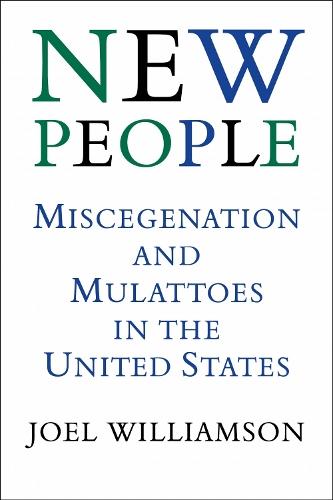
New People is an insightful historical analysis of the miscegenation of American whites and blacks from colonial times to the present, of the """"new people"""" produced by these interracial relationships, and of the myriad ways in which miscegenation has affected our national culture. Because the majority of American blacks are in fact of mixed ancestry, and because mulattoes and pure blacks ultimately combined their cultural heritages, what begins in the colonial period as mulatto history and culture ends in the twentieth century as black history and culture. Thus, understanding the history of the mulatto becomes one way of understanding something of the experience of the African American. Williamson traces the fragile lines of colour and caste that have separated mulattoes, blacks, and whites throughout history and speculates on the effect that the increasing ambiguity of those lines will have on the future of American society.
Full Product Details
Author: Joel Williamson
Publisher: Louisiana State University Press
Imprint: Louisiana State University Press
Edition: New edition
Dimensions:
Width: 15.20cm
, Height: 1.20cm
, Length: 22.80cm
Weight: 0.318kg
ISBN: 9780807120354
ISBN 10: 0807120359
Pages: 240
Publication Date: 30 October 1995
Audience:
College/higher education
,
Professional and scholarly
,
Undergraduate
,
Postgraduate, Research & Scholarly
Format: Paperback
Publisher's Status: Active
Availability: Manufactured on demand

We will order this item for you from a manufactured on demand supplier.
Reviews
Joel Williamson has courageously undertaken to write the first general history of mulattoes in the United States. Why has it taken so long?--American Historical Review Williamson's book is impressive for its chronological scope and for its attempts to examine the importance of color in historical perspective.--The Historical Journal In this splendid book, Williamson ranges widely and confidently over cultural, literary, and social sources to follow the twisting course of miscegenation and racism in America. . . . Williamson's graceful style and cogent arguments . . . make this a major essay on American character.--Library Journal In New People, Joel Williamson has tackled the most difficult and sensitive topic in the history of American race relations. It is beautifully written and infused with a kind of deep feeling and human concern that is too often lacking in scholarly works on race relations.--Reviews in American History
In this splendid book, Williamson ranges widely and confidently over cultural, literary, and social sources to follow the twisting course of miscegenation and racism in America. . . . Williamson's graceful style and cogent arguments . . . make this a major essay on American character.--Library Journal Joel Williamson has courageously undertaken to write the first general history of mulattoes in the United States. Why has it taken so long?--American Historical Review Williamson's book is impressive for its chronological scope and for its attempts to examine the importance of color in historical perspective.--The Historical Journal In New People, Joel Williamson has tackled the most difficult and sensitive topic in the history of American race relations. It is beautifully written and infused with a kind of deep feeling and human concern that is too often lacking in scholarly works on race relations.--Reviews in American History
In this splendid book, Williamson ranges widely and confidently over cultural, literary, and social sources to follow the twisting course of miscegenation and racism in America. . . . Williamson's graceful style and cogent arguments . . . make this a major essay on American character.-- Library Journal Joel Williamson has courageously undertaken to write the first general history of mulattoes in the United States. Why has it taken so long?-- American Historical Review Williamson's book is impressive for its chronological scope and for its attempts to examine the importance of color in historical perspective.-- The Historical Journal In New People, Joel Williamson has tackled the most difficult and sensitive topic in the history of American race relations. It is beautifully written and infused with a kind of deep feeling and human concern that is too often lacking in scholarly works on race relations.-- Reviews in American History
Mulattoes interest Professor Williamson (History, Univ. of North Carolina) not just for their own peculiar status, but for what that status reflects of American race relations. Relying on census records, case studies of communities, and the personal records (diaries, letters) of select families and individuals, he effectively demonstrates that in the transition from a largely separate mulatto elite in the early 1800s to its physical and cultural blending into the larger black population by the 1930s, a new people was created. With reference to most Latin American societies where fine distinctions of color are made, he asks why all shades of brown and even many shades of white were lumped together here as black. In answer, he points out that this was not always the case - that in Colonial Virginia, for example, settlers at first did not know how to socially-type the emerging gradations of color, then in 1662 settled on a law that declared the mulatto children of slave mothers to be slaves and of white mothers to be sold as servants. Major differences in the social status of mulattoes developed in the post-revolutionary era between the upper South (North Carolina and above) and lower South regions: in the upper South mulattoes were quite numerous but, when free, mostly poor farmers (offspring of unions with poor whites), while in the lower South they were fewer in number but relatively more favored. Usually the offspring of plantation owners or overseers, these mulattoes were given special treatment when slaves (they lived close to or in the plantation house, and learned special skills), and were respected as an important go-between class when free. But Williamson rightly sees first the growing commitment to slavery, then the hostility during Reconstruction (when the mulatto leadership substituted for the hated Yankees), as terminating the earlier variety in racial acceptance; by 1930 (in most states), anyone who had a drop of Negro blood was defined as black. But the mulatto leadership itself had been moving closer to the black masses, first as social and political missionaries to the South, then in the North as the cultural and political vanguard of the Harlem Renaissance. Largely through the efforts of the writers and politicians, by 1930 Brown America had emerged: The mulatto elite had, in fact, dissolved itself willingly into the Negro elite, and the Negro elite would lead in the 'fire next time.' Careful and imaginative historiography, good if occasionally difficult reading. (Kirkus Reviews)
Joel Williamson has courageously undertaken to write the first general history of mulattoes in the United States. Why has it taken so long?--American Historical Review In this splendid book, Williamson ranges widely and confidently over cultural, literary, and social sources to follow the twisting course of miscegenation and racism in America. . . . Williamson's graceful style and cogent arguments . . . make this a major essay on American character.--Library Journal Williamson's book is impressive for its chronological scope and for its attempts to examine the importance of color in historical perspective.--The Historical Journal In New People, Joel Williamson has tackled the most difficult and sensitive topic in the history of American race relations. It is beautifully written and infused with a kind of deep feeling and human concern that is too often lacking in scholarly works on race relations.--Reviews in American History
Author Information
Joel Williamson is Lineberger Professor in the Humanities at the University of North Carolina at Chapel Hill. He is the author of several books, including After Slavery: The Negro In South Carolina During Reconstruction, 1861-1877; The Crucible of Race: Black-White Relations in the American South Since Emancipation; and William Faulkner and Southern History.