Overview
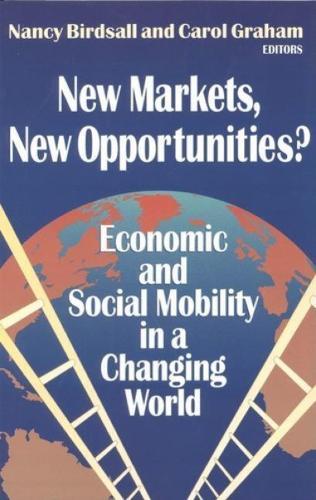
Many of the countries that have recently converted to a market-based economic system have also experienced an alarming increase in income inequality - a widening gap between the haves and the have-nots. This text asks to what extent the increasing inequality seemingly inherent in - and integral to - a market-based economy also increases the the opportunities for economic advancement. It highlights the importance of finding the answer this question by examining the issues of social mobility and opportunity as an essential part of the income inequality puzzle.
Full Product Details
Author: Nancy Birdsall ,
Carol L. Graham
Publisher: Bloomsbury Publishing Plc
Imprint: Brookings Institution
Dimensions:
Width: 15.40cm
, Height: 2.10cm
, Length: 22.90cm
Weight: 0.463kg
ISBN: 9780815709176
ISBN 10: 081570917
Pages: 331
Publication Date: 01 November 1999
Audience:
College/higher education
,
Professional and scholarly
,
Undergraduate
,
Postgraduate, Research & Scholarly
Format: Paperback
Publisher's Status: Active
Availability: Out of stock

The supplier is temporarily out of stock of this item. It will be ordered for you on backorder and shipped when it becomes available.
Reviews
"""fills a gap in the economic literature and should prove uesful to economists, sociologists, and policymakers"" —Bruno Sergi, Finance & Development, 12/13/2000 |""Inequality has always been a daunting economic, social, political, and moral challenge. In recent years it has become even more so. This excellent book asks readers to reconsider whether inequality matters and why. It will be a central reference for thinkers and policymakers concerned with the problem of inequality in a world of markets."" —Moises Naim, Foreign Policy, Foreign Policy |""This is a wide-ranging book that places the market economy where it belongs: amidst other institutions, different initiatives, and diverse tasks. Its broad approach contrasts with a narrow view of seeing development exclusively as market-driven or as being quintessentially state-managed. This is a substantial addition to the literature on development in a globalizing world."" —Amartya Sen, Cambridge University, Cambridge University |""Anyone concerned with the global economy has to face the question: how are people, especially poor people, faring in increasingly open, market-oriented systems? Who gets to exploit new opportunities? What are the implications of more mobility and less security for sustaining political support for market policies. With clarity and rigor, this book challenges us think about the technical and political dimensions of equitable, market-led growth. "" —Mark Malloch Brown, United Nations Development program, United Nations Development Program |""This is a great book.... the contributions are accessible to a large audience of economists, social scientists and policy-makers. The book is also interesting for researchers more technically oriented."" —Christophe Muller, University of Nottingham, U.K., Journal of International Development, 1/1/2001 |""All told, the book presents an excellent analysis of the growing interest in social mobility and suggests areas of research for future examination. The editors have done a good job in distinguishing between the economics of opportunity and the politics of public perception and in looking at those countries in which social mobility partially applies or is beginning to emerge. This book fills a gap in the economic literature and should prove useful to economists, sociologists, and policymakers."" —Bruno S. Sergi, Finance & Development, 12/1/2000"
fills a gap in the economic literature and should prove uesful to economists, sociologists, and policymakers -Bruno Sergi, Finance & Development, 12/13/2000 | Inequality has always been a daunting economic, social, political, and moral challenge. In recent years it has become even more so. This excellent book asks readers to reconsider whether inequality matters and why. It will be a central reference for thinkers and policymakers concerned with the problem of inequality in a world of markets. -Moises Naim, Foreign Policy, Foreign Policy | This is a wide-ranging book that places the market economy where it belongs: amidst other institutions, different initiatives, and diverse tasks. Its broad approach contrasts with a narrow view of seeing development exclusively as market-driven or as being quintessentially state-managed. This is a substantial addition to the literature on development in a globalizing world. -Amartya Sen, Cambridge University, Cambridge University | Anyone concerned with the global economy has to face the question: how are people, especially poor people, faring in increasingly open, market-oriented systems? Who gets to exploit new opportunities? What are the implications of more mobility and less security for sustaining political support for market policies. With clarity and rigor, this book challenges us think about the technical and political dimensions of equitable, market-led growth. -Mark Malloch Brown, United Nations Development program, United Nations Development Program | This is a great book.... the contributions are accessible to a large audience of economists, social scientists and policy-makers. The book is also interesting for researchers more technically oriented. -Christophe Muller, University of Nottingham, U.K., Journal of International Development, 1/1/2001 | All told, the book presents an excellent analysis of the growing interest in social mobility and suggests areas of research for future examination. The editors have done a good job in distinguishing between the economics of opportunity and the politics of public perception and in looking at those countries in which social mobility partially applies or is beginning to emerge. This book fills a gap in the economic literature and should prove useful to economists, sociologists, and policymakers. -Bruno S. Sergi, Finance & Development, 12/1/2000
fills a gap in the economic literature and should prove uesful to economists, sociologists, and policymakers --Bruno Sergi, Finance & Development, 12/13/2000 Inequality has always been a daunting economic, social, political, and moral challenge. In recent years it has become even more so. This excellent book asks readers to reconsider whether inequality matters and why. It will be a central reference for thinkers and policymakers concerned with the problem of inequality in a world of markets. --Moises Naim, Foreign Policy, Foreign Policy This is a wide-ranging book that places the market economy where it belongs: amidst other institutions, different initiatives, and diverse tasks. Its broad approach contrasts with a narrow view of seeing development exclusively as market-driven or as being quintessentially state-managed. This is a substantial addition to the literature on development in a globalizing world. --Amartya Sen, Cambridge University, Cambridge University Anyone concerned with the global economy has to face the question: how are people, especially poor people, faring in increasingly open, market-oriented systems? Who gets to exploit new opportunities? What are the implications of more mobility and less security for sustaining political support for market policies. With clarity and rigor, this book challenges us think about the technical and political dimensions of equitable, market-led growth. --Mark Malloch Brown, United Nations Development program, United Nations Development Program This is a great book... the contributions are accessible to a large audience of economists, social scientists and policy-makers. The book is also interesting for researchers more technically oriented. --Christophe Muller, University of Nottingham, U.K., Journal of International Development, 1/1/2001 All told, the book presents an excellent analysis of the growing interest in social mobility and suggests areas of research for future examination. The editors have done a good job in distinguishing between the economics of opportunity and the politics of public perception and in looking at those countries in which social mobility partially applies or is beginning to emerge. This book fills a gap in the economic literature and should prove useful to economists, sociologists, and policymakers. --Bruno S. Sergi, Finance & Development, 12/1/2000
Author Information
Nancy Birdsall is the founding president of the Center for Global Development. Prior to launching the center, Birdsall was senior associate and director of the Economic Reform Project at the Carnegie Endowment for International Peace. From 1993 to 1998, Birdsall was executive vice president of the Inter-American Development Bank. Carol Graham is a senior fellow in both Foreign Policy Studies and Global Economy and Development at the Brookings Institution, where she holds the Charles Robinson Chair in Foreign Policy. Her most recent book is Happiness around the World: The Paradox of Happy Peasants and Miserable Millionaires (Oxford University Press, 2010).