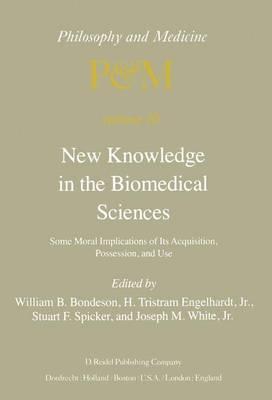
New Knowledge in the Biomedical Sciences: Some Moral Implications of Its Acquisition, Possession, and Use

Author:   W.B. Bondeson ,  H. Tristram Engelhardt Jr. ,  S.F. Spicker ,  J.M. White
Publisher:   Springer
Edition:   1982 ed.
Volume:   10
ISBN:  

9789027713193


Pages:   225
Publication Date:   31 January 1982
Format:   Hardback
Availability:   In Print   Availability explained
This item will be ordered in for you from one of our suppliers. Upon receipt, we will promptly dispatch it out to you. For in store availability, please contact us.

Our Price $462.00 Quantity:  
Add to Cart

Share |

New Knowledge in the Biomedical Sciences: Some Moral Implications of Its Acquisition, Possession, and Use


Overview

The spectacular development of medical knowledge over the last two centuries has brought intrusive advances in the capabilities of medical technology. These advances have been remarkable over the last century, but especially over the last few decades, culminating in such high technology interventions as heart transplants and renal dialysis. These increases in medical powers have attracted societal interest in acquiring more such knowledge. They have also spawned concerns regarding the use of human subjects in research and regarding the byproducts of basic research as in the recent recombinant DNA debate. As a consequence of the development of new biomedical knowledge, physicians and biomedical scientists have been placed in positions of new power and responsibility. The emergence of this group of powerful and knowledgeable experts has occasioned debates regarding the accountability of physicians and biomedical scientists. But beyond that, the very investment of resources in the acquisition of new knowledge has been questioned. Societies must decide whether finite resources would not be better invested at this juncture, or in general, in the alleviation of the problems of hunger or in raising general health standards through interventions which are less dependent on the intensive use of high technology. To put issues in this fashion touches on philosophical notions concerning the claims of distributive justice and the ownership of biomedical knowledge.

Full Product Details

Author:   W.B. Bondeson ,  H. Tristram Engelhardt Jr. ,  S.F. Spicker ,  J.M. White
Publisher:   Springer
Imprint:   Kluwer Academic Publishers
Edition:   1982 ed.
Volume:   10
Dimensions:   Width: 15.50cm , Height: 1.50cm , Length: 23.50cm
Weight:   1.160kg
ISBN:  

9789027713193


ISBN 10:   9027713197
Pages:   225
Publication Date:   31 January 1982
Audience:   College/higher education ,  Professional and scholarly ,  Postgraduate, Research & Scholarly ,  Professional & Vocational
Format:   Hardback
Publisher's Status:   Active
Availability:   In Print   Availability explained
This item will be ordered in for you from one of our suppliers. Upon receipt, we will promptly dispatch it out to you. For in store availability, please contact us.

Table of Contents

Section I / The Physician as Moral Arbiter.- The Physician as a Moral Force in American History.- The Physician as Moral Arbiter.- Section II / The Costs of New Knowledge.- Moral Issues Relating to the Economics of New Knowledge in the Biomedical Sciences.- Only the Best is Good Enough?.- Section III / Costs, Benefits, and the Responsibilities of Medical Science.- Morality and the Social Control of Biomedical Technology.- Rights and Responsibilities in Medical Science.- Health, Justice, and Responsibility.- Section IV / Biomedical Knowledge: Libertarian vs. Socialist Models.- The Need to Know: Utilitarian and Esthetic Values of Biomedical Science.- Medical Knowledge as a Social Product: Rights, Risks, and Responsibilities.- Biomedical Knowledge: Progress and Priorities.- Section V / Biomedical Ethics and Advances in Biomedical Science.- Applying Morality to Advances in Biomedicine: Can and Should This be Done?.- Biomedicine, Health Care Policy, and the Adequacy of Ethical Theory.- Section VI / Conclusions and Reflections: Present and Future Problems.- Why New Technology is More Problematic than Old Technology.- The Uses of Biomedical Knowledge: The End of the Era of Optimism?.- The Best is Yet to Come.- Scientific Advance, Technological Development, and Society.- The Life-World and the Patient’s Expectations of New Knowledge.- Epilogue.- Notes on Contributors.

Reviews

Author Information

Tab Content 6

Author Website:  

Countries Available

All regions
Latest Reading Guide

NOV RG 20252


Shopping Cart
Your cart is empty
Shopping cart
Mailing List