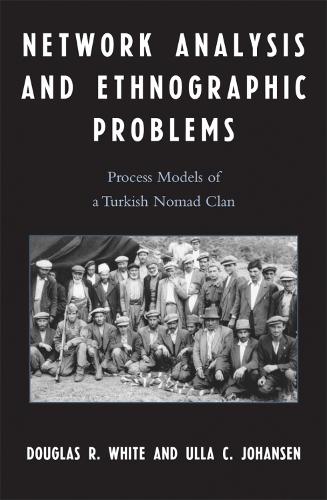
Full Product Details
Author: Douglas R. White ,
Ulla C. Johansen
Publisher: Bloomsbury Publishing Plc
Imprint: Lexington Books
Edition: New edition
Dimensions:
Width: 14.60cm
, Height: 3.00cm
, Length: 22.00cm
Weight: 0.676kg
ISBN: 9780739118924
ISBN 10: 0739118927
Pages: 544
Publication Date: 20 October 2006
Audience:
General/trade
,
General
Format: Paperback
Publisher's Status: Active
Availability: In Print

This item will be ordered in for you from one of our suppliers. Upon receipt, we will promptly dispatch it out to you. For in store availability, please contact us.
Reviews
This book presents a brilliant example of the application of network analysis to kinship...The applied value of this study cannot be overestimated because kin structures still play important social (and sometimes political) roles in many societies...This pioneering study establishes methodology that will be in demand in anthropology, political science, economics, legal studies, and Middle Eastern studies. -- Audrey Korotayev, Research Fellow, Oriental Institute, Russian Academy of Sciences Network analysis, as White has been developing it and as he and Johansen apply it here, is not just one technique or method but a whole armamentarium of them, united under a system of general and powerful conceptions of social organization as such. It is such an enormous advance over what anthropologists called network analysis in the 1960s and 70s that it is almost a type of negative advertising to call it by the same name, yet there is a connection. White and Johansen actually deliver what those analyses promised-and then keep going. -- Murray J. Leaf, University of Texas at Dallas [W]hat could be the most important book in anthropology in fifty years begins with an introduction to network analysis in relation to ethnography, providing a succinct history of network thinking including very recent developments in various disciplines about network topology and dynamics... In addition to its contribution to our understanding kinship theory in a quite new way, this book makes an outstanding contribution by reintroducing ethnographers to the network perspective... The authors point outthat 'taking a network path to coding and analysis' in ethnography leads to the ability to understand the emergence of social structural phenomena that would otherwise remain unobserved... Whether the reader is interested in kinship, in economics, in politics or history, this book should be considered must reading.. International Journal Of Middle East Studies This book shows how network analysis can usefully illuminate complex ethnographic situations that result from long term fieldwork in ways that go beyond the intuitive results of functionalism, (social) structuralism and practice theory. -- Nelson Graburn, University of California, Berkeley [W]hat could be the most important book in anthropology in fifty years begins with an introduction to network analysis in relation to ethnography, providing a succinct history of network thinking including very recent developments in various disciplines about network topology and dynamics... In addition to its contribution to our understanding kinship theory in a quite new way, this book makes an outstanding contribution by reintroducing ethnographers to the network perspective... The authors point out that 'taking a network path to coding and analysis' in ethnography leads to the ability to understand the emergence of social structural phenomena that would otherwise remain unobserved... Whether the reader is interested in kinship, in economics, in politics or history, this book should be considered must reading. International Journal Of Middle East Studies
This book presents a brilliant example of the application of network analysis to kinship. . . .The applied value of this study cannot be overestimated because kin structures still play important social (and sometimes political) roles in many societies. . . .This pioneering study establishes methodology that will be in demand in anthropology, political science, economics, legal studies, and Middle Eastern studies.--Audrey Korotayev
Author Information
Douglas White is Professor of Anthropology and Social Networks at the University of California, Irvine. Ulla Johansen is Professor of Anthropology at the University of Cologne, Germany.