Overview
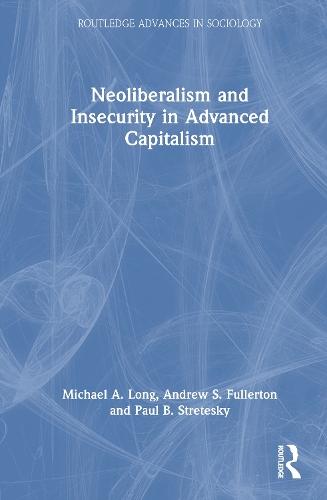
This book examines the relationship between neoliberalism and insecurity, beginning with the post‑World War II period and continuing up through the present. Neoliberalism – the dominant political economic perspective that elevates competition above all else at both the structural and individual levels – has increased the amount of insecurity (e.g., food, energy, job) across the world. It provides a theoretical and empirical analysis of how and why neoliberalism and insecurity have become intertwined over the last half century. The book takes a novel approach to the study of neoliberalism, insecurity, and their intersection. First, in addition to examining specific types of insecurity, the overall concept of insecurity is defined and theorized as a fundamental part of neoliberal capitalism. Second, to help bypass the structural versus individual binary that has come to characterize much of the neoliberalism literature, a field‑theoretic framework, heavily influenced by the work of Pierre Bourdieu, is employed. As such, it will be of great interest for researchers in neoliberalism, insecurity, and Bourdieu’s theory of practice, including advanced undergraduate students and graduate scholars from sociology, anthropology, geography, political science, and public health.
Full Product Details
Author: Michael A. Long (Oklahoma State University, USA) ,
Andrew S. Fullerton (Oklahoma State University, USA) ,
Paul B. Stretesky (University of Lincoln, UK)
Publisher: Taylor & Francis Ltd
Imprint: Routledge
Weight: 0.660kg
ISBN: 9781032354392
ISBN 10: 1032354399
Pages: 256
Publication Date: 23 May 2025
Audience:
General/trade
,
College/higher education
,
General
,
Tertiary & Higher Education
Format: Hardback
Publisher's Status: Active
Availability: In Print

This item will be ordered in for you from one of our suppliers. Upon receipt, we will promptly dispatch it out to you. For in store availability, please contact us.
Author Information
Michael A. Long is Professor of Sociology and Director of the Center for Insecurity and Inequality Research at Oklahoma State University. He has written widely on food insecurity, environmental sociology, sustainability, public health, and quantitative methodology. His most recent book is Applying Benford’s Law for Assessing the Validity of Social Science Data (with P. Stretesky, K. Berry, J. Johnston, M. Lynch, 2023). Andrew S. Fullerton is Professor of Sociology at Oklahoma State University. He has written widely on job insecurity, quantitative methodology, social stratification, and political sociology. He has published several articles on regression models for ordinal outcomes and a book titled Ordered Regression Models: Parallel, Partial, and Non‑Parallel Alternatives (with J. Xu, 2016). Paul B. Stretesky is Professor of Criminology and Director of Teaching and Learning in the School of Social and Political Sciences at the University of Lincoln, UK. His research interests include food insecurity, environmental crime and justice, quantitative methods, and violence. His most recent book, Applying Benford’s Law for Assessing the Validity of Social Science Data (2023), was co‑authored with M. Long, K. Berry, J. Johnston, and M. Lynch.