Full Product Details
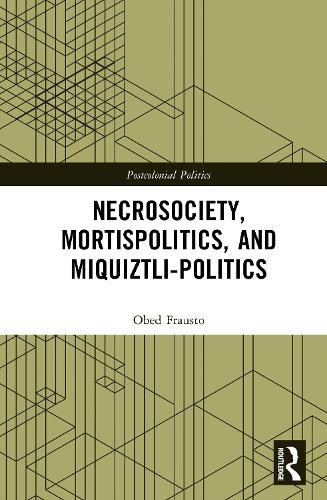
Author: Obed Frausto
Publisher: Taylor & Francis Ltd
Imprint: Routledge
ISBN: 9781041001751
ISBN 10: 1041001754
Pages: 138
Publication Date: 31 December 2025
Audience:
College/higher education
,
Professional and scholarly
,
Tertiary & Higher Education
,
Professional & Vocational
Format: Hardback
Publisher's Status: Forthcoming
Availability: Not yet available

This item is yet to be released. You can pre-order this item and we will dispatch it to you upon its release.
Reviews
""The book provides a concise outline of the central themes that currently move a politics of life and death in Latin America, especially in contemporary Mexico, while forwarding novel perspectives through which to open up the problematic to new possibilities."" Ronald Guy Emerson, UDLAP, Mexico ""History will remember 2025 as a year when the far-right grew and positioned itself, despite persistent civil resistance. Reading ""Necrosociety, Mortispolitics, and Miquiztli-politics"" is essential in comprehending the interplay between death and resistance in the coming years."" Zulia Orozco Reynosa, UABC, Mexico ""Obed Frausto’s Necrosociety, Mortispolitics, and Miquiztli-politics is an unusual accomplishment: a book highly original, theoretically rigorous, and politically relevant that reordered our mindsets regarding death, sovereignty, and freedom. In a three-panel conceptual triptych—necrosociety as critical diagnosis, mortispolitics as juridico-political apparatus, and miquiztli-politics as cosmopolitical alterative—Frausto creates a robust decolonial framework with a focus on Ibero-American legalities, Aztec epistemology, and a critique of capitalist necropolitics. What began as a widening of necropolitics becomes a core departure: miquiztli-politics recovers death as a site of posthuman ethics, responsibility in common, and metaphysical affirmation. Frausto moves with ease across disciplines—philosophy, anthropology, legal theory, Indigenous thought—to establish a pluriversal, hermeneutic political ontology that subverts Eurocentric paradigms but envisions emancipatory possibilities connected to relationality, multiplicity, and opposition. It speaks to political theorists, decolonial scholars, Latin American philosophers, Indigenous knowledge systems, and critical metaphysicians. Something more than that is here, though—what is here is a language with which to confront our planetary emergencies. It is a theoretical contribution but also an exhortation to reimagine the political from out of the wreckage of a dying planet."" Ariadna Estévez, UNAM, México
Author Information
Obed Frausto is Visiting Assistant Professor of Philosophy at the University of Texas Rio Grande Valley. He completed his doctoral studies in philosophy of science with a specialization in social studies of science and technology (2016) at the National Autonomous University of Mexico (UNAM). He has undertaken research fellowships at Harvard University, USA (2013); Université de Paris VIII (2014) (Vincennes-Saint-Denis); and Cardiff University, UK (2015). Dr Frausto’s research interests are political philosophy, social theory, decoloniality, and social science and technology studies. He is co-editor with Jason Powell and Sarah Vitale of the book The Weariness of Democracy (2020); author of Tres tradiciones en la teoría de la legitimidad política (2021); co-editor with Raúl Trejo Villalobos of the bilingual book Filosofía de los pueblos originarios/Philosophy of the Indigenous (2022); co-editor with Sébastien Lefèvre and Angélica Montes of the book Utopies et dystopies dans l’imaginaire politique (2022); author of The Power of the Metaphysical Artifact (2023); and co-editor with Angélica Montes Montoya, and Alexander V. Stehn of the book Descolonización democrática del pensamiento (Terra Ignota, 2025).