Overview
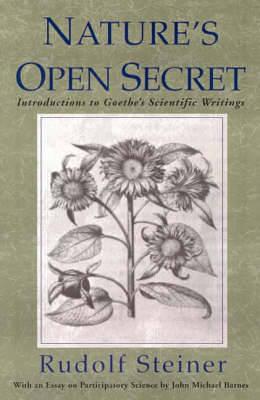
The holistic paradigm, Gaia, deep ecology, and new alchemy all have a hidden ancestor: Johann Wolfgang von Goethe (1749-1832).At the youthful age of twenty-one, Steiner was chosen to edit Goethe's scientific writings for the principle Geothe edition of his time. Goethe's literary genius was universally acknowledged; it was Steiner's task to understand and comment on Goethe's scientific achievements. Steiner recognized the significance of Goethe's work with nature and his epistemology, and here began Steiner's own training in epistemology and spiritual science. This collection of Steiner's introductions to Goethe's works re-visions the meaning of knowledge and how we attain it. Goethe had discovered how thinking could be applied to organic nature and that this experience requires not just rational concepts but a whole new way of perceiving. In an age when science and technology have been linked to great catastrophes, many are looking for new ways to interact with nature. With a fundamental declaration of the interpenetration of our consciousness and the world around us, Steiner shows how Goethe's approach points the way to a more compassionate and intimate involvement with nature.Contents: * 1. Introduction by John Barnes * 2. The Origin of Goethe's Concept of Metamorphosis * 3. The Origin of Goethe's Thinking on Animal Morphology * 4. The Nature & Significance of Goethe's Writings on Organic Morphology * 5. Goethe's Way of Knowing * 6. Concluding Remarks on Goethe's Morphology * 7. The Arrangement of Goethe's Scientific Writings * 8. From Art to Science * 9. Goethe's Theory of Knowledge * 10. Knowledge & Action in the Light of Goethe's Ideas * 11. Goethe's Way of Thinking Compared to Other Views * 12. Goethe and Mathematics * 13. Goethe's Fundamental Geological Principle * 14. Goethe's Meteorological Ideas * 15. On the Subjectivity of Sensory Perceptions * 16. Goethe As Thinker & Researcher * 17. Goethe versus Atomism * 18. Goethe's Worldview in His Verses in Prose * Essay by John Barnes: ""Participatory Science As the Basis for a Healing Culture"" * Bibliography & Further Reading Nature's Open Secret is a translation of Goethes Naturwissenschaftliche Schriften, Einleitungen, (1884-1897). Previous translations were titled Goethe the Scientist and Goethean Science.
Full Product Details
Author: Rudolf Steiner
Publisher: Anthroposophic Press Inc
Imprint: SteinerBooks, Inc
Dimensions:
Width: 15.00cm
, Height: 1.70cm
, Length: 23.00cm
Weight: 0.431kg
ISBN: 9780880107150
ISBN 10: 0880107154
Pages: 320
Publication Date: 18 March 2010
Audience:
General/trade
,
General
Format: Paperback
Publisher's Status: Active
Availability: Available To Order

We have confirmation that this item is in stock with the supplier. It will be ordered in for you and dispatched immediately.
Language: English
Author Information
Rudolf Steiner (b. Rudolf Joseph Lorenz Steiner, 1861-1925) was born in the small village of Kraljevec, Austro-Hungarian Empire (now in Croatia), where he grew up. As a young man, he lived in Weimar and Berlin, where he became a well-published scientific, literary, and philosophical scholar, known especially for his work with Goethe's scientific writings. Steiner termed his spiritual philosophy anthroposophy, meaning ""wisdom of the human being."" As an exceptionally developed seer, he based his work on direct knowledge and perception of spiritual dimensions. He initiated a modern, universal ""spiritual science"" that is accessible to anyone willing to exercise clear and unbiased thinking. From his spiritual investigations, Steiner provided suggestions for the renewal of numerous activities, including education (general and for special needs), agriculture, medicine, economics, architecture, science, philosophy, Christianity, and the arts. There are currently thousands of schools, clinics, farms, and initiatives in other fields that involve practical work based on the principles Steiner developed. His many published works feature his research into the spiritual nature of human beings, the evolution of the world and humanity, and methods for personal development. He wrote some thirty books and delivered more than six thousand lectures throughout much of Europe. In 1924, Steiner founded the General Anthroposophical Society, which today has branches around the world. John Michael Barnes, after teaching at Waldorf schools for twenty-five years, is working as a publisher and author, focusing on his lifelong interest in Goethean, phenomenological science. John Michael Barnes, after teaching at Waldorf schools for twenty-five years, is working as a publisher and author, focusing on his lifelong interest in Goethean, phenomenological science. John Michael Barnes, after teaching at Waldorf schools for twenty-five years, is working as a publisher and author, focusing on his lifelong interest in Goethean, phenomenological science.